Practical Protein Chemistry - A. Darbre 1989
Methods for Solid-Phase Amino Acid Sequence Analysis
Resin Synthesis
Glass-Based Supports
Porous Glass beads were first proposed as Supports for solid-phase analysis in 1973 [42, 61, 62].
12.3.2.1. Properties of controlled-pore glass (Corning). CPG glasses contain 96% silica, 3–4% B2O3, 0.5–1% Na2О, and trace amounts of certain metal oxides. They are available as porous beads, both unmodified and modified via various chemical Methods, making them suitable for a wide range of Applications.
Degradation rate of CPG glass. The beads are highly resistant to mechanical stress; the degradation rate of these supports depends on Temperature, time, pH, solution composition and volume, and particle surface area (the smaller the pore size, the larger the surface area). Glass stability decreases noticeably over time in the presence of TFA, and these supports are sensitive to hydrogen fluoride.
Advantages of using porous glasses for Amino Acid Sequence analysis. CPG beads maintain a constant volume throughout the entire Cleavage cycle and do not undergo Swelling or shrinking. Therefore, unlike organic polymer-based supports, columns can be packed with them without dilution by other Materials. The glasses are pressure-insensitive, allowing liquids to be pumped through the Column at high flow rates. They are chemically stable in all media except strong bases, particularly at elevated temperatures; consequently, peptide coupling to these supports should be performed at pH<10.
A modern Procedure for using CPG glasses is described in [32]. The protein is attached to the support via its N-terminal Amino Acid and partially cleaved with Cyanogen bromide. The resulting peptide mixture is washed off the glass and analyzed for Structure using the double-radioactive-label dansyl method. Other Protein Cleavage methods may also be employed.
12.3.2.2. Preparation of amino group-containing supports. To prepare aminopropyl glass (APG) and ß-N-aminoethyl-(ß-aminopropyl) glass (ß-APG), porous beads (CPG, 10/75, 200–400 mesh) are treated with 3-aminopropyltriethoxysilane (APTES) and ß-aminoethyl-(ß-aminopropyl)trimethoxysilane (AEAPTMS) [6, 17, 51, 61]. This modification of beads with a nominal pore diameter of 75 Å yields supports with a peptide-binding capacity of 150–170 nmol/mg of glass [61]. The synthesis pathway is shown in Fig. 12.2.
Procedure. 4 g of beads (CPG, 10/75, 200–400 mesh, Serva) are degassed for 2 h at 180 °C under vacuum (Water-jet pump). Add 30 ml of dry toluene and 3 ml of APTES (or AEAPTMS). Degas and heat in a sealed flask at 75 °C for 24 h with gentle agitation (a shaker is preferred). The support is separated from the solution on a glass filter and washed sequentially with toluene, acetone, and methanol (50 ml each, twice per solvent). Dry under vacuum over P2O5 at room temperature. Store under nitrogen at 4 °C.
Class="center">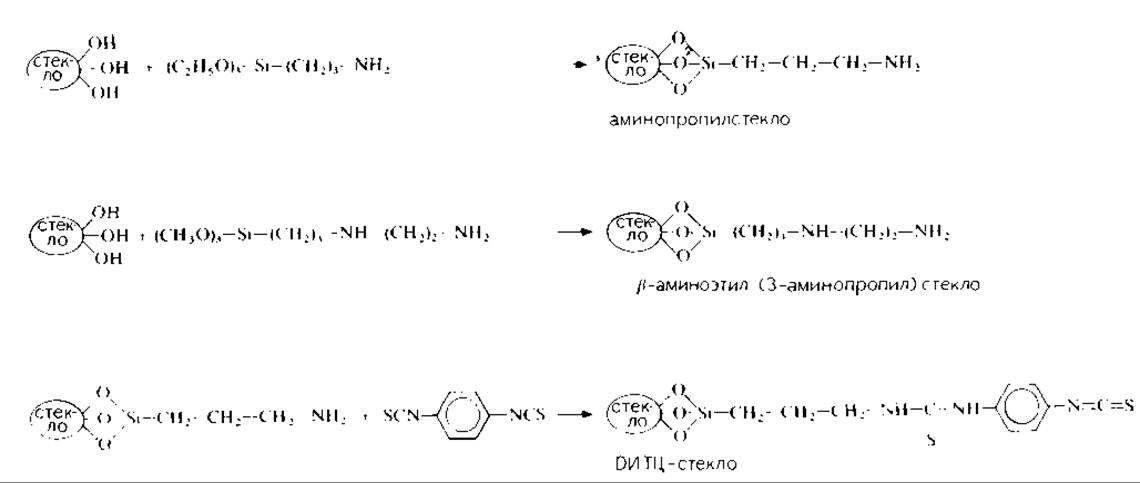
FIG. 12.2. Preparation of aminopropyl glass (APG), β-N-aminoethyl-(ß-aminopropyl) glass (ß-APG), and isothiocyanate glass (DITC-glass).
12.3.2.3. Preparation of isothiocyanate glass. For the synthesis of isothiocyanatopropyl support (ITC-APG)—which can be used to couple Peptides containing Lysine and aminoethylcysteine residues—the amino groups of aminopropyl glass are activated with p-phenylene diisothiocyanate (DITC) (Fig. 12.2)
[43, 61].
Procedure. It is recommended to use 25 mol of DITC per amino group of the support and 2–3 volumes of DMF per volume of glass. Dissolve 1 g of DITC in 13 ml of DMF. Add 2 g of aminopropyl glass portionwise over 1 h with gentle agitation. Maintain the mixture at room temperature for 2 h. Wash the beads on a glass filter with acetone and DMF (50 ml each, twice) and methanol (10 ml each, twice). Dry the support under vacuum.
Store as for APG.
Last update: 06/08/2026
Editorial and Educational Adaptation: This material has been compiled based on the primary/original source text. The project team performed an editorial review, corrected technical inaccuracies, structured sections, and adapted the content for an educational format.
What was processed:
- elimination of formatting defects (OCR errors, structural breaks, corrupted characters);
- editorial organization of content;
- standardization of terminology in accordance with academic sources;
- verification of factual statements against the original source text.
All mentions of the author, publication year, and origin of the primary text have been preserved in accordance with the source.