Biochemistry - The Chemical Reactions of Living Cells, Volume 3 - D. Metzler 1980
Biochemical Genetics and the Synthesis of Nucleic Acids and Proteins
How the Current Concepts Developed
DNA Replication
Using microspectrophotometry, it was established that The amount of DNA in a Cell doubles prior to Cell Division. It was clear that each daughter cell must receive one or more identical DNA molecules. However, the question remained open as to whether the original double-stranded DNA molecule is copied in such a way that an entirely new double-stranded DNA molecule is formed immediately, or whether the two strands of the parent molecule separate during Replication. In the latter case (so-called semiconservative replication), a new complementary strand would be synthesized along each of the two separated strands, resulting in The formation of two new double-stranded molecules.
The first experimental data clearly pointing to a semiconservative mode of replication were reported in 1958 by Meselson and Stahl [24]. E. coli Cells were grown on a medium in which 15NH4 ions served as the sole nitrogen source. The DNA of Bacteria that appeared after several successive Divisions of the original cells in this medium contained only the stable isotope 15N. These bacteria were rapidly transferred to a medium containing 14NH+4. The cells were left in the medium for the time required for their number to double, quadruple, and so on. At various stages, DNA was extracted and centrifuged in a cesium chloride density gradient. Small but easily detectable density differences made it possible to separate double-stranded DNA molecules into three fractions: molecules containing only 15N; molecules containing only partially 15N; and molecules containing only 14N. At the beginning of the experiment, only one type of DNA was present, with all molecules containing exclusively 15N. However, in the first generation following transfer to the 14N medium, the density of the bulk DNA indicated that the contents of 15N and 14N in the DNA molecules were equal. The DNA of half of the bacteria in the next generation still contained both types of isotopes in equal amounts, whereas the other half showed only 14N in their DNA. Exactly these results could be predicted based on the semiconservative mechanism of replication.
Several years later, Cairns investigated the replication process directly using DNA autoradiography with thymidine labeled with a radioactive hydrogen isotope, tritium (3H) [25]. E. coli cells were grown on a medium containing 3H-thymidine for various time intervals, typically about 1 h (roughly the time of two generations). The cells were then lysed, and the extended DNA molecules were isolated on thin membrane filters, after which autoradiograms were prepared. As a result of incubation with 3H-thymidine, circles 1.1–1.4 mm in length, corresponding to the isolated extended DNA molecules, could be detected on the autoradiogram. Furthermore, the autoradiograms revealed partially labeled DNA molecules caught in The process of replication. Thus, after a 2-h incubation, about half of the bacterial DNA molecules were fully labeled, whereas the other half exhibited regions where the label content was twice as low. The molecules in these regions apparently bore the label in only one strand and, consequently, corresponded to non-replicated segments (all molecules had managed to undergo one replication cycle in the presence of 3H-thymidine, leading to the formation of weakly labeled molecules; however, the second cycle was not yet completed in some molecules). It was concluded that the most intensely labeled regions correspond to molecules in which replication has gone to completion. The shape of the "replication forks" suggested that DNA Synthesis proceeds continuously, starting at a single point and continuing along the circular molecule at a constant rate. Although subsequent experiments (Section D) showed that replication most often proceeds bidirectionally rather than unidirectionally, Cairns' experiments were of paramount importance as they laid the foundation for a method enabling the direct observation of METABOLISM/36.html">DNA replication in vivo.
a. DNA polymerases
What are the precursors of DNA? Early experiments showed that the nucleoside 3H-thymidine is actively incorporated into DNA. However, from an energetic standpoint, it seemed unlikely that thymidine served as the direct precursor. Evidence that nucleoside triphosphates play The Role of precursors was obtained in 1958 when Kornberg discovered E. coli DNA polymerase. Isolating 600 mg of Kornberg's enzyme, commonly referred to as DNA polymerase I, required 90 kg of bacterial cells [4, 26] (each cell contains about 400 molecules of the enzyme). This enzyme possessed many of the properties predicted for a DNA-synthesizing enzyme. Its activity required a template DNA strand and a shorter primer strand. As seen in equation (15-2), DNA polymerase I recognizes the 3' end of the primer strand and attaches the corresponding nucleoside triphosphate to it, which forms a base pair with the next Base of the template strand. It then catalyzes the Cleavage of pyrophosphate while simultaneously attaching a new nucleotide to the 3' end of the primer. "Working" in this manner, the enzyme can convert a single-stranded DNA template into double-stranded DNA, with each point of the newly synthesized strand of this DNA containing a base complementary to the base of the template strand.
Class="center">
The MECHANISM OF ACTION of DNA polymerase I, described by equation (15-2), accounts only for the straightforward pathway of complementary DNA strand formation; how the copying of double-stranded DNA can be accomplished cannot be explained by this mechanism alone. One of the problems is that in order to copy double-stranded DNA, the two strands must unwind and separate from one another. If unwinding and replication occur at only a single Replication fork, as implied by Cairns' experiments, the entire molecule would have to unwind at a rate of 300 revolutions per second for the E. coli chromosome to replicate completely in 20 min. In addition, for replication to proceed, a "swivel" type of formation (or at least a "nick" in one of the strands) must exist within the chromosome [equation (15-3)].
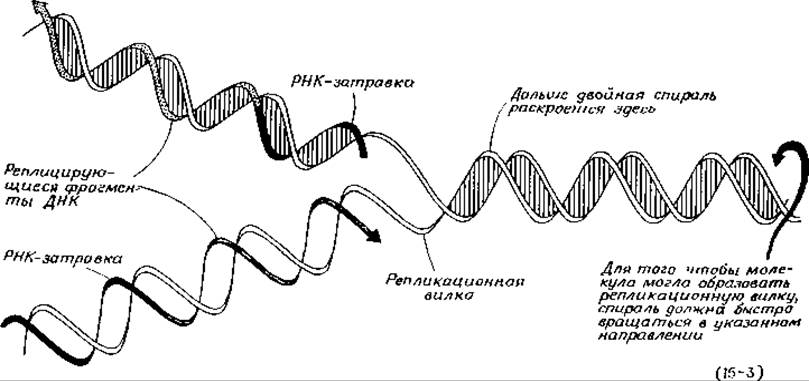
A more serious problem stems from the fact that DNA strands have opposite orientations. This means that The addition of new NUCLEOTIDES to one of the strands at the replication fork must proceed from the 3' end, and to the other—from the 5' end. It follows that for specific polymerization to take place, there should be Two Types of DNA polymerases, one for each end. Nevertheless, despite intensive searches, all polymerases discovered so far (DNA polymerases I, II, and III) add new residues exclusively to 3' ends.
b. Replication fragments and DNA ligase
In 1968, Okazaki reported that short DNA fragments, termed replication fragments (or Okazaki fragments) [27], appear in bacterial cells during replication. Subsequently, another major discovery was made—a new enzyme, DNA ligase [28, 29], was found, which is capable of joining two DNA fragments into a continuous strand. The specific action of this enzyme consists in the repair ("sealing") of single-stranded breaks in DNA. As seen in equation (15-4), a broken strand of a DNA molecule contains free 3'-hydroxyl and 5'-phosphate groups that must be joined. E. coli DNA ligase activates the phosphate group in an unusual way, namely by replacing nicotinamide mononucleotide with an adenylyl group from NAD+ [equation (15-4), step a]. The reaction is completed by the cleavage of AMP [equation (15-4), step b]. It should be noted that cells infected with bacteriophage T4 induce a special ligase that utilizes ATP instead of NAD+ for activation.

c. Modern concept of replication requiring An RNA primer
It was recently discovered that a short RNA chain forming an RNA-DNA hybrid can serve as a primer for DNA polymerase in vitro. These findings, combined with the Discovery of Okazaki fragments and ligase, suggest that the following events take place at the replication fork: the double-stranded DNA unwinds within a localized region, presumably with the participation of unwinding Proteins (Section D). A short RNA primer fragment that forms Base Pairs with the DNA is synthesized in a specific primer region. Next, DNA polymerase elongates this RNA chain, utilizing deoxyribonucleoside triphosphates for the synthesis of replication fragments. Synthesis proceeds along both strands in the directions indicated in equation (15-3). Subsequently, the primer RNA ends are cleaved off. The gaps in the synthesized strand are filled in through the further action of the polymerase, and the nicks are sealed by the action of ligase. According to this mechanism, one strand can be synthesized continuously over its entire length, whereas the other must be formed discontinuously by the addition of replication fragments. However, in some organisms, both strands may be synthesized discontinuously.
Since the bulk of new data on replication has been obtained through Genetic Methods, it seems appropriate to defer further Structure/133.html">Discussion of this subject to Section D.
Last update: 06/08/2026
Editorial and Educational Adaptation: This material has been compiled based on the primary/original source text. The project team performed an editorial review, corrected technical inaccuracies, structured sections, and adapted the content for an educational format.
What was processed:
- elimination of formatting defects (OCR errors, structural breaks, corrupted characters);
- editorial organization of content;
- standardization of terminology in accordance with academic sources;
- verification of factual statements against the original source text.
All mentions of the author, publication year, and origin of the primary text have been preserved in accordance with the source.