Biochemistry - Chemical Reactions in Living Cells, Volume 3 - D. Metzler 1980
Metabolism of Nitrogenous Compounds
Metabolism of Pyrimidines and Purines
Biosynthesis of Pyrimidines
All Cells must be capable of producing pyrimidine and purine bases, which are used in the synthesis of Nucleic Acids and Coenzymes. In many organisms, the pathway leading to purine formation is exceptionally active, as indicated by the fact that uric acid or related compounds serve as the primary excretory product for excess nitrogen. This is characteristic of the Nitrogen METABOLISM of birds and reptiles, which excrete uric acid rather than urea, and of spiders, which excrete guanine.
The transfer of the carbamoyl group from carbamoyl phosphate to aspartate (Fig. 14-29, step a) yields a product that readily undergoes cyclization through the elimination of Water, forming dihydroorotate. Carbamoyltransferase is a highly regulated enzyme and is currently the subject of intensive research (Ch. 4, Sec. D, 8; Ch. 6, Sec. B, 7). Dihydroorotate is oxidized by a specialized flavoprotein, with NAD+ acting as the external oxidant. In the next step (Fig. 14-29, step d), the resulting orotic acid combines with the phosphoribosyl moiety of a PRPP molecule [Eq. (14-42)], producing the first nucleotide, orotidine-5'-phosphate.
Class="center">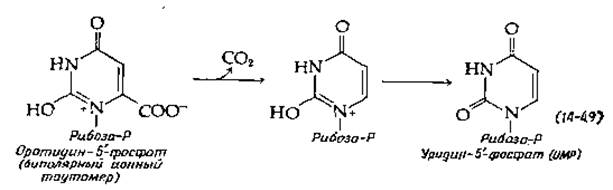
Orotidylate (orotidine-5'-phosphate) undergoes an unusual type of decarboxylation (Fig. 14-29, step e) that apparently does not require a coenzyme. It has been suggested that the enzyme stabilizes a zwitterionic tautomer of the substrate. A neighboring positive charge [149] could facilitate this decarboxylation [Eq. (14-49)]. Consequently, uridine-5'-phosphate (UMP) is formed from aspartate via a relatively direct and straightforward pathway. Double phosphorylation utilizing ATP yields UDP and UTP.

FIG. 14-29. Biosynthesis OF PYRIMIDINE NUCLEOTIDES.
Cytosine nucleotides are derived from UTP, with the initial step being amination to form CTP (Fig. 14-29, step h). In many respects, this reaction resembles The conversion of citrulline to Arginine—a process requiring ATP and involving the transfer of nitrogen from an aspartate molecule (Sec. C, 2). However, in CTP formation, the amide group of glutamine serves as the nitrogen donor (though NH4+ can also be utilized). CTP is incorporated into RNA and into metabolic intermediates such as CDP-Choline; CTP can also undergo dephosphorylation to yield CDP. It is CDP that serves as the principal precursor for the deoxyribonucleotides dCDP and thymidine diphosphate.
a. Formation of Deoxyribonucleotides
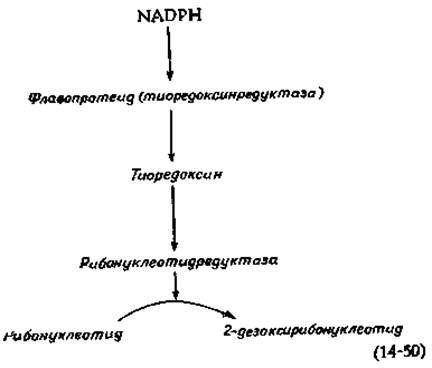
Ribonucleoside diphosphates are converted into their corresponding 2-deoxy derivatives (step k, Fig. 14-29) through a series of reactions involving NADPH, the flavoprotein thioredoxin (Ch. 8, Sec. I, 2 and M, 4), and Ribonucleotide reductase, as shown in Equation (14-50).
Ribonucleotide reductase from E. coli consists of two nonidentical subunits, one of which contains non-heme iron [150]. In several bacterial species and in Euglena, vitamin B12 is required, and the reduction process occurs at the nucleoside triphosphate level [151]. The system utilized by Lactobacillus cells is described in Ch. 8, Sec. M, 4. Mammalian ribonucleotide reductase, which is likely similar to the E. coli enzyme, is considered a promising target for antitumor drugs. The enzyme's activity is regulated by a complex network of feedback mechanisms, presumably ensuring that DNA precursors are synthesized only in amounts strictly required for DNA Replication [152]. Because an excess of a single deoxyribonucleotide can inhibit the reduction of all ribonucleoside diphosphates, DNA Synthesis can be inhibited by either deoxyadenosine or high concentrations of thymidine, even though both compounds serve as DNA precursors.
Phosphorylation of dCDP to form dCTP (step l, Fig. 14-29) completes The biosynthesis of the first pyrimidine DNA precursor. Uridine nucleotides are produced via two pathways. Reduction of UDP yields dUDP (step k, Fig. 14-29). More commonly, however, hydrolytic deamination of deoxycytidine nucleotides takes place (reactions m and m', Fig. 14-29). The methylation leading to thymine nucleotides proceeds via The formation of dUMP. The latter can be obtained by the hydrolytic Cleavage of phosphate from dUDP or, in eukaryotes, through the conversion pathway dCDP->dCMP->dUMP (steps l' and m', Fig. 14-29). Alternatively, E. coli employs a more circuitous route: dCDP->dCTP->dUTP->dUMP (steps l, m, and n, Fig. 14-29). One of the intermediates is dUTP. Interestingly, DNA polymerases are capable of incorporating this compound into polynucleotides. The only reason this does not happen in cells (which would lead to the formation of uracil-containing DNA) is that dUTP is rapidly converted to dUMP by pyrophosphatase (step m, Fig. 14-29).
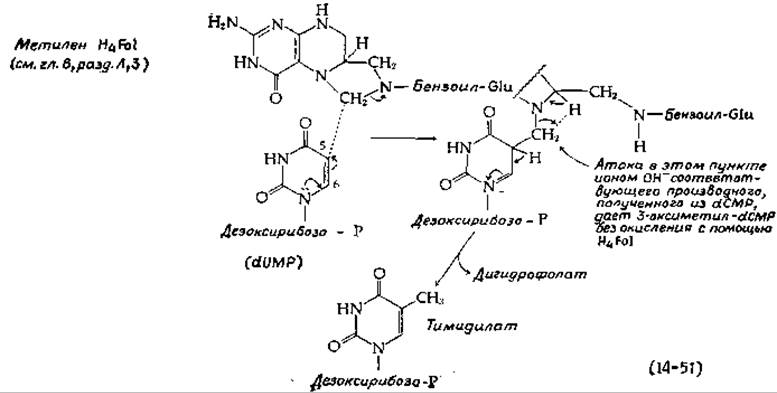
The formation of thymidylate (dTMP) from dUMP (step o, Fig. 14-29) is catalyzed by thymidylate synthase. The reaction, described by Equation (14-51), involves the transfer of a single-carbon unit cleaved from methylenetetrahydrofolic acid [153]. A slightly different mechanism, proposed on The basis of model experiments, involves an addition reaction at the C-6 atom facilitated by the presence of an adjacent nucleophilic group [154].
Fascinating alterations in Nucleotide Metabolism occur in E. coli cells infected with T-even phages. This process involves the Transcription of phage genes and the synthesis of corresponding host-Cell Proteins [155]. Among these viral Gene products are several Enzymes that influence nucleotide metabolism. Three of them are indicated in Fig. 14-30 by dashed arrows. One enzyme catalyzes the hydrolytic conversion of dCTP to dCMP, while another synthesizes 5-hydroxymethyl-dCMP. Such virus-specific enzymes may represent promising targets for antiviral therapies.
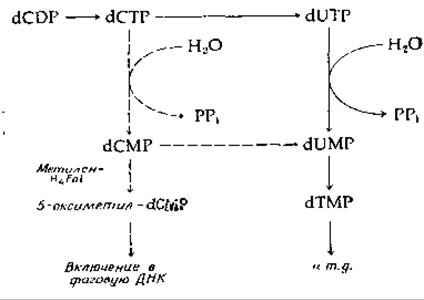
FIG. 14-30. Selected alterations in nucleotide metabolism in E. coli cells induced by T-even bacteriophage infection; (—>) normal metabolic pathways, (— — — —>) phage-induced metabolic pathways.
Supplement 14-G
Thymidylate Synthase, a Target Enzyme for Cancer Chemotherapya
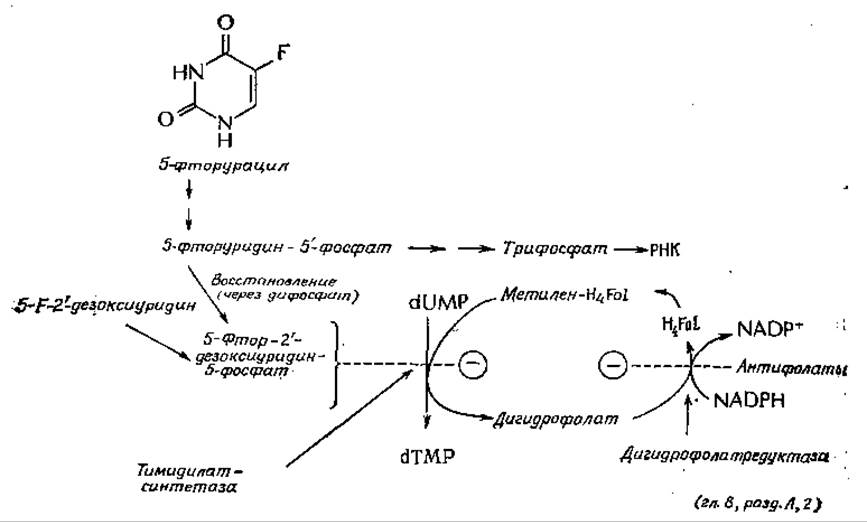
When a cell—whether bacterial or animal—is deprived of thymine, it loses The ability to synthesize DNA. However, Protein and RNA synthesis may continue. This can be demonstrated experimentally using thymine-requiring mutants. Nevertheless, these cells eventually lose viability and die. The exact cause of this "thymineless death" remains unclear. It is possible that thymine is required for the Repair of DNA damage, and in its absence, damaged DNA is transcribed, ultimately leading to the synthesis of defective proteins. Regardless of the exact mechanism, this phenomenon forms the basis of some of the most effective approaches to cancer chemotherapy. Cancer cells, with their characteristic High Metabolic Rate, are particularly sensitive to thymine deprivation. Consequently, thymidylate synthase has emerged as one of the most successful targets for inhibitory drugs. A potent inhibitor of this enzyme is 5-fluoro-2'-deoxyuridine monophosphate. Its inhibitory action was discovered when it was found that 5-fluorouracil could be utilized in cancer chemotherapy.
The effects of fluorouracil on cells can be multifaceted. It may also be incorporated into RNAb, but for cancer chemotherapy, the inhibition of thymidylate synthase by its reduced product is likely of primary importance. 5-Fluoro-2'-deoxyuridine is considerably less toxic than 5-fluorouracil and has proven to be a more effective therapeutic agent. It should be noted that thymidylate synthase requires methylenetetrahydrofolate as a reducing agent, and that the reduction of dihydrofolate is a crucial step in the overall process. As previously mentioned (Ch. 8, Sec. L, 2), some of the most potent antitumor drugs are Folic acid analogues such as methotrexate (N10-methyl-4-amino-4-deoxyfolic acid). Their action stems from the inhibition of Dihydrofolate Reductase, which (among other consequences) deprives thymidylate synthase of its necessary substrate.
a This is the title of Section V of Fridkin's article on thymidylate synthase in Adv. Enzymol., 38, 235–292 (1973).
b Horowitz J., Ou C.-N., Ishag M., Ofehand J., Bierbaum J., JMB, 88, 301–312 (1974).
b. Salvage of bases
Just as orotic acid is converted into a ribonucleotide at stage g, Fig. 14-29, other free pyrimidine and Purine bases can also react with PRPP to yield monoribonucleotides and PPi as products. These reactions constitute a salvage pathway by which purine and pyrimidine bases released during nucleic acid degradation can be reused. However, it should be noted that thymine is generally not reused. Nevertheless, an important experimental technique for biochemists is the incorporation of radioactive thymine or thymidine into DNA in living organisms. Thymidine is rapidly phosphorylated to dTTP by sequential Kinases. Another important pyrimidine salvage reaction is the conversion of cytosine to uracil by hydrolytic deamination, similar to the process occurring at stage m, Fig. 14-29.
Last update: 06/08/2026
Editorial and Educational Adaptation: This material has been compiled based on the primary/original source text. The project team performed an editorial review, corrected technical inaccuracies, structured sections, and adapted the content for an educational format.
What was processed:
- elimination of formatting defects (OCR errors, structural breaks, corrupted characters);
- editorial organization of content;
- standardization of terminology in accordance with academic sources;
- verification of factual statements against the original source text.
All mentions of the author, publication year, and origin of the primary text have been preserved in accordance with the source.