Biochemistry: The Chemical Reactions of Living Cells, Volume 2 - D. Metzler 1980
Enzymes: Cellular Protein Catalysts
Enzyme Inhibition and Activation
Allosteric Effectors and Enzyme Conformation Changes
Many regulatory phenomena apparently rely on the binding of an effector to an allosteric site, which induces a conformational change in the enzyme molecule. The Effect of allosteric inhibitors and activators on oligomeric Enzymes is generally referred to as allostery (or allosterism)1). However, Allosteric Regulation can also occur in monomeric enzymes; therefore, we shall begin our Structure/133.html">Discussion with a monomer that contains binding sites for a substrate, an inhibitor, and an activator, and can exist in two Conformations, A and B (Fig. 6-10). Let us assume that [cf. equation (4-42)] conformer B binds both the substrate and the activator equally well, but binds the inhibitor poorly or not at all. Conversely, conformer A binds the inhibitor strongly, yet exhibits a low affinity for the substrate and the activator. The dynamic equilibrium between these two conformers, possessing different binding capacities, allows the enzyme to be "turned on" or "turned off" depending on environmental conditions.
Class="center">
FIG. 6-10. A. A monomeric enzyme with binding sites for an inhibitor I and an activator J. Conformer A tightly binds inhibitor I, but shows low affinity for activator J or substrate S. Conformer B binds substrate S and catalyzes its conversion. Conformer B also binds activator J, the presence of which stabilizes this conformational state. In the well-known model proposed by Monod et al. [35], conformers A and B are designated as T and R, respectively. B. States of a dimeric enzyme stabilized by an inhibitor or an activator (T and R states, respectively). In the R state, both subunits adopt a conformation favorable for substrate binding.
1) For a more detailed Introduction to the molecular foundations of allosteric regulation, the reader is referred to the recently published book: B. I. Kurganov, Allosteric Enzymes, Moscow: Nauka, 1978 (Translator's Note).
The cellular inhibitor binds to conformer A and, at a sufficiently high concentration, converts the entire enzyme population into the inactive form A. The enzyme is thus "turned off," or at least exhibits very low activity. Conversely, at high activator concentrations, the enzyme is "turned on" through the stabilization of conformation B. The fraction of enzyme molecules in the active form B is determined by the instantaneous cellular concentrations of the inhibitor, activator, and substrate. This interplay between inhibition and activation underlies many regulatory phenomena in cellular METABOLISM (Chap. 1, Sec. E).
The action of inhibitors and activators on a monomeric enzyme existing in two interconverting forms, A and B (Fig. 6-10), can be described by equations of the type (6-48) and (6-49) [scheme (6-47)], whose individual terms correspond to inhibition and activation. The equilibrium between the two conformers can also be characterized using equation (4-44). For monomeric enzymes, it is generally impractical to separate the constants Kt and KBX [cf. equation (4-44)], which characterize the conformational change and the binding of the substrate or activator, respectively.
The majority of intracellular enzymes possess an oligomeric structure; consequently, the binding of allosteric effectors leads to highly intriguing phenomena. Deriving the appropriate mathematical expressions requires introducing pairs of binding constants for the inhibitor and the activator to describe their affinity for conformers A and B. Because material balance equations must account for all possible complexes, the resulting expressions are quite complex. The saturation Functions in the Monod–Wyman–Changeux model (Chap. 4, Sec. D) take a relatively simple form. According to equation (4-53), the degree of saturation  for this model
is given by the following expression:

Here, L is the allosteric constant, the meaning of which for a dimer is apparent from equation (4-50). The symbol c denotes The ratio of the dissociation constants KBS and KAS, which characterize the affinity of the substrate for conformers B and A, respectively1)
c = KBS/KAS (6-52)
Finally, a represents the "normalized" Substrate Concentration2):
а = [S]/KBS. (6-53)
Note that this chapter uses dissociation constants for the ES complexes, whereas Chapter 4, including equation (4-53), employs association constants.
2) In the notation adopted in Chapter 4, a = [S]/KBS.
To account for the Influence of the inhibitor (I) and the activator (J), one introduces the ratios of the dissociation constants for the BI and AI complexes, and for the BJ and AJ complexes:

as well as the normalized concentrations of the inhibitor and activator:

The saturation function in the presence of an inhibitor and an activator at concentrations of ß and γ, respectively, is still described by

FIG. 6-11. Dependence of the degree of saturation  and the fraction of the enzyme in the R conformation
  on the logarithm of the "normalized" substrate concentration (a=[S]/KBS) for a hypothetical tetrameric enzyme (n = 4) whose mechanism follows the Monod–Wyman–Changeux model [39]. The curves were calculated at c = 0.1 and two values of the apparent allosteric constant, L' = 4 and L' = 104.
equation (6-51); however, the allosteric constant L must be replaced by the apparent allosteric constant L' [39]:

Figure 6-11 illustrates the dependence of y on lg a for a tetramer at two different values of L' and a fixed value of c. In both cases,  approaches 1 as lg a increases. However, because inhibition is noncompetitive at high values of L', a significant fraction of the enzyme remains in the T (or A) conformation under saturating conditions.
As we saw earlier, Noncompetitive inhibition is not completely reversed at very high substrate concentrations. Monod et al. introduced a state function  , which is defined as the fraction of the enzyme existing in the R conformation (B).

In a K-system (see Section B, 2), The rate of the enzymatic reaction is determined precisely by the value of  . Figure 6-11 shows a plot of
  versus lg a. Note that when the value of U is small, the state function
  does not approach zero, even as [S]→0. In other words, the enzyme is never completely "shut off." Similarly, at high values of U, the enzyme never operates at full capacity.
Figure 6-11 can be compared with Figure 6-7, which presents analogous curves for noncompetitive inhibition of a monomeric enzyme. We note that saturation of the oligomeric enzyme occurs over a narrower range of Ligand concentrations than for the monomeric enzyme; that is, saturation of the oligomeric enzyme by the substrate (especially in the presence of an inhibitor) proceeds cooperatively. This occurs only when, in the absence of the substrate, the enzyme predominantly resides in the T state (A).
In the model proposed by Monod et al. [35], allosteric interactions between two identical molecules (whether substrate or effector molecules) are termed homotropic. Such interactions result in cooperative or anticooperative binding behavior. Allosteric interactions between nonidentical molecules (e.g., between a substrate and an activator) are termed heterotropic.
For many enzymes, the Monod et al. model turns out to be overly simplified, and analyzing equilibrium binding requires a more general approach (Chapter 4). It should be kept in mind, however, that alongside K-systems, there are V-systems, in which an allosteric effector causes A change in the maximum velocity [see scheme (6-47)], and sometimes in both kinetic parameters simultaneously (maximum velocity and substrate affinity).
The fact that experimental data are satisfactorily described by a particular equation cannot be regarded as proof that the proposed mathematical model is adequate. For example, Rabin [40] provided an alternative simple explanation for the sigmoidal dependence of the enzymatic reaction rate on substrate concentration1). Even a monomeric enzyme with a single binding site can exhibit cooperative properties. The enzyme in its active conformation (E) interacts with the substrate, and the resulting ES complex rapidly dissociates to yield the product [upper loop in scheme (6-58)]. However, the possibility of a slow conformational transition E→E' cannot be excluded (where E' is a weakly active form with a significantly lower affinity for the substrate). Furthermore, the E'S complex (if formed) can be in equilibrium with ES, which induces a change in the conformational state of the protein. At low substrate concentrations, the E' form will predominate, and consequently, enzymatic activity will be low. At high substrate concentrations, the enzyme will remain in the E form long enough to bind another substrate molecule and thus maintain the active conformation. The details of this and other kinetic models implying that plots of rate versus substrate concentration must be sigmoidal are discussed by Newsholme and Start [41].
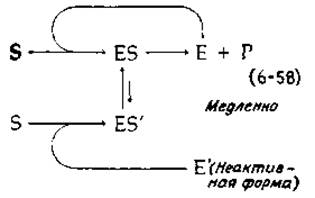
1) Rabin [40] limited his discussion to qualitative reasoning. The quantitative aspect is examined in the work by Ainshe G. R., Jr., Shill J. P., Neet K. E. (1972) J. Biol. Chem., 247, 7088–7096. — Transl. note.
The cooperative nature of enzyme-substrate binding is arguably of no less physiological significance than the Cooperative binding of oxygen by Hemoglobin, which ensures more efficient release of bound oxygen in Tissues (Chapter 4, Section D, 5). Cooperativity of substrate binding is absent when, owing to an excess of activator, the enzyme transitions into the R state (B), in which the binding sites behave independently. At the same time, activator binding must be characterized by strong cooperativity; that is, the reaction rate must change more sharply with variations in activator concentration than in the case of hyperbolic activation. Likewise, cooperative inhibitor binding ensures a more rapid "shutoff" of the enzyme as the inhibitor concentration increases. Presumably, the evolution of oligomeric enzymes is driven, at least in part, by the greater efficiency of regulatory mechanisms based on cooperative effector binding.
Last update: 06/08/2026
Editorial and Educational Adaptation: This material has been compiled based on the primary/original source text. The project team performed an editorial review, corrected technical inaccuracies, structured sections, and adapted the content for an educational format.
What was processed:
- elimination of formatting defects (OCR errors, structural breaks, corrupted characters);
- editorial organization of content;
- standardization of terminology in accordance with academic sources;
- verification of factual statements against the original source text.
All mentions of the author, publication year, and origin of the primary text have been preserved in accordance with the source.