Human Biochemistry Volume 1 - Murray R. 1993
Structure and Functions of Proteins and Enzymes
Enzymes: Regulation of Activity
Regulation of Metabolism
METABOLISM/2.html">THE CONCEPT OF homeostatic Regulation of the internal environment was introduced by Claude Bernard in the late 19th century. The ability of an animal to maintain a constant composition of its intracellular milieu implies that all essential enzymatic reactions proceed at rates commensurate with Changes in the internal environment of the Organism and its surroundings. A Cell or an organism is considered diseased when it fails to respond adequately to internal or external stimuli. To understand the mechanisms of homeostasis in normal Cells and to elucidate the Molecular Basis of various disorders, it is essential to comprehend the factors that govern the rates of enzymatic reactions.
All Chemical Reactions, including enzymatic ones, are reversible to some extent1. Within living cells, however, such reversibility may be absent because reaction products are rapidly depleted by subsequent enzymatic reactions. The flow of metabolites in living cells can be likened to Water flowing through a pipe. Although water can theoretically flow in both directions, in practice it flows in only one direction. Similarly, the metabolic flux in cells is predominantly unidirectional. True equilibrium, which is entirely uncharacteristic of living systems, is attained only after cell death. A living cell is a dynamic steady-state system that maintains a unidirectional flow of metabolites (Fig. 10.1). In mature cells, the average concentrations of metabolites remain approximately constant over extended periods2. The flexibility of this steady-state system is ensured by a variety of adjustment and compensatory processes through which the organism maintains internal constancy despite variations in diet, fluid and mineral intake, physical activity, and ambient Temperature.
Overview of Metabolic Regulation
For the organism to function properly, the flux of metabolites through anabolic and Catabolic pathways must be precisely regulated. All coupled chemical processes must proceed at rates that meet the demands of the organism as a whole within its environment. ATP generation, macromolecular synthesis, transport, secretion, and renal tubular reabsorption must sensitively respond to even minor fluctuations in the cellular, organic, or systemic environment. These processes must be coordinated to cope with environmental changes (such as the intake or depletion of nutrients) as well as periodic intracellular events (such as DNA Replication). Until recently, the molecular details of regulation were studied exclusively in Bacteria; these organisms lack complex hormonal and neural control systems, allowing molecular processes to be investigated using genetic approaches. Today, however, we are able to thoroughly examine regulatory mechanisms at THE MOLECULAR LEVEL in animal cells as well.
1 A readily reversible reaction is characterized by a small absolute value of ∆G. Reactions with a large negative ∆G can be considered practically irreversible in most biochemical systems.
2 Nevertheless, short-term fluctuations in metabolite concentrations and enzyme levels do occur and are of great physiological significance.
Class="center">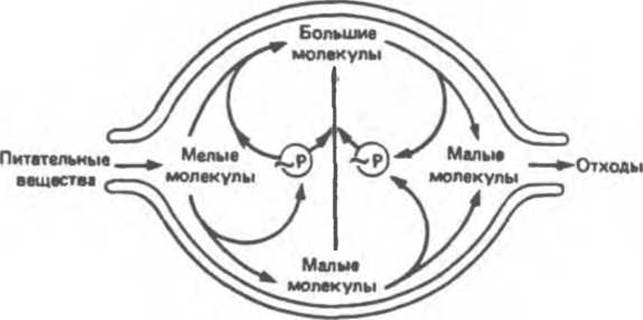
Fig. 10.1. Schematic representation of a cell in a steady state.
To investigate Metabolic Disorders and develop therapeutic approaches, a clear understanding of regulatory processes in human cells is indispensable. At the same time, the molecular-level regulation of many metabolic processes in mammals remains insufficiently understood. It is evident that metabolic regulation in mammals differs substantially from superficially similar processes in bacteria. Nevertheless, we shall examine these regulatory principles in bacteria first, as this will allow us to outline general mechanisms that remain fundamental to The Study of human physiology and pathology.
MECHANISMS OF ENZYME Regulation
The carbon flux "flowing" through a given enzymatic reaction can be controlled by altering the following parameters: (1) the absolute amount of the enzyme present; (2) the pool of reactants (other than the enzyme); and (3) the catalytic efficiency of the enzyme. Most life forms employ all Three types of regulation.
Last update: 06/08/2026
Editorial and Educational Adaptation: This material has been compiled based on the primary/original source text. The project team performed an editorial review, corrected technical inaccuracies, structured sections, and adapted the content for an educational format.
What was processed:
- elimination of formatting defects (OCR errors, structural breaks, corrupted characters);
- editorial organization of content;
- standardization of terminology in accordance with academic sources;
- verification of factual statements against the original source text.
All mentions of the author, publication year, and origin of the primary text have been preserved in accordance with the source.