Harper's Illustrated Biochemistry, Volume 1 - Murray R. 1993
Bioenergetics and Carbohydrate and Lipid Metabolism
Physiologically Important Lipids
Fatty Acids
Fatty acids are aliphatic carboxylic acids derived primarily from fats and oils. Natural fats typically contain fatty acids with an even number of carbon atoms, as they are synthesized from two-carbon units that form an unbranched carbon chain. The chain can be saturated (containing no double bonds) or unsaturated (containing one or more double bonds).
Nomenclature
The systematic name of a fatty acid is most commonly formed by adding the suffix "-oic" to the name of the corresponding hydrocarbon (Geneva nomenclature). Saturated acids thus end in "-anoic" (e.g., octanoic acid), while unsaturated acids end in "-enoic" (e.g., octadecenoic acid, or oleic acid). Carbon atoms are numbered starting from the carboxyl group (which contains carbon atom 1). The carbon atom adjacent to the carboxyl group (carbon 2) is also referred to as the α-carbon. Carbon 3 is the β-carbon, and the carbon of the terminal methyl group (carbon n) is the ω-carbon. Various conventions have been established to indicate the number and position of double bonds; for example, ∆9 indicates that a double bond in the fatty acid molecule is located between carbon atoms 9 and 10, whereas ω9 denotes a double bond between the ninth and tenth carbon atoms counting from the ω-end. Widely used common names, along with the number of carbon atoms, the number of double bonds, and their positions, are listed in Fig. 15.1. During METABOLISM, animal organisms can introduce additional double bonds into fatty acids, but always between an existing double bond (such as ω9, ω6, or ω3) and the carboxyl carbon; this divides animal fatty acids into three distinct families: ω3, ω6, and ω9.
Class="center">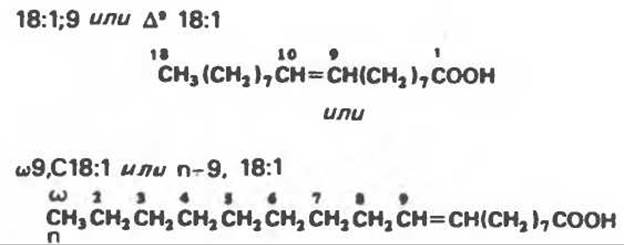
Fig. 15.1. Oleic acid ($n - 9$; pronounced "n minus 9").
Saturated fatty acids
Saturated fatty acids belong to a homologous series beginning with acetic acid. Examples are given in Table 15.1.
Other members of the series with a higher number of carbon atoms also exist, occurring primarily in Waxes. Several Branched-Chain Fatty Acids have been isolated from both PLANT AND ANIMAL sources.
Unsaturated fatty acids (Table 15.2)
These are classified according to their degree of unsaturation.
A. Monounsaturated (monoethenoid, monoenoic) acids.
B. Polyunsaturated (polyethenoid, polyenoic) acids.
C. Eicosanoids. Derived from eicosa-(20-C)-polyenoic fatty acids, these compounds are subdivided into Prostanoids and Leukotrienes (LTs). Prostanoids include Prostaglandins (PGs), prostacyclins (PGIs), and thromboxanes (TXs). The term prostaglandin is sometimes used in a broader sense to refer to all prostanoids collectively.
Table 15.1. Saturated fatty acids

1) Strictly speaking, not an alkyl derivative.
Table 15.2. Unsaturated fatty acids of physiological and nutritional significance
|
Number of carbon atoms, number and position of double bonds |
Series |
Name |
Systematic name |
Occurrence |
|
Monoenoic acids (one double bond) |
||||
|
16 : 1; 9 |
ω 7 |
Palmitoleic |
cis-9-hexadecenoic |
Found in almost all fats |
|
18 :1; 9 |
ω 9 |
Oleic |
cis-9-octadecenoic |
The fatty acid most commonly found in natural fats |
|
18 : 1; 9 |
ω 9 |
Elaidic |
trans-9-octadecenoic |
Ruminant fats and hydrogenated fats |
|
22 : 1; 13 |
ω 9 |
Erucic |
cis-13-docosenoic |
Rapeseed and mustard oil |
|
24: 1; 15 |
ω 9 |
Nervonic |
cis-15-tetracosenoic |
In cerebrosides |
|
Dienoic acids (two double bonds) |
||||
|
18 : 2; 9, 12 |
ω 6 |
Linoleic |
all-cis-9,12-octadecadienoic |
Wheat, peanut, cottonseed, soybean, and many other vegetable oils |
|
Trienoic acids (three double bonds) |
||||
|
18 : 3; 6, 9, 12 |
ω 6 |
γ-Linolenic |
all-cis-6,9,12-octadecatrienoic |
Certain plants (evening primrose oil); minor fatty acid in animals |
|
18 : 3; 9, 12, 15 |
ω 3 |
α-Linolenic |
all-cis-9,12,15-octadecatrienoic |
Frequently found alongside linoleic acid, especially in linseed oil |
|
Tetraenoic acids (four double bonds) |
||||
|
20 : 4; 5, 8, 11, 14 |
ω 6 |
Arachidonic |
all-cis-5,8,11,14-eicosatetraenoic |
Found alongside linoleic acid, notably in peanut oil; a vital component of animal Phospholipids |
|
Pentaenoic acids (five double bonds) |
||||
|
20 : 5; 5, 8, 11, 14, 17 |
ω 3 |
Timnodonic (EPA) |
all-cis-5,8,11,14,17-eicosapentaenoic |
An important constituent of fish oil (cod Liver oil) |
|
22 : 5; 7, 10, 13, 16, 19 |
ω 3 |
Clupanodonic |
all-cis-7,10,13,16,19-docosapentaenoic |
Fish oils, Brain phospholipids |
|
Hexaenoic acids (six double bonds) |
||||
|
22 : 6; 4, 7, 10, 13, 16, 19 |
ω 3 |
Cervonic (DHA) |
all-cis-4,7,10,13,16,19-docosahexaenoic |
Fish oils, brain phospholipids |
Prostaglandins were originally discovered in seminal fluid, but have since been identified in virtually all mammalian Tissues, exhibiting a wide range of important physiological and pharmacological properties. They are synthesized in vivo via the cyclization of the central region of the carbon chain of $C_{20}$ (eicosanoactive) polyunsaturated fatty acids (such as arachidonic acid), resulting in The formation of a cyclopentane ring (Fig. 15.2). A related group of compounds, the thromboxanes, found in Blood Platelets, contain a cyclopentane ring that incorporates an oxygen atom (forming an oxane ring) (Fig. 15.3). Three different eicosanoid fatty acids give rise to three groups of eicosanoids, which differ in the number of double bonds in their side chains—designated as $PG_1$, $PG_2$, and $PG_3$. Various functional groups can be attached to the ring, giving rise to several Different types of Prostaglandins and thromboxanes, which are denoted by the letters A, B, etc. For instance, E-type prostaglandins ($PG-E_2$) contain a keto group at position 9, whereas F-type prostaglandins feature a hydroxyl group at the same position. Leukotrienes represent a third group of eicosanoid derivatives; they are formed not through fatty acid cyclization, but via the lipoxygenase enzymatic pathway (Fig. 15.4). First discovered in leukocytes, they are characterized by the presence of three conjugated double bonds.

Fig. 15.2. Prostaglandin $E_2$ ($PG E_2$).
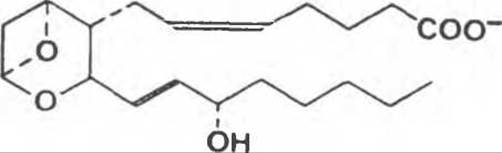
Fig. 15.3. Thromboxane $A_2$.
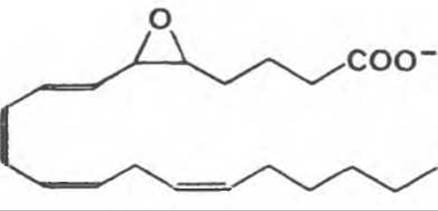
Fig. 15.4. Leukotriene $A_4$.
G. Other unsaturated fatty acids. Many other fatty acids have been found in biological Materials, containing notably hydroxyl groups (e.g., ricinoleic acid) or cyclic groups.
Cis-trans isomerism of unsaturated fatty acids
The carbon chains of saturated fatty acids form a zigzag line when extended (as occurs at lower temperatures). At higher temperatures, rotation around a series of bonds takes place, leading to chain shortening—which is why Biomembranes become thinner as the Temperature rises. Unsaturated fatty acids exhibit geometric isomerism due to differences in the orientation of atoms or groups relative to the double bond. If the acyl chains lie on the same side of the double bond, a cis-configuration is formed, which is characteristic, for instance, of oleic acid; if they lie on opposite sides, the molecule is in the trans-configuration, as in the case of elaidic acid, an isomer of oleic acid (Fig. 15.5). Natural polyunsaturated long-chain fatty acids almost all possess the cis-configuration; at the site of the double bond, the molecule is "bent" and forms a 120° angle. Thus, oleic acid has an L-like shape, whereas elaidic acid retains a "linear" trans-configuration in the region containing the double bond. An increase in the number of cis-double bonds in fatty acids leads to an increase in the number of possible spatial configurations of the molecule. This can have a major impact on the packing of molecules within membranes, as well as on the positioning of fatty acid molecules within more complex molecules such as phospholipids. The presence of double bonds in the trans-configuration alters these spatial relationships. Trans-configured fatty acids are present in certain food products. Most of them are formed as by-products during hydrogenation, a process that converts fatty acids into a saturated form; this method is used, in particular, to "harden" natural oils in The production of margarine. In addition, small amounts of trans-acids are ingested via animal fat, which contains trans-acids produced by the action of microorganisms present in the rumen of ruminants.

Fig. 15.5. Geometric isomerism of fatty acids (∆9, 18:1) (oleic and elaidic acids).
Alcohols
Alcohols found as components of Lipids include glycerol, Cholesterol, and higher alcohols (e.g., cetyl alcohol C16H33OH), which are typically found in waxes, as well as the polyisoprenoid alcohol dolichol (Fig. 15.27).
Fatty acid aldehydes
Fatty acids can be reduced to aldehydes. These compounds are found in natural fats in both free and bound states.
Physiologically important properties of fatty acids
The Physical Properties of body lipids depend largely on the carbon chain length and the degree of unsaturation of the corresponding fatty acids. For instance, the melting point of fatty acids with an even number of carbon atoms increases with chain length and decreases with an increasing degree of unsaturation. A triacylglycerol in which all three chains are saturated fatty acids containing at least 12 carbon atoms each is solid at body temperature; however, if all three fatty acid residues are of the 18:2 type, the corresponding triacylglycerol remains liquid at temperatures below 0 °C. In practice, naturalacylglycerols contain a mixture of fatty acids that ensures the performance of a specific functional role. Membrane Lipids, which must remain in a liquid state, are more unsaturated compared to storage lipids. In tissues subjected to cooling—during hibernation or under extreme conditions—lipids are found to be more unsaturated.
Last update: 06/08/2026
Editorial and Educational Adaptation: This material has been compiled based on the primary/original source text. The project team performed an editorial review, corrected technical inaccuracies, structured sections, and adapted the content for an educational format.
What was processed:
- elimination of formatting defects (OCR errors, structural breaks, corrupted characters);
- editorial organization of content;
- standardization of terminology in accordance with academic sources;
- verification of factual statements against the original source text.
All mentions of the author, publication year, and origin of the primary text have been preserved in accordance with the source.