Principles of Biochemistry, Volume 3 - A. Lehninger 1985
Selected Aspects of Human Biochemistry
Hormones
cAMP stimulates protein kinase activity
How does cAMP stimulate The conversion of inactive phosphorylase b into active phosphorylase a? As we recall (Sec. 20.14), this conversion is mediated by phosphorylase kinase, which catalyzes The transfer of terminal phosphate groups from two ATP molecules to the hydroxyl groups of two specific Serine residues in phosphorylase b, leading to The formation of phosphorylase a:
Class="center">2АТР + Фосфорилаза b → 2ADP +
+ Фосфорилаза а
Cyclic adenosine monophosphate (cAMP) does not exert a direct effect on phosphorylase kinase on its own. This enzyme also exists in active and less active forms (Sec. 15.12). The inactive form of phosphorylase kinase is converted into the active form via phosphorylation using ATP.
We now turn to the regulatory link between cAMP and Glycogen phosphorylase activity. The only missing link is an enzyme called protein kinase, which also exists in active and inactive forms. Active protein kinase catalyzes the phosphorylation of inactive phosphorylase kinase by means of ATP to yield the active phosphorylated form; in this reaction, ATP serves as the donor of the phosphate groups, and Ca2+ ions act as its activator:
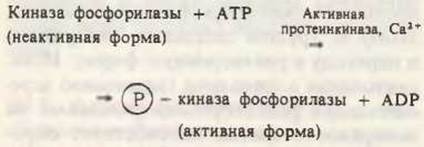
Phosphorylase kinase is a very large protein with a molecular weight exceeding 1 million. It consists of 16 subunits, each containing a specific serine residue that is phosphorylated by means of ATP under the action of activated protein kinase.
Protein kinase, which plays a pivotal role in the cAMP-mediated activation of phosphorylase, is an allosteric enzyme. In its inactive form, it is composed of two catalytic subunits (C) and two Regulatory Subunits (R) (Fig. 25-10). When these subunits are assembled into a complex of composition C2R2, the enzyme is inactive. cAMP acts as an allosteric activator of protein kinase. Upon binding of four cAMP molecules to specific sites on the two regulatory subunits, the C2R2 complex dissociates into free catalytic subunits possessing enzymatic activity and the R2-cAMP4 complex, in which cAMP remains bound. Thus, cAMP relieves the inhibition of protein kinase activity imposed by the bound regulatory subunit (Fig. 25-10).
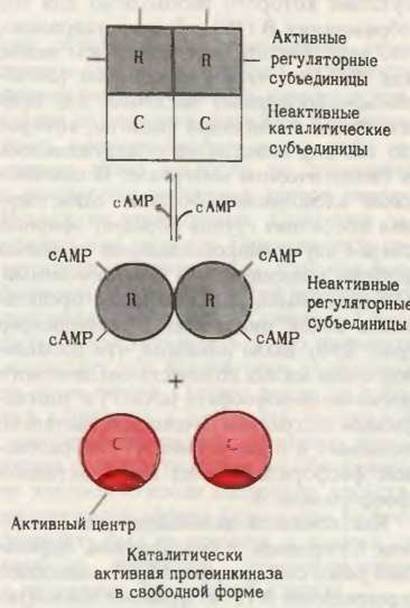
Fig. 25-10. Activation of the inactive form of protein kinase by cyclic adenosine monophosphate (cAMP), which binds to two regulatory subunits (R), thereby releasing two active catalytic subunits (C) of protein kinase.
Table 25-4. Hormones whose action is mediated by cAMP
Epinephrine |
Parathyroid hormone |
Corticotropin |
Thyrotropin |
Lipotropin |
Vasopressin |
It was subsequently discovered that cAMP mediates the cellular action not only of epinephrine but also of many Other Hormones (Table 25-4). The protein kinase activated by cAMP can phosphorylate A number of Key Enzymes across a variety of target Cells.
Last update: 06/08/2026
Editorial and Educational Adaptation: This material has been compiled based on the primary/original source text. The project team performed an editorial review, corrected technical inaccuracies, structured sections, and adapted the content for an educational format.
What was processed:
- elimination of formatting defects (OCR errors, structural breaks, corrupted characters);
- editorial organization of content;
- standardization of terminology in accordance with academic sources;
- verification of factual statements against the original source text.
All mentions of the author, publication year, and origin of the primary text have been preserved in accordance with the source.