Principles of Biochemistry, Volume 1 - A. Lehninger 1985
Biomolecules
Globular Proteins: Structure and Function of Hemoglobin
Hemoglobin also serves as a transporter of CO2 and H+ ions
In addition to transporting oxygen from the Lungs to the Tissues, Hemoglobin carries two End products of cellular Respiration, H+ and CO2, from the tissues to the lungs and Kidneys—the two Organs responsible for excreting these products. In peripheral tissue Cells, organic fuel is oxidized in Cell/35.html">Mitochondria using oxygen delivered by hemoglobin from the lungs, producing carbon dioxide, Water, and Other Compounds. The production of CO2 increases the concentration of H+ ions in tissues (i.e., lowers the pH) because Hydration of CO2 yields H2CO3, a weak acid that dissociates into H+ ions and bicarbonate ions.
Class="center">H2CO3 ⇄ H+ + HCO-3.
Hemoglobin transports a significant fraction (about 20%) of the total CO2 and H+ ions produced in tissues and delivered to the lungs and kidneys.
Many years ago, it was discovered that the binding of oxygen by hemoglobin is profoundly influenced by pH and CO2 concentration: the binding of CO2 and H+ ions reduces the affinity of hemoglobin for O2. In peripheral tissues, which have a relatively low pH and high CO2 concentration, the affinity of hemoglobin for oxygen decreases as CO2 and H+ ions are bound. Conversely, in the capillaries of the lungs, the release of CO2 and the accompanying rise in Blood pH increase the affinity of hemoglobin for oxygen. This Effect of pH and CO2 concentration on the binding and release of oxygen by hemoglobin is known as the Bohr effect, named after the Danish physiologist Christian Bohr, who first discovered it.
The Bohr effect is due to a reaction in which, besides oxygen, two other ligands capable of binding to hemoglobin are involved, namely H+ ions and CO2. The oxygen-binding reaction of hemoglobin, as we have written it so far:
Hb + O2 ⇄ HbO2,
actually presents an incomplete picture. To explain The Effect of H+ ion concentration on oxygen binding by hemoglobin, we must write this reaction in a different form:
HHb+ + O2 ⇄ HbO2 + H+,
where HHb+ is the protonated form of hemoglobin. This equation shows that the oxygen saturation curve of hemoglobin depends on the H+ ion concentration (Fig. 8-17). Hemoglobin binds both oxygen and H+ ions, but there is an inverse relationship between these two processes. If the partial pressure of oxygen is high, as in the lungs, hemoglobin binds oxygen while releasing H+ ions. At low partial pressure of oxygen, as in tissues, H+ ions will bind to hemoglobin. However, H+ ions and oxygen bind to different sites on the hemoglobin molecule. Oxygen binds to the iron atoms of the Hemes, whereas H+ ions bind to the R groups of Histidine-146 residues in the β-chains and to two other residues in the α-chains. Thus, the four polypeptide chains of hemoglobin communicate with each other not only regarding oxygen binding by the heme groups, but also regarding the binding of H+ ions by specific amino acid residues.
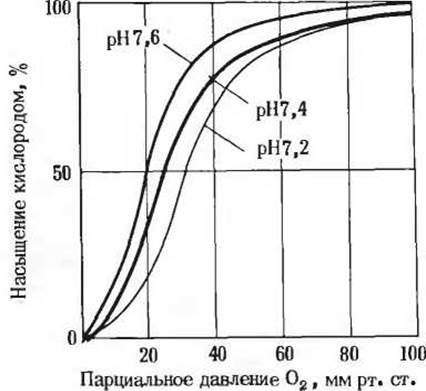
Fig. 8-17. Effect of pH on the oxygen saturation curve of hemoglobin. At the low pH characteristic of tissues (pH 7.2), oxygen is released more readily than at the higher pH (pH 7.6) characteristic of the lungs, where oxygen binds more easily.
But that is not all, as hemoglobin also binds carbon dioxide, and this process is again inversely related to oxygen binding. CO2 binds to the terminal α-amino group of each of the four polypeptide chains, resulting in The formation of carbaminohemoglobin
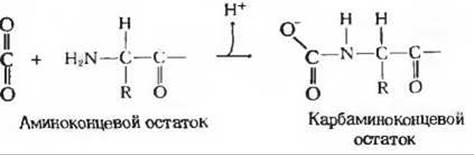
At high CO2 concentrations, such as those found in tissues, some CO2 binds to hemoglobin, reducing its affinity for O2 and causing the release of O2. Conversely, when O2 binds to hemoglobin in the lungs, the affinity of hemoglobin for CO2 decreases. It follows that the oxygen saturation curve of hemoglobin depends on both pH and CO2 concentration. This reciprocal relationship between O2 binding, on one hand, and the binding of CO2 and H+ ions, on the other, offers significant physiological advantages. In tissues, at low pH and high CO2 concentrations, oxygen is readily released from hemoglobin, whereas in the lungs, the high concentration of oxygen promotes the release of CO2 and H+ ions. Thus, because the hemoglobin molecule can transmit information about Ligand binding from one polypeptide subunit to another, it is exquisitely adapted to the cooperative transport of O2, CO2, and H+ ions by erythrocytes.
But now a series of questions arises. What Structural Features of hemoglobin enable these physiologically advantageous changes in oxygen affinity, which are inversely related to its affinity for CO2 and H+ ions? How is the information about ligand binding transmitted from one polypeptide subunit of hemoglobin to another? Why does hemoglobin possess these properties while Myoglobin does not?
Last update: 06/08/2026
Editorial and Educational Adaptation: This material has been compiled based on the primary/original source text. The project team performed an editorial review, corrected technical inaccuracies, structured sections, and adapted the content for an educational format.
What was processed:
- elimination of formatting defects (OCR errors, structural breaks, corrupted characters);
- editorial organization of content;
- standardization of terminology in accordance with academic sources;
- verification of factual statements against the original source text.
All mentions of the author, publication year, and origin of the primary text have been preserved in accordance with the source.