LEHNINGER PRINCIPLES OF BIOCHEMISTRY - VOL. 1. THE FOUNDATIONS OF BIOCHEMISTRY: STRUCTURE AND CATALYSIS - 2011
PART I. STRUCTURE AND CATALYSIS
12. BIOSIGNALING
12.8. Regulation of Transcription by Steroid Hormones
A large group of steroid, retinoid (retinoic acid), and THYROID Hormones exert their effects through a mechanism fundamentally different from that of Other Hormones: they act in The Nucleus to alter Gene Expression. We discuss this mode of action in detail in Chapter 28, along with other mechanisms of gene regulation. Here, we provide only A brief Overview.
Steroid Hormones (such as estrogen, progesterone, and cortisol) are hydrophobic and poorly soluble in Blood; they are carried from their site of release to target Tissues by specific carrier Proteins. In target Cells, these hormones cross Cell/30.html">The Plasma Membrane by Passive Diffusion and bind to specific receptor proteins localized in the nucleus (Fig. 12-29). Hormone binding induces Conformational Changes in the receptor proteins, enabling them to interact with specific regulatory sequences in DNA called hormone response elements (HREs); this alters gene expression (see Fig. 28-34). The hormone-receptor complex can either enhance or repress the expression of specific genes adjacent to HREs. Hours or days are required for these regulators to exert their full effect—this is the time needed for changes in Introduction/24.html">DNA METABOLISM/31.html">Transcription and subsequent Protein Synthesis to manifest in metabolism.
Class="center">Figure 12-29. General mechanism by which steroid and thyroid hormones, retinoids, and vitamin D regulate gene expression. Details of transcription and protein synthesis are discussed in Chapters 26 and 27. Some Steroids also act through the plasma membrane, but via an entirely different mechanism.

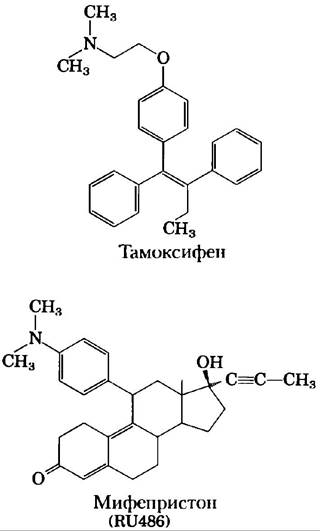
The Specificity of the steroid-receptor interaction is exploited in the Treatment of breast Cancer with the drug tamoxifen. In certain types of breast cancer, the division of cancer cells is driven by the constant presence of the hormone estrogen. Tamoxifen competes with estrogen for binding to the estrogen receptor, but the tamoxifen-receptor complex has little or no effect on gene expression. Tamoxifen is an estrogen antagonist and, when administered following surgery or during Chemotherapy for hormone-dependent breast cancer, slows or halts the growth of remaining cancer cells. Another steroid analogue, the drug mifepristone (RU486), is used to terminate early pregnancies. As an antagonist of the hormone progesterone, RU486 binds to the progesterone receptor and blocks the hormonal action required for the implantation of a fertilized egg in the Uterus. ■
Some steroid-mediated effects occur so rapidly that they are unlikely to result from changes in protein synthesis via the classical nuclear receptor mechanism of steroid hormone action. For example, estrogen-mediated vasodilation is known to be independent of gene transcription or protein synthesis, as the steroid action leads to a decrease in cAMP concentration. Such effects are likely achieved through an alternative signal Transduction mechanism.
Summary of Section 12.8 Regulation of Transcription by Steroid Hormones
■ Steroid hormones cross The Cell membrane and bind to specific receptor proteins.
■ The hormone-receptor complex binds to specific DNA sequences, known as hormone response elements, and interacts with other proteins to regulate the expression of adjacent genes.
■ Certain effects of steroid hormones are mediated through other, more rapid signaling pathways.
Last update: 06/08/2026
Editorial and Educational Adaptation: This material has been compiled based on the primary/original source text. The project team performed an editorial review, corrected technical inaccuracies, structured sections, and adapted the content for an educational format.
What was processed:
- elimination of formatting defects (OCR errors, structural breaks, corrupted characters);
- editorial organization of content;
- standardization of terminology in accordance with academic sources;
- verification of factual statements against the original source text.
All mentions of the author, publication year, and origin of the primary text have been preserved in accordance with the source.