BIOCHEMISTRY - Laboratory Practical - NAU 2015
MODULE II
ENZYMES AND METABOLIC PATHWAYS.
ENERGY METABOLISM
Laboratory Work 7
INVESTIGATING THE SPECIFICITY OF HYDROLYTIC ENZYMES
Objective: to demonstrate various types of Specificity in hydrolytic Enzymes.
Basic Theoretical Background
Enzymes are highly specific substances. They differ in the type of specificity. If an enzyme catalyzes The conversion of only a single substrate, it exhibits absolute specificity.
If an enzyme catalyzes the conversion of a group of substrates, its specificity is relative (or group). Such an enzyme is highly specific to the type of bond within the substrate molecule. Hydrolytic enzymes (Hydrolases) catalyze the Cleavage of covalent bonds in substrate molecules involving Water. Hydrolases can possess either absolute or relative (group) specificity. Most hydrolytic Enzymes of the human gastrointestinal tract exhibit group specificity. For example, proteases (proteinases or peptidases) catalyze the cleavage of peptide bonds in protein molecules, with Amino Acids being the final product of Hydrolysis. Glycosidases cleave glycosidic bonds, with CARBOHYDRATES as their substrate, which break down upon complete hydrolysis into simple carbohydrates—Monosaccharides. Esterases act on Lipids, whose constituent components are linked by ester bonds; the products of neutral lipid hydrolysis are glycerol and Higher Fatty acids. Nucleases (DNAases, RNAases) accelerate the hydrolysis of Nucleic Acids into NUCLEOTIDES.
Stereospecific enzymes are those that catalyze the conversion of only a specific stereoisomer of a substrate while having no effect on other stereoisomers.
Equipment: test tube rack, pipettes, water bath, dropper bottles, thermostat, gas burner.
7.1. Specificity of Amylase and Invertase Action
Materials and Reagents: saliva solution, 0.5% starch solution, 0.5% sucrose solution, 0.1% iodine solution in 0.2% potassium iodide solution, Fehling's reagent, and invertase preparation (see laboratory works 2 and 6).
Pour 3 ml of starch solution into each of two test tubes. Add 1 ml of saliva solution (amylase) to the first tube, and 1 ml of invertase preparation to the second tube, mix well, and place them in a thermostat (38 °C).
Pour 3 ml of sucrose solution into two other test tubes. Add 1 ml of invertase preparation to the first tube, and 1 ml of saliva solution to the second tube, and also place them in the thermostat (38 °C).
After 15 min, add five drops of iodine solution to the first two tubes containing starch and observe the coloration. In the tube with amylase, the blue color does not appear or subsequently disappears due to The breakdown of starch by amylase. In the second tube, the solution remains blue because invertase does not act on starch.
In the other two test tubes, enzyme activity is detected via a positive Fehling's test for reducing sugars. To do this, add 1 ml of Fehling's reagent to each tube and heat to boiling. Sucrose lacks reducing properties, whereas glucose—one of the products of sucrose hydrolysis—exhibits reducing properties due to the presence of an aldehyde group. Therefore, in the tube where sucrose was broken down into glucose and fructose under the action of invertase, a brick-red color is observed due to The formation of copper(I) oxide, whereas in the tube where sucrose remained intact, the Fehling's test is negative.
Record the results of the study in Table 7.1.
Table 7.1
Determination of α-Amylase and Invertase Specificity
Enzyme |
Substrate |
Reaction Conditions |
Reaction |
|
With Iodine |
Fehling's |
|||
Amylase |
Starch |
37 °С 15 min |
||
Amylase |
Sucrose |
|||
Invertase |
Starch |
37 °С 15 min |
||
Invertase |
Sucrose |
|||
7.2. Group Specificity of Invertase Action
Materials and Reagents: invertase preparation (see laboratory work 6), Fehling's reagent (see laboratory work 2), 1% raffinose solution, 1% sucrose solution.
Procedure
Pour 1 ml of invertase preparation into each of two test tubes. Invertase is specific to the fructose moiety of the disaccharide sucrose and the trisaccharide raffinose. Add 2 ml of sucrose solution to one tube, and 2 ml of raffinose solution to the second tube. Mix the Contents of the tubes and place them in a thermostat (38 °C) for 5–10 min. Under the action of the enzyme, the β-glycosidic bond closer to the fructose part of the molecule is cleaved. Then, add 3 ml of Fehling's reagent to each tube, mix thoroughly, and heat to boiling. The products of the Enzymatic hydrolysis of sucrose and raffinose give a positive reaction with Fehling's reagent.
A red precipitate of copper(I) oxide forms in both test tubes.
7.3. Action of Urease
Materials and Reagents: urea solution (5%), 1% alcoholic phenolphthalein solution, 0.01% crystalline urease solution or urease preparation (add 46 ml of distilled water and 2 ml of 0.1 M HCl to up to 8 g of soy flour or crushed and ground pumpkin seeds, mix, add a few drops of toluene, let stand for half a day, and filter).
Procedure
Pour 1 ml of urea solution into each of two test tubes and add five drops of phenolphthalein solution. Add 5 ml of the urease preparation or urease solution to one of them and mix. Add 5 ml of distilled water to the second test tube. Urease accelerates the breakdown of urea to form CO2 and NH3:
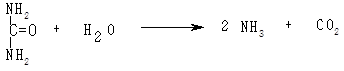
Ammonia is formed in the test tube with urease, which shifts the medium pH to alkaline. The action of urease is deduced from this shift in pH toward alkaline values.
In the presence of phenolphthalein, the solution turns pink. The color of the solution in the control test tube without urease remains unchanged.
7.4. Absolute Specificity of Urease Action
Materials and Reagents: urease preparation or 0.01% crystalline urease solution, 1% alcoholic phenolphthalein solution, 5% urea solution, 5% thiourea solution.
Procedure
Pour 5 ml of the preparation or urease solution into each of two test tubes and add five drops of phenolphthalein solution. Add 1 ml of urea solution to the first tube, and 1 ml of thiourea solution to the second. Leave both test tubes at room Temperature for 20 min. Minor changes in substrate Structure cause an enzyme with absolute specificity to have no effect on that substrate. Thus, urea is the substrate for urease, whereas thiourea, which differs from urea by the presence of a sulfur atom, is not cleaved by urease.
The contents of the test tube with urea turn pink due to the formation of ammonia during urea hydrolysis.
Thiourea is not cleaved by urease; therefore, no coloration appears in the second test tube.


Urea Thiourea
Processing of Experimental Data
Construct a table listing substrates that can be hydrolyzed by hydrolytic enzymes known to you. Highlight the types of specificity for these enzymes.
Selection/5.html">Control Questions and Tasks
1. Name the classes of enzymes. To which class do urease, amylase, and invertase belong?
2. Name the types of Enzyme Specificity. Give Examples.
3. What type of specificity is characteristic of most hydrolytic enzymes?
4. What do enzymes with group (relative) specificity act upon?
5. Write the reaction for starch hydrolysis. Which enzyme catalyzes it?
6. Why does the pH change during the action of urease?
References: [1; 4–7].
Last update: 06/08/2026
Editorial and Educational Adaptation: This material has been compiled based on the primary/original source text. The project team performed an editorial review, corrected technical inaccuracies, structured sections, and adapted the content for an educational format.
What was processed:
- elimination of formatting defects (OCR errors, structural breaks, corrupted characters);
- editorial organization of content;
- standardization of terminology in accordance with academic sources;
- verification of factual statements against the original source text.
All mentions of the author, publication year, and origin of the primary text have been preserved in accordance with the source.