Chemistry and Biology of Proteins - F. Haurowitz 1953
Internal Structure of Globular Proteins
Cyclic Structures in Proteins
Heating methyl or ethyl esters of Amino Acids yields cyclopeptides. The simplest ring obtained by this pathway is the diketopiperazine ring:
Class="center">
Diketopiperazines have also been obtained through partial Protein Hydrolysis. For instance, treating Fibroin with 70% sulfuric acid at room Temperature yielded glycylalanine anhydride and glycyltyrosine anhydride [59]. Although amino acids do not form anhydrides under these conditions, secondary formation of such cyclic structures cannot be entirely ruled out when Water content is low [60]. Assuming that diketopiperazine groupings actually existed within native Proteins in the aforementioned experiments, the question arises as to how they are linked within the protein macromolecule. Proteolytic Enzymes are unable to cleave diketopiperazine structures [61, 62]. This casts doubt on the hypothesis that diketopiperazine groups are present in native proteins, suggesting instead that they are secondary artifacts formed during protein hydrolysis1. The same applies to anhydrides obtained under harsher hydrolysis conditions, such as heating proteins in anhydrous glycerol at 130–150 °C [63]. It has been established that free Lysine amino groups in the protein molecule are altered during such Treatment, likely resulting in the coupling of these groups with the carboxyl groups of dicarboxylic amino acids [64, 65]. These Methods have been utilized to prepare cyclopeptides containing A large number of amino acid residues. For example, heating alanylglycylglycine methyl ester yielded cyclopeptides containing about 20 amino acid residues [66]. Some of these cyclopeptides, lacking terminal free amino and carboxyl groups, are cleaved by Endopeptidases—that is, proteolytic enzymes that act on internal peptide bonds [67]. Natural cyclopeptides of this type have been discovered in certain Bacterial toxins (see Chapter XV).
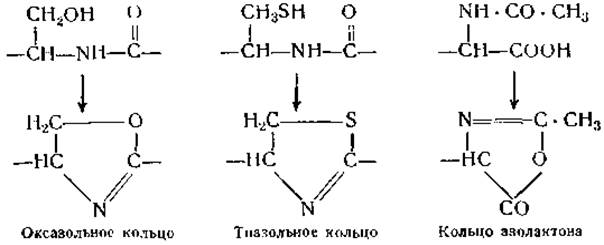
Cyclic anhydrides can form not only through the Condensation of amino and carboxyl groups, but also As a result of joining amino and carboxyl groups with hydroxyls or thiols, yielding oxazoline and thiazole moieties, as well as azlactones.
1 By asserting that the presence of diketopiperazine structures in native proteins has not been experimentally proven and that these groups likely form secondarily during protein hydrolysis, the author completely ignores the widely recognized and numerous studies by Academician N. D. Zelinsky and his coworkers (V. S. Sadikov, N. I. Gavrilov, et al.). Their work provides both experimental Evidence for the presence of these groupings in native proteins and data concerning their Cleavage by proteolytic enzymes. According to the diketopiperazine theory formulated by N. D. Zelinsky and V. S. Sadikov as early as 1923, cyclic groupings represent one of the fundamental structural units of the protein molecule, largely determining its most critical properties.
In subsequent research, N. I. Gavrilov and A. V. Koperina demonstrated that The amount of nitrogen incorporated into cyclic structures accounts for 8.4% to 27.6% of the total nitrogen content in various proteins. Specifically, this proportion is 21.6% in serum albumin, 27.6% in gelatin, and 8.4% in sturine (N. I. Gavrilov and A. V. Koperina, Journal of General Chemistry, 17, 335, 1947; N. I. Gavrilov, Abstracts of Papers at the Second Session of the Medical and biological Department of the USSR Academy of Medical Sciences, 4, 1949). These data were obtained by electroreducing the specified proteins under conditions that precluded the reduction of peptide bonds. Based on these findings, the ratio between the number of Amino Acids Forming cyclic groupings and those comprising peptide chains was also calculated. It was found that for every two amino acid molecules forming a cyclic diketopiperazine Structure, there are 4 amino acids in the peptide chains of gelatin, 5 in serum albumin, and 6 in sturine. N. D. Zelinsky and N. I. Gavrilov proposed that the most probable form of linkage between the cyclic diketopiperazine groupings and the peptide chains in the protein molecule is an amidine bond, formed by the free amino group of the peptide and the carbonyl group of the diketopiperazine.
According to the authors (N. D. Zelinsky, N. I. Gavrilov, L. N. Akimova, Journal of General Chemistry, 18, 960, 1948), a Glycine model of a protein micromolecule synthesized via this pathway—containing a single piperazine core and two tripeptide protein chains—exhibited amphoteric properties, yielded a biuret reaction typical of proteins, and was hydrolyzed by proteolytic enzymes from gastric and intestinal juices.
All the presented data thus indicate that the author of this book is entirely mistaken in claiming that there is no convincing evidence for the presence of cyclic groupings of the diketopiperazine type in native proteins, and in basing their concept of protein molecular structure solely on the notion of peptide chains linked to one another by various bonds. The entire issue certainly requires further investigation. This applies particularly to clarifying The Nature of the bonds between the cyclic groupings and the peptide chains. It is clear, however, that at present there are no grounds to dismiss the diketopiperazine theory or declare it baseless. — Ed. note.
The potential existence of such ring structures in proteins has been discussed repeatedly; however, no experimental evidence of their presence has been provided to date [68, 69]. The question regarding the possible existence of the —S ∙ CO— bond in proteins was resolved in the negative after it was found that reacting The sulfhydryl groups of native proteins with iodine does not lead to an increase in the number of acidic groups [70].
Subjecting proteins to the action of metallic sodium in amyl alcohol yields pyrrole bases and other heterocyclic compounds [71]. It has been suggested that these cyclic compounds form part of the native protein molecule. However, similar compounds are also produced by heating amino acids. For instance, Glutamic Acid and Glutamine are readily and almost quantitatively converted into pyrrole derivatives upon heating:

Acknowledging the presence of heterocyclic rings in the protein molecule would also be incompatible with data on the Optical Properties of Proteins (see Chapter VII).
Based on X-Ray Diffraction studies of crystalline proteins, it has been hypothesized that proteins contain trioxytriazine rings formed by the condensation of three enolized Peptides [72]:

This hypothesis, however, has been criticized by both specialists in protein X-ray crystallography and physical chemists [73]. It was rejected on the grounds that proteins lack a sufficient number of hydroxyl groups to form such compounds [74].
It was also established that the crystal lattice dimensions of trioxytriazine ring polymers are such that they can accommodate only glycine and Alanine, leaving no room for the side chains of Other Amino Acids [75]. Finally, it was determined that the assumption of trioxytriazine rings in proteins is energetically unfavorable [76]. Investigations of numerous compounds containing —СО ∙ NH— groups also demonstrated that The conversion of these groups into —C(OH)=N— groups is coupled with The formation of aromatic rings [77]. The energy released during the formation of these rings is utilized to establish the enolized lactim bond [77].
The presence of other ring structures in proteins is likewise unlikely. If proteins contained cyclic groupings susceptible to cleavage by hydrolytic agents, hydrolysis in the presence of heavy water should lead to the formation of compounds containing tightly bound deuterium. This, however, was not observed during the tryptic hydrolysis of casein in the presence of heavy water [78]1. Thus, there is no reason to believe that proteins contain any cyclic groupings other than those integrated into aromatic and heterocyclic amino acids.
Last update: 06/08/2026
Editorial and Educational Adaptation: This material has been compiled based on the primary/original source text. The project team performed an editorial review, corrected technical inaccuracies, structured sections, and adapted the content for an educational format.
What was processed:
- elimination of formatting defects (OCR errors, structural breaks, corrupted characters);
- editorial organization of content;
- standardization of terminology in accordance with academic sources;
- verification of factual statements against the original source text.
All mentions of the author, publication year, and origin of the primary text have been preserved in accordance with the source.