ECOLOGICAL BIOCHEMISTRY - Study Guide - V. M. Isaienko 2005
Chapter 2. ECOLOGICAL AND BIOCHEMICAL INTERACTIONS OF PROKARYOTES, MICROSCOPIC FUNGI, AND ALGAE WITH HIGHER PLANTS AND ANIMALS
2.3. Interaction of Lower Fungi and Yeasts
Many lower plants are characterized by a complex life cycle and a sexual process involving the fusion of Cells residing in an aquatic environment.
Studies on the vital activity of lower plants and Fungi have established that their ontogeny, sexual reproduction, and population density regulation occur with the participation of chemoregulators and authors [attractants].
For instance, in the ontogeny of Dictyostelium, There is a transition from an amoeboid stage to a multicellular pseudoplasmodium stage, during which cells aggregate into a single pseudoplasmodium. The regulation of this process in Dictyostelium discoideum involves the chemoattractant cAMP, which is secreted by cells into the external environment. Cell/30.html">The Plasma Membrane of these cells features a specific cAMP receptor that responds at cAMP concentrations as low as 10-7 — 10-6 mol/L. Furthermore, Folic acid and pterin play an important role in the chemotaxis of Dictyostelium. It has been established that folic acid and cAMP induce similar effects in Dictyostelium: chemotaxis, synthesis of cGMP and cAMP, and cAMP secretion.
Another substance essential for the normal ontogeny of Dictyostelium discoideum has been identified, namely the differentiation-inducing factor (DIF). Structurally, it is 1-(3,5-dichloro-2,6-dihydroxy-4-methoxyphenyl)-1-hexanone. This substance acts as an extracellular chemoregulator that transmits signals from Cell to Cell.
The fusion of two haploid cells is of substantial importance in The life cycle of Algae and fungi. Sex pheromones, also referred to as mating pheromones or attractants, play a crucial role in drawing these cells toward each other.
It has been established that female Gametes of the fungus Allomyces (Class Chytridiomycetes) secrete the sex pheromone sireninin to attract male gametes. Reproduction in the fungus Achlya ambisexualis involves two steroidal pheromones: antheridiol, which is produced and secreted by female sex Organs and induces The formation of male sex organs, and oogyniol, which is produced and secreted by male sex organs and stimulates the growth and differentiation of female sex organs.
In mucoraceous fungi (Mucor mucedo and others), methyl-4-dihydrotrisporates, methyltrisporates, trisporol, and trisporates have been identified as pheromones. The structural formulas of certain lower plant pheromones are shown in Fig. 2.1.
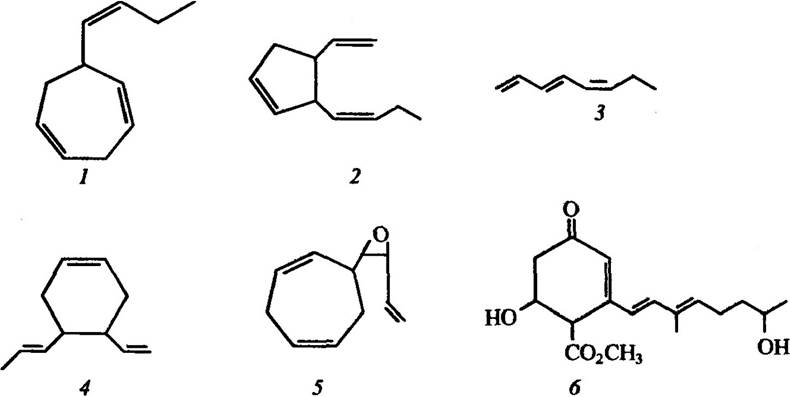
Fig. 2.1. Structure of pheromones:
1 — ectocarpene; 2 — multifidene; 3 — fucoserratene; 4 — aucantene; 5 — lamoxirene; 6 — methyltrisporate
In the Yeast Rhodosporidium toruloides, the fusion of two cells is mediated by an S-farnesyl undecapeptide. The presence of a pheromone-like factor has also been established in the yeast Schizosaccharomyces pombe.
Pheromones that attract spermatozoa to female gametes exist in many microphytic algae. For instance, mature female gametes of several kelp species (order Laminariales) release pheromones that facilitate the release of spermatozoa from antheridia (specialized reproductive cells). One such substance is lamoxirene (Fig. 2.1), which has also been found in the brown alga Desmarestia aculeata. Pheromones also exist in other algae. Thus, in the green alga Volvox carteri, the differentiation of reproductive cells (gonidia) is induced by pheromones produced by the male sex organs.
Cultivation studies of certain phytoplanktonic algae have revealed that substances inhibiting algal culture growth accumulate in the culture medium. These substances have been termed phytoplankton autoinhibitors. Their action can be viewed as an example of population self-regulation, preventing uncontrolled growth under conditions of limited environmental food resources.
In addition to autoinhibition, planktonic algae have been found to exhibit an inhibitory effect wherein substances secreted by cells of one algal species suppress the growth of cells of another species. For example, studies on the interactions among algae of the genera Chlamydomonas, Haematococcus, Scenedesmus, Anacystis, and Chlorella have shown that one or both species are inhibited in all combinations. Anacystis nidulans is particularly aggressive, partially or completely halting the growth of all other species.
It has been found that A number of filamentous nitrogen-fixing cyanobacteria (Anabaena doliolum, Fischerella muscicola, etc.) are capable of secreting bacteriocins and Other Antibiotics that exert a deleterious effect on related strains.
Substances (5-methylthio-1,2,3-trithiane and 4-methylthio-1,2-dithiolane) that suppress the Photosynthesis of epiphytic microscopic algae have been identified in food additives.
Certain soil microalgae inhibit the GROWTH AND REPRODUCTION of fungi. For instance, the culture liquid of the alga Scenedesmus obliquus destroys Verticillium dahliae, the fungal pathogen responsible for cotton wilt.
Mycoparasitic fungi (which parasitize other fungi) are capable of producing lytic Enzymes (chitinase, proteinases, glucanases, etc.) that they use to break down The Cell walls of many other fungi. Parasitic fungi can utilize substances released by other fungi as signals to induce the growth of their own hyphae. Conversely, a parasitic fungus can produce substances that stimulate the hyphal growth of its prospective fungal host. Such a capability is characteristic, for example, of Calcarisporium parasiticum and Gonatobotrys simplex.
Fungi defending themselves against mycoparasites are capable of producing repellents, antibiotics, and other substances exhibiting antifungal activity. For instance, the fungus Leucopaxillus cerealis secretes an antibiotic that prevents the colonization of pine roots by other fungi, including pathogenic microorganisms.
Last update: 06/08/2026
Editorial and Educational Adaptation: This material has been compiled based on the primary/original source text. The project team performed an editorial review, corrected technical inaccuracies, structured sections, and adapted the content for an educational format.
What was processed:
- elimination of formatting defects (OCR errors, structural breaks, corrupted characters);
- editorial organization of content;
- standardization of terminology in accordance with academic sources;
- verification of factual statements against the original source text.
All mentions of the author, publication year, and origin of the primary text have been preserved in accordance with the source.