Biochemistry and Molecular Biology - Belyasova N.A. 2002
Fundamentals of Genetic Engineering
Construction and Analysis of Genomic Libraries
Construction of Genomic Libraries and Gene Identification
In most cases, studying the Structure and properties of a specific Gene in an Organism requires a preliminary step: constructing a gene bank, or genomic library (clone library). A gene bank is a collection of bacterial clones or phage particles containing at least one copy of each sequence in the organism's genome. The required number of clones in a library is determined by The ratio of the Genome Size to the size of the cloned DNA fragments. For example, if the haploid genome of Saccharomyces cerevisiae contains 1.4-107 bp, and the capacity of the cloning vector used is 15-103 bp, the entire Yeast genome can be represented by 1.4-107 /15-103 ≈ 1-103 recombinant clones. In practice, however, creating such a library requires 4,000–5,000 clones to ensure a 99% probability of finding the target gene or genomic segment. This redundancy occurs because the ligation of individual foreign DNA fragments with vectors is a random process, meaning some genomic regions may be represented multiple times in a small sample, while others may not appear at all. A complete Human Genome library comprises approximately 900,000 clones.
The two most frequently used types of clone libraries are Genomic Libraries and cDNA libraries. Genomic libraries are collections of an organism's METABOLISM/27.html">Genes and DNA sequences. They are typically generated using vectors constructed from bacteriophage λ or cosmids. These vectors have a high carrying capacity, which helps reduce the total number of clones needed in the library.
A cDNA library ("complementary" DNA, see Section 1) consists of a set of clones containing double-stranded DNA copies of all cellular mRNAs. Plasmid or phage vectors (based on phage λ) are most commonly used to construct these libraries.
However, both types of libraries can be compared to an unorganized collection of books, which only becomes a library once a catalog is compiled to systematically organize the entire collection. In other words, the next essential step is the identification of genes within the genomic library. This task can be accomplished in several ways: by analyzing the insert polynucleotide sequence itself or by examining its expression products in host Cells. In the first approach, the screening strategy for recombinant clones relies on probes complementary to specific Regions of the genes or cDNA. In the second approach, screening is based on phenotypic changes in cells that have taken up a particular DNA fragment due to the newly synthesized protein, or simply on The properties of the protein itself. Let us examine some of the Methods used for Gene Identification in libraries.
Gene identification via cellular phenotype changes. This method is most frequently used in "self-cloning," i.e., transferring genes on multicopy Plasmids back into the same microorganism from whose genome they were isolated. For example, suppose one needs to find E. coli clones in a library that contain genes responsible for Alanine Biosynthesis. This requires transferring vectors carrying the cloned DNA fragments into alanine-dependent mutant strains of E. coli. Selection of progeny should be performed on a synthetic medium lacking alanine, where colony formation is restricted to Bacteria that have taken up the gene complementing the respective mutation. This Procedure is known as a "complementation test" and requires strains with well-characterized Mutations in the target genes.
Immunological screening of gene products. If DNA fragments were cloned into expression vectors that ensure the Transcription and Translation of foreign genes, target clones can be identified using immunological tests. To do this, bacterial colonies grown on a solid medium (replica plate) are lysed using chloroform vapors, and their contents are transferred via replica plating onto a polyvinyl sheet coated with Antibodies against the target protein. The sheet is washed under mild conditions so that only the antibody-bound Proteins remain. Next, the sheet is treated with iodine isotope-labeled (125I) antibodies directed against the same protein. As a result, a complex forms on the plate consisting of the antigen (the target protein) and two antibody molecules, one of which carries a radioactive label. The Location of this complex can be detected by autoradiography. By correlating THE POSITION OF the labeled complex with the positions of the colonies on the master plate, researchers can identify the clone containing the gene responsible for synthesizing the target protein.
Library screening using probes. Section 1 of this chapter describes the procedure for obtaining cDNA. To search for a desired cDNA within a library, the following approach is used. An isolated colony containing a vector with an insert is selected and incubated to produce a large quantity of a homogeneous culture. Plasmid DNA is isolated from the cells and denatured to separate the strands. The denatured DNA is then immobilized on a nitrocellulose filter. A mixture of mRNAs extracted from the same cells whose genes are being targeted is passed through the filter. Consequently, only those mRNAs that are complementary to the homogeneous cDNA are retained on the filter. The bound mRNA is eluted from the filter and introduced into a Cell-free translation system, where the corresponding protein is synthesized. This protein can be identified immunologically or by chromatographic analysis. If successful, the researcher obtains an identified clone whose cells contain the cDNA, which then serves as a probe to search for the individual gene or mRNA.
A cDNA probe can be used for the rapid and highly efficient screening of any clone library. The scheme for such an experiment is shown in Fig. 20.8. Isolated microorganism colonies or viral plaques growing on a lawn of sensitive cells are transferred by replica plating onto a nitrocellulose filter placed On the surface of a solid medium in a Petri dish. The cells are lysed (typically via alkaline lysis using NaOH) and their DNA is denatured. Under specific conditions (80°C, vacuum), the DNA binds firmly to the nitrocellulose filter. The filter is then incubated in a solution containing a denatured 32P-labeled probe. Under these conditions, complementary DNA sequences form duplexes. Autoradiographic analysis reveals a dark spot at the location on the filter where the DNA complementary to the probe is situated. Researchers then match this zone back to the corresponding colony (or plaque) on the master plate.
Instead of cDNA, mRNA or chemically synthesized oligonucleotide probes can be used to screen gene libraries. The latter approach requires prior knowledge of either The nucleotide sequence of the gene or the Amino Acid Sequence of the target protein. Based on The amino acid sequence of a polypeptide segment 5–6 residues long, all possible mRNA sequences capable of encoding that region are predicted. Because of the degeneracy of The Genetic Code, there are usually many such variants. The corresponding set of complementary oligonucleotides is then synthesized in vitro. These NUCLEOTIDES can be used directly to screen a cDNA pool or a genomic library. Alternatively, these oligonucleotides can replace oligothymidylates as primers for Reverse Transcriptase to synthesize cDNA substantially enriched in the target sequences. In this case, the reverse transcription process will preferentially copy those mRNAs that contain ribonucleotide sequences complementary to the primers.
Class="center">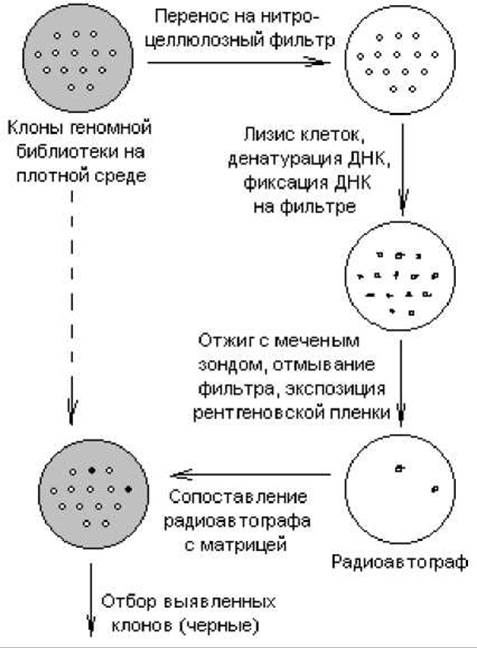
Fig. 20.8. Scheme for screening a clone library using probes
Last update: 06/08/2026
Editorial and Educational Adaptation: This material has been compiled based on the primary/original source text. The project team performed an editorial review, corrected technical inaccuracies, structured sections, and adapted the content for an educational format.
What was processed:
- elimination of formatting defects (OCR errors, structural breaks, corrupted characters);
- editorial organization of content;
- standardization of terminology in accordance with academic sources;
- verification of factual statements against the original source text.
All mentions of the author, publication year, and origin of the primary text have been preserved in accordance with the source.