Practical Protein Chemistry - A. Darbre 1989
Determination of the composition of protein oligomers. Preparation of monomers and polypeptide chains
Introduction
R. C. MARSHALL, A. S. INGLIS (Division of Protein Chemistry, CSIRO, 343 Royal Parade, Parkville, 3052 Victoria, Australia)
This chapter focuses primarily on practical Methods for determining the composition of protein oligomers, identifying and separating monomers, and isolating individual polypeptide chains. As is well known, oligomeric protein molecules consist of non-covalently linked monomers (subunits), which in turn may comprise several polypeptide chains joined by disulfide bridges (or Other types of covalent bonds). For example, a tetramer composed of two pairs of different monomers, one of which contains two polypeptide chains, can be schematically represented as follows:
Class="center">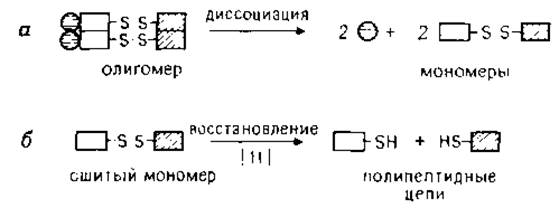
The methods described in this chapter can be used to estimate the stoichiometric composition of oligomers. In turn, data on the relative amounts of monomers in an oligomer, their molecular weight, and their properties provide useful preliminary insights into the Tertiary and Quaternary structures of the oligomer. However, discussing the principles (and Symmetry) of the Structural Organization of complex oligomers is beyond The Scope of this chapter [131]. Readers seeking additional information can consult specialized reviews dedicated to protein quaternary Structure [93], Protein-Protein Interactions [62], and methods for determining subunit structure [173].
Since the Identification of monomers and individual oligomer fragments is an integral part of structural analysis, some overlap between the material presented here and other chapters is entirely possible. The experimental methods described in this chapter are recommended to the reader based on the personal experience of the authors and their colleagues, taking into account their cost-effectiveness and high reproducibility. Technically demanding methods, such as mass spectrometry, ultracentrifugation, and X-ray crystallography, are covered in Chapters 19 and 20. Additional information can also be found in specialized reviews [4, 88, 93, 177].
Methods for the isolation and identification of monomers provide information on the Molecular Weight of the oligomer and its subunits, their number, and their properties, while also yielding preparations suitable for Primary Structure determination. When protein crystals can be obtained, studying the primary structure is conveniently carried out in parallel using sequencing and physical methods (e.g., X-ray crystallography), as cross-referencing the resulting data significantly accelerates the analysis [158]. However, such opportunities are rare. Often, obtaining sufficiently pure protein or subunit preparations suitable for Amino acid analysis is one of the main challenges, because the target protein may be present in only minor quantities within a complex mixture of accompanying Proteins and degradation products, or the starting mixture may contain proteins with very similar properties. If a protein is poorly soluble and requires harsher solubilization conditions, heterogeneous preparations may arise even at the initial stage of isolation. This heterogeneity is likely caused by changes in net charge resulting from the deamidation of asparagine and glutamine amide groups, carbamylation of the $\varepsilon$-amino groups of certain Lysine residues by cyanate ions present in urea solutions [38], or nonspecific modification of Methionine and Histidine residues during Cysteine alkylation.
Heterogeneity in molecular weight can result from the Cleavage of labile peptide bonds—for example, the acid-labile Asp-Pro bond in 80% formic acid [100]. An indication of such Hydrolysis is the detection of an N-terminal Proline residue. An important prerequisite for obtaining a homogeneous protein is the absence of protease contaminants in the preparation, as even trace amounts can induce Limited proteolysis at specific peptide bonds [91].
Blocking of the $\alpha$-amino group of the N-terminal amino acid residue can occur relatively easily, rendering sequencing impossible. The most common causes of such blocking are the cyclization of an N-terminal glutamine residue, carbamylation of $\alpha$-amino groups in urea solutions, and the presence of trace aldehydes in the Reagents [54].
These complications can be avoided by strictly adhering to reaction conditions and following the recommended experimental Procedures.
Last update: 06/08/2026
Editorial and Educational Adaptation: This material has been compiled based on the primary/original source text. The project team performed an editorial review, corrected technical inaccuracies, structured sections, and adapted the content for an educational format.
What was processed:
- elimination of formatting defects (OCR errors, structural breaks, corrupted characters);
- editorial organization of content;
- standardization of terminology in accordance with academic sources;
- verification of factual statements against the original source text.
All mentions of the author, publication year, and origin of the primary text have been preserved in accordance with the source.