Practical Protein Chemistry - A. Darbre 1989
Analytical Methods
Gas-Liquid Chromatography of Amino Acids
Amino Acids can be converted into volatile derivatives and subsequently analyzed by Gas-Liquid Chromatography (GLC). A single-step modification method, trimethylsilylation, was developed for the Qualitative and quantitative analysis of all protein amino acids [119, 121]. A major drawback of this method is that Certain amino acids yield multiple peaks; however, it successfully resolves Asp and Glu in the presence of Asn and Gln.
The most successful variations of the method comprise two stages:
1) Esterification of the carboxyl groups and 2) acylation of other reactive groups (amino, hydroxyl, sulfhydryl, guanidino). Table 8.2 lists the Amino Acid Derivatives that have been shown to provide optimal results for GLC Separation.
A detailed Structure/133.html">Discussion of Amino acid analysis by GLC can be found in several excellent reviews [28, 30, 170, 229, 395] and a dedicated monograph [422].
While mastering this technique yields satisfactory qualitative results with relative ease, achieving accurate quantitative assessment requires greater persistence. Various complications may arise, particularly in the determination of Histidine, Arginine, and cystine, which are prone to degradation on certain stationary phases [90, 123]. Quantitative investigations have been most extensively pursued by Gehrke and coworkers using N-butyl trifluoroacetyl amino acid esters, as well as by MacKenzie and Tenaschuk, who studied isobutyl heptafluorobutyryl amino acid esters. The synthesis Procedures for the latter compounds, utilized by the author, are outlined below.
Class="center">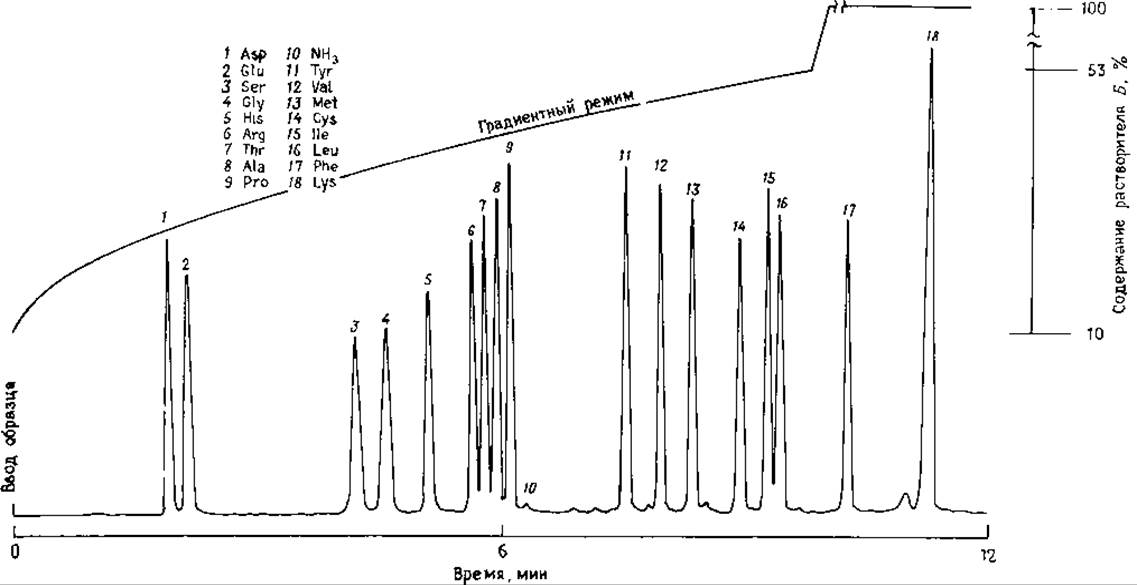
FIG. 8.8. Pico-Tag™ analysis of an amino acid mixture (250 pmol, Pierce). Conditions: Pico-Tag™ Column (Waters), 38°C, detection at 254 nm, scale 0.1 AUFS. Solvent A: 6% acetonitrile + 94% 0.14 M sodium acetate + 3.6 mM triethylamine (pH 6.4). Solvent B: 60% acetonitrile in Water. Flow rate 1 mL/min. Gradient: 0–46% B, 10 min, wash with 100% B. (Courtesy of Waters Associates.)

FIG. 8.9. Pico-Tag™ analysis of 1 pmol of amino acids (Pierce H). Scale 0.005 AUFS, other conditions as in Fig. 8.8. (Courtesy of Waters Associates.)
Table 8.2. Selected amino acid derivatives for gas-liquid chromatography
|
Ester |
Acyl group |
Reference |
|
Methyl |
Trifluoroacetyl |
91, 73 |
|
n-Propyl |
» |
117, 118 |
|
Heptafluorobutyryl |
198, 239 |
|
|
n-Butyl |
Trifluoroacetyl |
315, 122, 422 |
|
Isobutyl |
Heptafluorobutyryl |
231,232, 233, 289,339, 96, 260, 57, 58, 261 |
|
Isoamyl |
418, 109 |
Most researchers have employed the Fischer method for carboxyl group esterification, using treatments with varying concentrations of HCl. Several modifications aimed at improving product yields have been proposed. Although a direct, single-step esterification Procedure is commonly used, transesterification Methods [120, 352] were also developed, wherein amino acid methyl esters were converted into n-butyl esters to circumvent difficulties arising from the poor solubility of certain amino acids in higher alcohols. Nevertheless, researchers subsequently returned to the original single-step approach [316].
Last update: 06/08/2026
Editorial and Educational Adaptation: This material has been compiled based on the primary/original source text. The project team performed an editorial review, corrected technical inaccuracies, structured sections, and adapted the content for an educational format.
What was processed:
- elimination of formatting defects (OCR errors, structural breaks, corrupted characters);
- editorial organization of content;
- standardization of terminology in accordance with academic sources;
- verification of factual statements against the original source text.
All mentions of the author, publication year, and origin of the primary text have been preserved in accordance with the source.