Biochemistry and Molecular Biology - Belyasova N.A. 2002
Structure and Functions of Cellular Components
Cellular Polysaccharides
Structure of Plant Cell Walls
Plant Cell Walls possess extraordinary mechanical strength and undergo continuous structural and compositional remodeling during growth. Their primary structural components are Polysaccharides, with Cellulose being the most abundant, which largely dictates the overall architecture of the wall.
Cellulose. This homopolysaccharide is the most widespread carbohydrate on Earth (plants produce up to 1011 tons of cellulose annually). Cellulose monomers are glucose residues linked into long chains (comprising up to 10,000 glucose residues each) via β(1→4)-glycosidic bonds (Fig. 5.3). In such molecules, complete free rotation around the 1C—O and O—4C bonds is restricted, forcing the polymer into a conformation favorable for intermolecular hydrogen bonding when the chains are arranged in an antiparallel orientation. As a result, cellulose molecules aggregate into microfibrils approximately 10 to 25 nm in thickness. These microfibrils intertwine to form fine strands, which can further twist around one another like the strands of a rope to yield macrofibrils. Each macrofibril is roughly 0.5 µm thick and can reach 6–8 µm in length. The tensile strength of macrofibrils is comparable to that of steel wire of equivalent thickness. Furthermore, individual segments of the microfibrils exhibit a highly ordered, crystalline Structure that imparts crystalline properties to The Cell wall. Thus, the intricate Organization and high degree of crystallinity of cellulose within cell walls are no coincidence, as this polymer serves vital protective and structural roles in plants. In this crystalline state, these polysaccharides are inaccessible to endogenous Enzymes, meaning cellulose cannot be utilized by the plant as an energy reserve. Only a select few organisms (certain Bacteria, Fungi, Protozoa, and rare animals) possess the enzymatic machinery required to break down cellulose.
Cellulose micro- and macrofibrils within The plant cell wall are embedded in a matrix, which also consists primarily of polysaccharides and evolves in composition during plant growth. At early developmental stages, the matrix is composed predominantly of pectic substances, whereas xylans and various neutral polysaccharides (collectively termed "hemicellulose") appear later. Pectins are polymers of a-galacturonic acid in which certain hydrogen atoms are replaced by methyl groups (-СН3) (Fig. 5.3). Xylans are polymers composed of xylose units (Fig. 5.3).
At later Selection/3.html">Stages of development, concomitant with cell wall lignification, the Cells deposit Lignin—a chemically stable polymer rich in aromatic rings. Additionally, plant Cell walls contain minor amounts of Glycoproteins, various insoluble lipid polymers, and Waxes.
Class="center">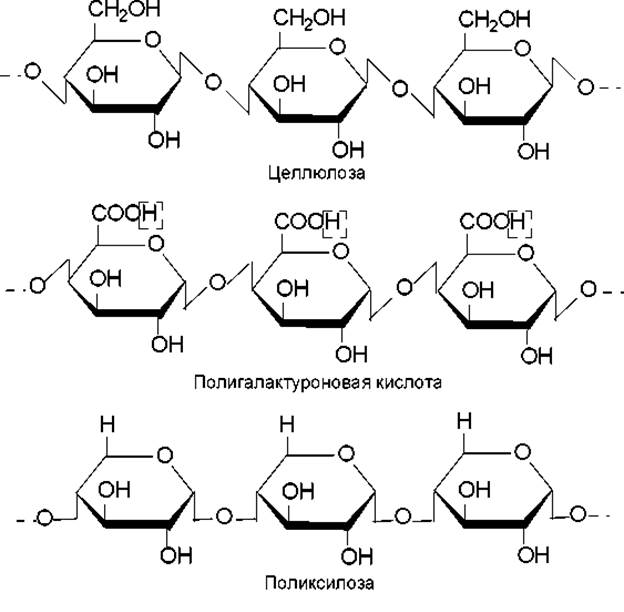
Fig. 5.3. Structure of polysaccharide fragments from plant cell walls. The dashed boxes enclose hydrogen atoms in pectins that can be substituted with methyl groups.
The Cell walls of certain plants contain uncommon polysaccharides with unusual architectures. For instance, the walls and intercellular matrix of marine red Algae contain Agar, a complex heteropolysaccharide that is a mixture of sulfated polysaccharides—agarose and agaropectin. Agarose is composed of alternating D-galactose and 3,6-anhydro-L-galactose residues linked alternately by ß(1→4) and a(1→3) bonds. Agaropectin possesses a more complex structure, consisting of D-galactose, 3,6-anhydrogalactose, uronic acids, and sulfate groups. Agar serves as the most widely used solidifying agent for solid growth media, which are indispensable in microbiology, as well as a gelling agent in the food industry. Notably, the vast majority of microorganisms are incapable of degrading agar, which constitutes one of its primary advantages over gelatin as a solidifying agent for nutrient media. Agarose is also extensively utilized in biochemical research: in aqueous environments, it forms gels with large pores whose dimensions are governed by the agarose concentration. Agarose gels are routinely employed for the fractionation of Proteins and Nucleic Acids, as well as for cell immobilization.
Last update: 06/08/2026
Editorial and Educational Adaptation: This material has been compiled based on the primary/original source text. The project team performed an editorial review, corrected technical inaccuracies, structured sections, and adapted the content for an educational format.
What was processed:
- elimination of formatting defects (OCR errors, structural breaks, corrupted characters);
- editorial organization of content;
- standardization of terminology in accordance with academic sources;
- verification of factual statements against the original source text.
All mentions of the author, publication year, and origin of the primary text have been preserved in accordance with the source.