Chordate Zoology - Textbook - Y. V. Tsaryk - 2013
Chapter 5. SUPERCLASS TETRAPODS (LAND VERTEBRATES) TETRAPODA, seu QUADRIPEDA.
ANAMNIOTES (ANAMNIA) AND AMNIOTES (AMNIOTA)
5.2. CLASS REPTILES, OR REPTILIANS, REPTILIA
5.2.2. Origin and Evolution of Reptiles
At the end of the Paleozoic, conditions emerged that favored The Development of terrestrial animals, particularly reptiles. The divergence of reptiles from their amphibian ancestors began earlier, possibly during the Middle Carboniferous, when forms adapted to terrestrial life (though still tied to humid biotopes and Water bodies) branched off from primitive embolomerous stegocephalians—anthracosaurs similar to Diplovertebron (Fig. 5.30). They fed on small aquatic and terrestrial invertebrates, were highly mobile, and possessed a slightly larger Brain. It is possible that the keratinization of their integument had already begun.
Class="center">
Fig. 5.30. The amphibian Diplovertebron, close to the seymouriamorph group
In the Middle Carboniferous, a new Lineage arose from similar forms—the seymouriamorphs (Seymouriamorpha). Their remains have been found in the Upper Carboniferous to Lower Permian deposits. They represent a transitional stage between amphibians and reptiles; some paleontologists classify them as amphibians. The vertebrae of these animals provided great flexibility and strength to the spine; the Differentiation of the first two cervical vertebrae into the atlas and axis began to take shape. For terrestrial animals, this offered significant advantages in spatial orientation, capturing active prey, and defense against predators. The Skeleton of the limbs and their girdles was fully ossified. The Skull possessed an occipital condyle (Fig. 5.31).
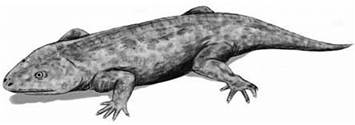
Fig. 5.31. Seymouria
It remains unclear when reproduction and egg development in the aerial environment first arose. It is believed to have occurred during the Carboniferous, during The Emergence of cotylosaurs (Cotylosauria). Their skull roof was solid and consisted of bones
characteristic of modern reptiles. The atlas and axis were formed. In some forms, the limbs lifted the body off the ground. There were small, lizard-like forms that fed on various vertebrates, as well as large (up to 3 m long) herbivores. Some cotylosaurs led a semi-aquatic lifestyle, while others may have become truly terrestrial inhabitants.
The warm and humid climate of the Carboniferous favored the development of amphibians. At the end of the Carboniferous and the beginning of the Permian, intense mountain building (the uplift of the Urals, Carpathians, Caucasus, and mountains in Asia and America—the Hercynian orogeny) was accompanied by topographic fragmentation, increased zonal contrasts (cooling in high latitudes), and a reduction in the area of humid biotopes. This favored the establishment of terrestrial vertebrates.
Cotylosaurs flourished during the Permian and went extinct as early as the Middle Triassic, possibly due to competition from various progressive groups of reptiles that had branched off from them. In the Permian, turtles (Chelonia) also diverged from cotylosaurs.
In the Upper Carboniferous, two subclasses of reptiles that transitioned to an aquatic lifestyle arose from cotylosaurs. Specifically, these included the order of mesosaurs, which comprised small, crocodile-like animals with long, slender Teeth (Fig. 5.32). Mesosaurs lived in water bodies, likely fed on fish, and could venture onto land. The order of ichthyosaurs appeared in the Triassic; remains of their representatives are found in Upper Cretaceous deposits. In the seas of the Mesozoic Era, they occupied the niche of modern cetaceans and resembled fish or dolphins in appearance (fusiform body, elongated jaws armed with numerous teeth, a large bilobed tail, and paired limbs modified into flippers). Their body length ranged from 1 to 14 m. They fed on aquatic invertebrates and fish, with large ichthyosaurs preying on smaller ones.

Fig. 5.32. Evolution of reptiles: extinct Representatives of the main groups (not to scale)
In the Permian, a major lineage of diapsid reptiles branched off from cotylosaurs, characterized by The formation of two temporal fenestrae in the skull. This group later split into two subclasses: lepidosaurs and archosaurs. The rhynchocephalians (Rhynchocephalia) also arose at that time. They possessed large temporal fenestrae, a small beak at the tip of the upper jaws, and uncinate processes on the Ribs. Rhynchocephalians went extinct at the end of the Jurassic, but tuataras have survived to the present day. Squamates (Squamata) became numerous and diverse during the Cretaceous. At the end of this period, snakes evolved from lizards. The heyday of squamates occurred in the Cenozoic Era, although even today they comprise the majority of reptiles.
The subclass Archosauria was the most diverse in form and ecological specialization during the Mesozoic Era. Archosaurs inhabited land, water bodies, and conquered the air. The ancestral group of archosaurs was the thecodonts, Thecodontia (or pseudosuchians), which diverged from eosuchians, possibly in the Late Permian, and flourished in the Triassic. They resembled lizards and ranged in length from 15 cm to 3–5 m. Most of them led a terrestrial lifestyle, with hind limbs longer than their forelimbs. The remaining thecodonts transitioned to a semi-aquatic lifestyle; crocodiles (Crocodylia) arose from them at the end of the Triassic.
In the Middle Triassic, flying reptiles, or pterosaurs (Pterosauria), evolved from thecodonts; by the Early Jurassic, specialized forms appeared, ranging in size from a sparrow to giants with a wingspan of up to 7–8 m. Their resemblance to birds was due to a broad Sternum with a keel, pneumatic bones, fused skull bones, and large eyes. Some species possessed teeth, while in others they were reduced, with the jaws covered by a horny sheath (beak).
In the Late Triassic, two groups of dinosaurs diverged from carnivorous pseudosuchians that moved primarily on their hind limbs: the saurischian (Saurischia) and ornithischian (Ornithischia) dinosaurs. These groups developed in parallel; during the Jurassic and Cretaceous periods, they produced an extraordinary diversity of species ranging in size from a rabbit to giants weighing 30–50 tons. They inhabited land and coastal zones of water bodies. They went extinct at the end of the Cretaceous. Most saurischians were predators and reached large sizes (up to 10–15 m). Their jaws were armed with large teeth, and they had strong claws on the toes of their hind limbs. Some saurischians were herbivorous and moved on all four limbs. These included the largest terrestrial reptiles—diplodocids (Diplodocus). They had a long tail, a long, flexible neck with a small HEAD; their body length reached 30 m, and their weight was 20–25 tons.
Ornithischian dinosaurs were likely herbivorous. Some of them moved on their hind limbs, with shortened forelimbs. This group also included giants measuring 10–15 m in length (iguanodons, Iguanodon).
Another lineage of reptiles is the subclass of mammal-like reptiles, or synapsids (Theromorpha, seu Synapsida). They diverged from primitive Carboniferous cotylosaurs, inhabited humid biotopes, and retained many amphibian features (gland-rich Skin, limb Structure, etc.). In the Upper Carboniferous and Permian, forms emerged that were grouped into the order of pelycosaurs (Pelycosauria). They possessed amphicoelous vertebrae, a skull with a single temporal fenestra and a single occipital condyle, teeth on the palatine bones, and large abdominal ribs (gastralia). Externally, they resembled lizards with a body length of up to 1 m, though some species reached 3–4 m. They went extinct at the end of the Permian. Earlier, the therapsids (Therapsida), or mammal-toothed reptiles, had branched off from them.
Thus, during the adaptive radiation at the end of the Permian and the beginning of the Triassic, a diverse reptilian fauna existed, comprising 13–15 orders. Throughout the Mesozoic (about 150 million years ago), they held a dominant position in aquatic and terrestrial biotopes.
At the end of the Cretaceous period, a new and powerful cycle of mountain building (the Alpine orogeny) began on Earth, accompanied by significant landscape transformations, the redistribution of seas and land, a growing overall aridity of the climate, and sharper seasonal and zonal contrasts. Vegetation shifted accordingly: the dominance of cycads and conifers gave way to angiosperms, whose fruits and seeds offered a higher nutritional value. Such changes inevitably impacted the animal kingdom, especially since two new classes of warm-blooded vertebrates—birds and mammals—had already emerged by this time. The reptiles that survived into this era could not adapt to the altered living conditions; an active role in their extinction was played by increasing competition from smaller yet more active birds and mammals. Representatives of these classes possessed thermoregulatory capabilities, high metabolic rates, and more complex behavior, which led to a surge in their population and ecological significance. They quickly and efficiently adapted to transformed landscapes, rapidly colonized new habitats, and intensively exploited novel food sources.
The modern Cenozoic era began, in which birds and mammals took center stage, while among reptiles only small and agile squamates (lizards and snakes), well-protected turtles, and a small group of aquatic archosaurs—crocodilians—survived.
Last update: 13/08/2026
Editorial and Educational Adaptation: This material has been compiled based on the primary/original source text. The project team performed an editorial review, corrected technical inaccuracies, structured sections, and adapted the content for an educational format.
What was processed:
- elimination of formatting defects (OCR errors, structural breaks, corrupted characters);
- editorial organization of content;
- standardization of terminology in accordance with academic sources;
- verification of factual statements against the original source text.
All mentions of the author, publication year, and origin of the primary text have been preserved in accordance with the source.