Chordate Zoology - textbook - Y. V. Tsaryk - 2013
Chapter 5. SUPERCLASS TETRAPODS (LAND VERTEBRATES) TETRAPODA, seu QUADRIPEDA.
ANAMNIOTES (ANAMNIA) AND AMNIOTES (AMNIOTA)
5.4. CLASS MAMMALS, MAMMALIA, seu THERIA
5.4.4. Systematics and Characteristics of Representatives of the Main Orders of the Class Mammalia
5.4.4.2. Subclass Theria
5.4.4.2.17. Order Rodents Rodentia (mouse-like rodents Muriformes)
This is the most numerous group of modern mammals, comprising 2,015 species grouped into 30-35 extant families. They are found in all PARTS OF THE world and inhabit A wide variety of landscapes. They are mostly small to medium-sized and herbivorous. A pair of powerful, ever-growing upper and lower incisors has an outer surface made of hard enamel, while the inner surface consists of softer dentin (the difference in the wear rate of these parts ensures the constant sharpness of the cutting edge); canines are absent, replaced by a toothless gap called a diastema. The surface of the premolars and molars (usually 3-5 in the upper jaw and 3-4 in the lower jaw) features slightly protruding enamel ridges or is tuberculate, adapted for grinding coarse plant food. The digestive tract is long, typically with a large cecum. Small rodent species are characterized by rapid sexual maturation (reaching maturity at 1-2 months of age) and high fecundity (giving birth at intervals of 1.5-2.0 months).
Rodents are of great importance to humans. Beavers, marmots, squirrels, muskrats, chinchillas, and others are valuable fur-bearing animals. Among mice, voles, gerbils, and ground squirrels, There are many agricultural pests, and many of them carry pathogens of dangerous epidemic diseases affecting humans, domestic animals, and game species (plague, tularemia, encephalitis, leishmaniasis, leptospirosis, etc.). Rodents are one of the most important components of biocenoses in the Arctic (lemmings), taiga (squirrels, voles), broadleaf forests (bank voles, mice, dormice, etc.), steppes, savannas, and deserts (marmots, gerbils, hamsters, ground squirrels, jerboas, etc.). Their activity plays an important role in soil formation and The Development of vegetation cover.
The oldest rodent remains have been found in the Paleocene deposits of North America. During the Tertiary period, they dispersed widely, resulting in a great diversity of organizational types. Based on The Structure of the masticatory apparatus (the STRUCTURE OF THE jaws and chewing Muscles), rodents are divided into three groups, which, however, are not given taxonomic significance. The first is the anatomically most primitive squirrel-like rodents, Sciuromorpha; the second is the mouse-like rodents, Myomorpha; and the third is the porcupine-like rodents, Hystricomorpha.
The pocket gopher family Geomyidae lives in North America and Mexico, leading a subterranean lifestyle. The pocket mouse and kangaroo rat family Heteromyidae is distinguished by relatively longer hind legs, resembling the gerbils or jerboas of the Eastern Hemisphere in body shape; they inhabit desert and semi-desert landscapes of the southwestern part of North and Central America. A similar appearance is shared by the South African springhare Pedetes caffer (the sole representative of the springhare family Pedetidae). Externally, it resembles a hare-sized jerboa.
The beaver family Castoridae includes only two species: the Eurasian beaver Castor fiber and the North American beaver Castor canadensis; they live in river floodplains in the forest zone; on shallow rivers, they construct dams, dig burrows in the banks, or build sturdy 'lodges' from branches. They store piles of tree branches at the bottom of Water bodies, feeding on their bark during winter. By the early 20th century, due to predatory extermination, isolated colonies of this animal survived only in some areas of Polissia and the Middle Dnieper region. Currently, it is widespread in Polissia and the forest-steppe zone; the species population is recovering.
Class="center">
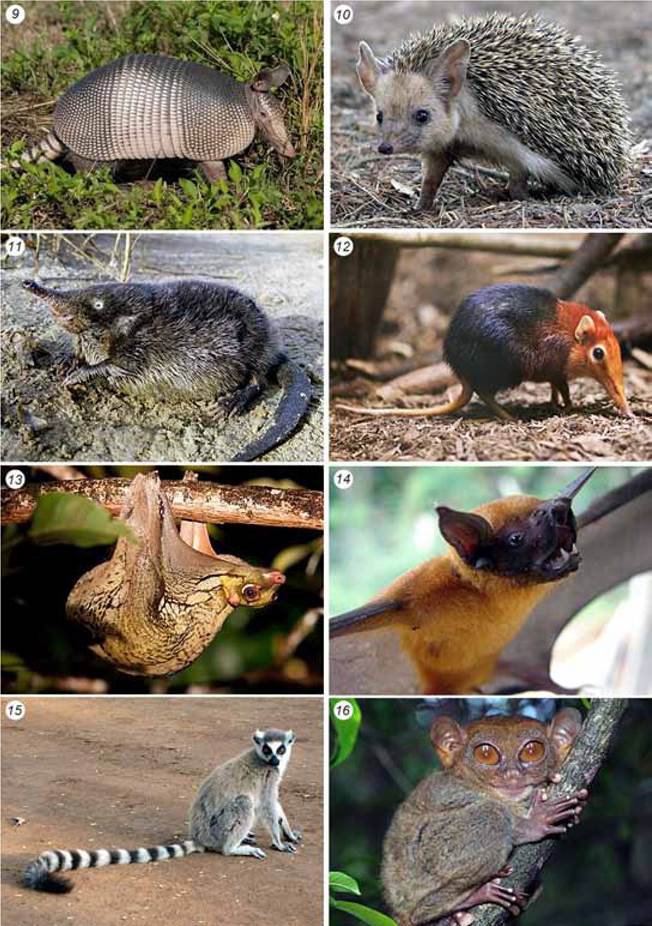
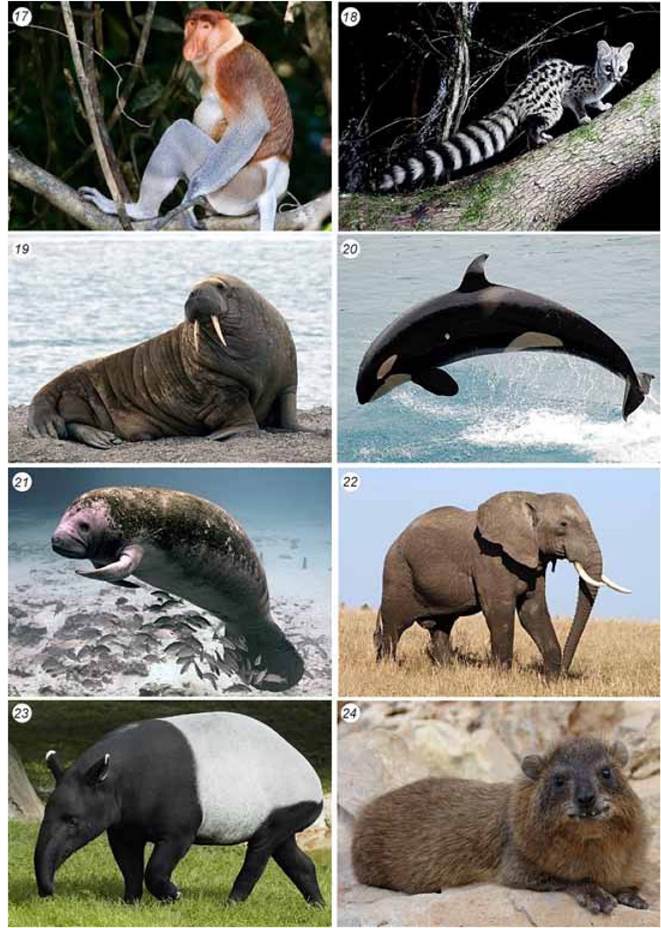
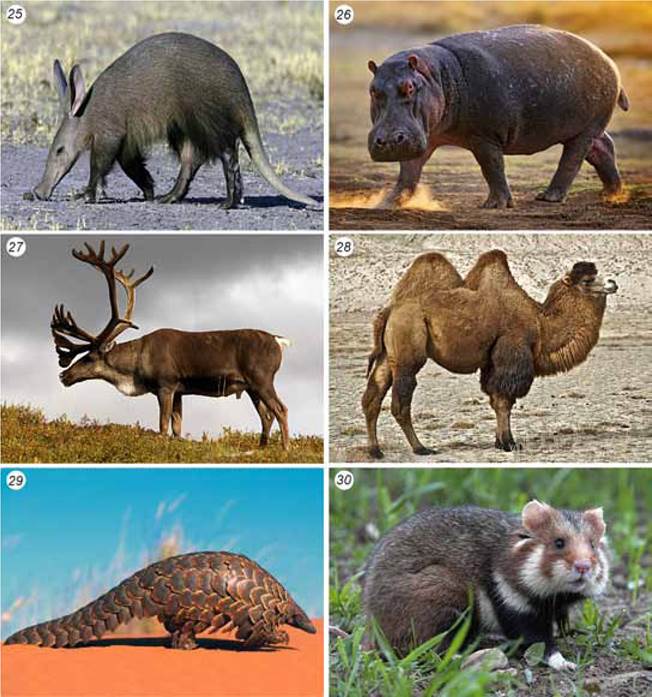
Fig. 5.74. Representatives of the Class Mammalia: 1 - platypus Ornithorhynchus anatinus; 2 - Virginia opossum Didelphis virginiana;
3 - greater bilby Macrotis lagotis; 4 - common spotted cuscus Spilocuscus maculatus; 5 - koala Phascolarctos cinereus; 6 - red kangaroo Macropus rufus; 7 - giant anteater Myrmecophaga tridactyla; 8 - pale-throated three-toed sloth Bradypus tridactylus; 9 - nine-banded armadillo Dasypus novemcinctus; 10 - long-eared hedgehog Hemiechinus auritus; 11 - Russian desman Desmana moschata; 12 - black and rufous elephant shrew Rhynchocyon petersi; 13 - Sunda flying lemur Cynocephalus variegatus; 14 - greater bulldog bat Noctilio leporinus;
15 - ring-tailed lemur Lemur catta; 16 - Philippine tarsier Tarsius syrichta; 17 - proboscis monkey, or kahau Nasalis larvatus; 18 - common genet Genetta genetta; 19 - walrus Odobenus rosmarus; 20 - killer whale Orcinus orca; 21 - West Indian manatee Trichechus manatus;
22 - African bush elephant Loxodonta africana; 23 - Malayan tapir Tapirus indicus; 24 - rock hyrax Procavia capensis; 25 - aardvark Orycteropus afer; 26 - hippopotamus Hippopotamus amphibius; 27 - reindeer Rangifer tarandus; 28 - Bactrian camel Camelus bactrianus; 29 - giant pangolin Manis gigantea; 30 - European hamster Cricetus cricetus
The squirrel family Sciuromoridae is distributed across all continents except Australia and Antarctica, comprising over 270 species. Sciurids are divided into two ecological groups: terrestrial (marmots, ground squirrels) and arboreal (tree squirrels); chipmunks occupy an intermediate position. Marmots (Marmota) inhabit meadow and steppe biotopes of both hemispheres, with some mountain species. They live in burrows, feed on the vegetative parts of herbaceous plants, and hibernate. They live in large colonies where neighbors are linked by constant vocal signaling that warns of danger. Marmots are objects of the fur trade and carry diseases dangerous to humans, including plague, among others. Ground squirrels (Citellus, Cynomys, Callospermophilus, etc.) are more widely distributed and also inhabit deserts. They form dense colonies, damage crops, and carry pathogens of dangerous diseases.
Chipmunks (Tamias, Eutamias) are associated with woody and shrubby vegetation and lead a semi-arboreal lifestyle. Tree squirrels are specialized arboreal animals with a predominantly solitary (or family) lifestyle; they are particularly diverse in the forests of South Asia (palm squirrels Funambulus, Callosciurus, etc.); some reach a body length of 50 cm and a weight of 3 kg (Ratufa). The red squirrel Sciurus vulgaris inhabits the taiga, mixed, and broadleaf forests of Eurasia; it is one of the most important fur-bearing animals and has been acclimatized in the forests of Crimea and the Caucasus. African ground squirrels Xerus resemble ground squirrels in their lifestyle (living in burrows); the long-clawed ground squirrel Spermophilopsis leptodactylus, distributed in the sandy deserts of Kazakhstan, Central Asia, and northern Iran, is closely related to them.
The fauna of Ukraine includes six species of the squirrel family: the steppe marmot Marmota bobac, the European ground squirrel Spermophilus citellus, the speckled ground squirrel Spermophilus suslicus, the Podolian ground squirrel Spermophilus odessanus, the little ground squirrel Spermophilus pygmaeus, and the red squirrel Spermophilus vulgaris.
The flying squirrel family Pteromyidae consists of arboreal rodents with a leathery membrane on the sides of the body between the fore and hind limbs, which allows them to glide from tree to tree over a distance of 15-50 m. The Siberian flying squirrel Pteromys volans is a small animal; the largest, the red giant flying squirrel Petaurista petaurista, reaches a weight of 1.5 kg with a body length of 60 cm and inhabits the mountain forests of Southeast Asia. Flying squirrels feed on tree leaves, buds, fruits, and seeds, and, when possible, small animals.
The African scaly-tailed squirrel family Anomaluridae consists of arboreal rodents with a tail whose underside is covered with sharp scales that help them cling to smooth tree trunks. When moving along trees, the animals support themselves with their tail and, by alternately extending and flexing their body, pull themselves up using their limbs.
Among mouse-like rodents, the dormouse family Gliridae is represented by small, predominantly arboreal, nocturnal rodents. They inhabit the forests and gardens of North Africa, Southern Europe, and Central Asia (extending to the Altai Mountains). Four species occur in Ukraine: the forest dormouse Dryomys nitedula, the hazel dormouse Muscardinus avellanarius, the edible dormouse Glis glis, and the highly rare garden dormouse Eliomys quercinus. Currently, this family also includes the desert dormouse Selevinia betpakdalensis, a single species from Eastern Kazakhstan.
The jerboa family Dipodidae is distributed across the steppes and deserts of mainly Africa and Asia. They are characterized by highly developed hind limbs, weak forelimbs, and a long balancing tail. These small to medium-sized hibernating animals (body length 5-30 cm) feed on seeds and plant shoots, and consume large quantities of small invertebrates. In Ukraine, they are represented by two rare species with a generally southern distribution: the great jerboa Allactaga major and the thick-tailed jerboa Stylodipus telum.
The jumping mouse family Zapodidae are close relatives of jerboas; they resemble mice externally and are predominantly insectivorous. They are distributed in Europe and Asia south of the Arctic Circle, as well as in North America. In Ukraine, there are four rather rare species: the northern birch mouse Sicista betulina, the Strand's birch mouse Sicista strandi, the southern birch mouse Sicista loriger, and the Severtzov's birch mouse Sicista severtzovi.
The family Muridae is highly diverse in size and appearance. This species-rich family includes members (such as house mice and rats) that have spread worldwide alongside humans. Species diversity is particularly rich in Southeast Asia and Africa. The largest representatives, the Philippine cloud rats Phloemys, can exceed a weight of 1 kg. Their evolutionary plasticity has enabled widespread dispersal; this group plays a significant role in biocenoses and is highly abundant in human settlements. Murids are one of the primary mammalian groups in the theriofauna of Ukraine, recorded during all types of surveys; the family comprises ten species: the striped field mouse Apodemus agrarius, the brown rat Rattus norvegicus, the house mouse Mus musculus, the yellow-necked mouse Sylvaemus tauricus, and others.
The hamster family Cricetidae is species-rich and widely distributed. South American hamsters (Ichtyomys, Laptomys, Anotomys) feed on fish and other aquatic animals. Two species of this family in the fauna of Ukraine are never abundant: the European hamster Cricetus cricetus (Fig. 5.74, 30) and the grey dwarf hamster Cricetulus migratorius.
The vole family Arvicolidae is distributed across the Northern Hemisphere and is represented by A number of abundant species: lemmings in the tundra, red-backed voles Myodes in forests, voles Microtus and steppe voles Lagurus in the forest-steppe and steppe, and water voles Arvicola and muskrats Ondatra in oxbow lakes and marshes. The family Arvicolidae is the most numerous group of mammals in our fauna; it is dominant in most habitat types, both natural (forests, shrublands, marshes, meadows) and semi-natural (orchards, fields, roadsides). The fauna of Ukraine includes 15 species: the muskrat Ondatra zibethicus, the bank vole Myodes glareolus, the European snow vole Chionomys nivalis, the European water vole Arvicola amphibius, the common vole Microtus arvalis, and others.
The blind mole-rat family Spalacidae consists of fossorial rodents that rarely emerge to the surface and feed on the underground parts of plants. These animals have vestigial external ears and tails, short limbs, and eyes completely covered by Skin, with a thick fold of skin densely covered with stiff, bristle-like hairs in their place. Five rather rare mammalian species of this family occur in Ukraine: the lesser blind mole-rat Nannospalax leucodon, the sandy blind mole-rat Spalax arenarius, the Bukovina blind mole-rat Spalax graecus, the Podolian blind mole-rat Spalax zemni, and the greater blind mole-rat Spalax microphthalmus.
Within the porcupine-like rodents group, a central place is occupied by the Old World porcupine family Hystricidae, which are large terrestrial or semi-arboreal rodents. The sides, back, and tail of their body are covered with long quills, while other parts are covered with coarse Hair. They feed on shoots and leaves of shrubs, grasses, and underground parts of plants. They live in burrows or caves, inhabiting the Mediterranean, Asia, and Africa. A typical representative is the crested porcupine Hystrix cristata. In North America and northern South America, the New World porcupines Erethizontidae are found; their bodies are covered with short quills, and they lead a predominantly arboreal lifestyle.
The cavy family Caviidae inhabits South America; most species are small, burrowing animals. The capybara family Hydrochoeridae is represented by a single species. The capybara Hydrochoerus capybara is the largest among modern rodents (body length 1.5 m, weight 50-60 kg). They settle along the riverbanks of South America, are excellent swimmers and divers, and feed on aquatic plants. The agouti family Dasyproctidae consists of large rodents (body length 60-75 cm) living in the forests of Mexico, Central, and South America. The chinchilla family Chinchillidae inhabits the pampas and mountainous regions of South America, ascending to altitudes of 3,000–6,000 m above sea level, and possesses high-quality fur.
The coypu family Myocastoridae inhabits water bodies of Cuba, Jamaica, Haiti, and South America. The coypu Myocastor coypus was first introduced to Ukraine in 1931. Acclimatization results demonstrated that the coypu cannot adapt to water bodies that freeze over. Under semi-captive breeding conditions, they are kept in natural water bodies only during the warm season. They are bred on auxiliary and specialized farms, as well as in semi-wild conditions, providing high-quality fur and dietary meat. By consuming aquatic vegetation, they alter The Nature of water bodies, occasionally damage hydraulic structures, and harm crops. In the mountainous regions and arid lowlands of South America, rat-like species of the octodont family Ododontidae live in complex burrows with extensive systems of underground passages and tunnels. In Africa, a fossorial lifestyle is characteristic of the African mole-rat family Bathyergidae.
This order has been the subject of the largest number of specialized and review publications, and it is within this group that The most significant taxonomic rearrangements and clarifications have occurred. Although mammalian systematics is relatively well-studied, many unresolved questions remain. Clarifying phylogenetic relationships between species can alter the composition of genera and even families. With the development of genetic Research Methods in zoology, so-called sibling species have been discovered in recent years; the animals belonging to them are extremely similar to one another and can often only be distinguished by chromosome number or biochemical markers. Such species are particularly numerous among small mammals, including voles, shrews, birch mice, and mice.
Last update: 19/08/2026
Editorial and Educational Adaptation: This material has been compiled based on the primary/original source text. The project team performed an editorial review, corrected technical inaccuracies, structured sections, and adapted the content for an educational format.
What was processed:
- elimination of formatting defects (OCR errors, structural breaks, corrupted characters);
- editorial organization of content;
- standardization of terminology in accordance with academic sources;
- verification of factual statements against the original source text.
All mentions of the author, publication year, and origin of the primary text have been preserved in accordance with the source.