General Microbiology - Schlegel, H. G. 1987
Utilization of inorganic hydrogen donors: aerobic chemolithotrophic bacteria
Oxidation of ferrous iron
The iron bacterium Thiobacillus ferrooxidans oxidizes ferrous iron to ferric iron:
Class="center">
This bacterium closely resembles T. thiooxidans and remains viable at medium pH values down to 2.5. However, it derives energy not only from the Oxidation of reduced sulfur compounds, but also from The oxidation of Fe2+ ions. This iron bacterium inhabits acidic mine waters containing various metal sulfides, including pyrite (FeS2). It has been definitively established that acidophilic iron Bacteria are capable of a chemoautotrophic lifestyle.
Recently, thermophilic strains of iron- and sulfur-oxidizing thiobacilli have also been discovered. Strains of the thermophile Sulfolobus acidocaldarius are likewise capable of oxidizing ferrous iron1. From soils containing stibnite, researchers successfully isolated an autotrophic bacterium, Stibiobacter senarmontii, capable of oxidizing Sb3+ to Sb5+.
Bioleaching of metals from ores. The ability of certain acidophilic iron- and sulfur-oxidizing bacteria to convert metal sulfides and elemental sulfur into Water-soluble heavy metal sulfates is utilized in the leaching of low-grade ores to recover copper, zinc, nickel, molybdenum, and uranium. While the leaching method is already applied on a large scale to recover metals from waste rock dumps, its scope may potentially be extended to underground mining operations as well. In the simplest case, water is passed through a thick layer of crushed rock containing ore [e.g., pyrite (FeS2)] along with associated metal sulfides such as Cu2S (chalcocite), CuS, ZnS, NiS, MoS2, Sb2S3, CoS, and PbS, and the sulfate-bearing solution is subsequently collected. After concentration of this solution, the corresponding metals are precipitated from it.
1 Ferrous iron is also oxidized by the obligately autotrophic bacterium Leptospirillum ferrooxidans.—Ed. note.
The dissolution of heavy metal sulfides occurs through the combined action of multiple processes: bacterial oxidation of reduced sulfur compounds (1) or elemental sulfur (2) to sulfuric acid, bacterial oxidation of Fe2+ to Fe3+ (3), and, finally, chemical oxidation of insoluble heavy metal salts to soluble sulfates and sulfur (4):
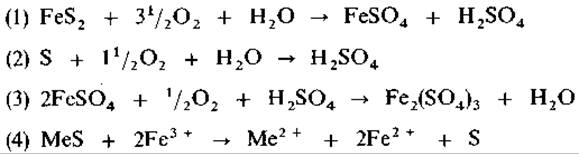
Thus, bacteria supply sulfuric acid and regenerate Fe3+; both of these components are consumed during ore dissolution.
These transformations are carried out by Thiobacillus thiooxidans and T. ferrooxidans. The corresponding bacterial strains exhibit unusual resistance to relatively high concentrations of Cu2+, Co2+, Zn2+, Ni2+, and other heavy Metal Ions. Sulfolobus strains capable of oxidizing sulfur and iron also participate in the leaching process.
Other iron bacteria. The best-known and most easily identifiable iron bacteria also include Gallionella ferruginea (see Fig. 3.16) and Leptothrix ochracea. They can be found, for instance, in drainage pipes and mountain streams among flocs and thick deposits of iron oxides. Until recently, it remained unclear whether these bacteria could utilize The energy released during the oxidation of Fe2+ to Fe3+ and grow autotrophically. Recently, ribulose-1,5-bisphosphate carboxylase was discovered in Representatives of the genus Gallionella; consequently, they are now classified as lithoautotrophic bacteria.
Bacteria oxidize not only iron but also manganese. The chlamydobacterium Leptothrix discophorus is capable of oxidizing Mn2+ to Mn4+. However, it has not yet been precisely established whether the energy derived from this oxidation is used for metabolic purposes.
Obligate chemolithoautotrophy. Obligate chemolithoautotrophy represents the extreme degree of adaptation and specialization among organisms that oxidize inorganic substrates. To explain this phenomenon, several hypotheses have been proposed and tested:
1. One may proceed from the assumption that The Tricarboxylic Acid Cycle is not essential for the oxidation of inorganic substrates (just as it is unnecessary for Fermentation). Indeed, the reducing equivalents generated by the oxidation of the inorganic substrate enter the Respiratory Chain. Only the biosynthetic Functions of the tricarboxylic acid cycle (The formation of 2-oxoglutarate and succinate) need to be ensured. However, the enzyme 2-oxoglutarate dehydrogenase is not required for this. Testing has shown that A number of obligately autotrophic bacteria indeed lack it. Furthermore, 2-oxoglutarate dehydrogenase was not detected in many facultatively autotrophic bacteria when Cells were grown on a medium with an inorganic energy source. Thus, a mutant of a facultatively autotrophic bacterium that has lost The ability to synthesize 2-oxoglutarate dehydrogenase would behave as an obligately autotrophic microorganism.
2. Since nitrifying bacteria, as well as bacteria that oxidize sulfur, sulfite, and iron, possess a 'split' respiratory chain, it is entirely possible that some obligate autotrophs have an irreversible step in the first segment of this chain that precludes its normal function, namely the oxidation of NADH2 (this section is utilized solely for Reverse Electron Transport). Such a disruption of chain reversibility, possibly related to enzyme regulation, could serve to conserve the reducing power (NADH2) acquired at a high energy cost.
A unified explanation for obligate autotrophy has not yet been established. It is possible that this phenomenon has different causes across various physiological groups of bacteria.
Last update: 13/08/2026
Editorial and Educational Adaptation: This material has been compiled based on the primary/original source text. The project team performed an editorial review, corrected technical inaccuracies, structured sections, and adapted the content for an educational format.
What was processed:
- elimination of formatting defects (OCR errors, structural breaks, corrupted characters);
- editorial organization of content;
- standardization of terminology in accordance with academic sources;
- verification of factual statements against the original source text.
All mentions of the author, publication year, and origin of the primary text have been preserved in accordance with the source.