BIOTECHNOLOGY - V. H. Gerasymenko - 2006
Part II. Applied Biotechnologies
Chapter 20. BIOTECHNOLOGY OF ENZYME PRODUCTION
20.3. PRODUCTION OF COMMERCIAL ENZYME PREPARATIONS
20.3.1. Enzyme Isolation
The next stage in the biotechnological process of enzyme production is the Isolation of the target product (the enzyme). This stage depends on whether the product accumulates within The Cell (intracellular Enzymes), is secreted into the culture liquid (extracellular enzymes), or whether the cell mass itself is the product (Fig. 20.1). Isolating an enzyme (product) accumulated inside Cells is the most challenging task, requiring the cells to be separated from the culture liquid and their cell walls to be disrupted (disintegrated).
Class="center">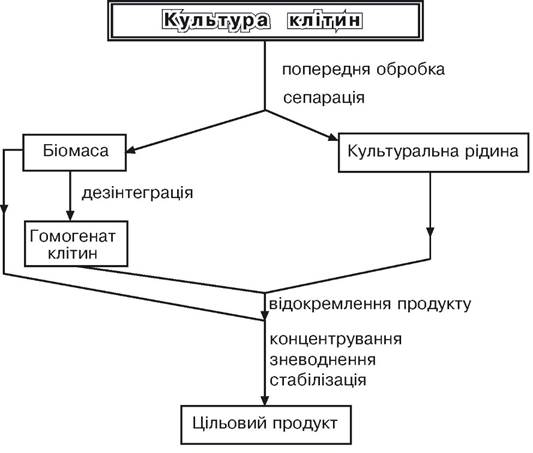
Fig. 20.1. MAIN STAGES OF Isolation and Purification of biotechnological products
(according to N. S. Egorov et al., 1987)
Microbial cultures grown by surface cultivation and culture liquids after submerged cultivation contain a large amount of ballast substances: producer biomass, unused nutrient medium components, and metabolic products. Enzymes account for approximately 1 % of surface cultures and no more than 0.1 % of submerged cultures.
For subsequent application, enzymes often need to be isolated and purified. These processes are both labor-intensive and costly.
Enzyme isolation is a set of techniques used to obtain enzyme preparations suitable for research, medical, and biotechnological Applications.
Isolation of extracellular enzymes. Extracellular enzymes are recovered from the culture liquid following Separation—that is, the separation of the culture liquid from the microbial protein biomass. Separation is sometimes preceded by special treatments such as pH adjustment, heating, or The addition of protein coagulants to improve biomass separation and product stabilization. Various Separation Methods are available.
1. Flotation. This method can be employed when producer cells in the bioreactor accumulate in the surface layers of the liquid. Flotation devices of various designs skim, pump off, or scrape away the foam containing microbial cells.
2. Filtration. All existing filter types (drum, disk, belt filters, etc.) operate on the same principle: retaining biomass on a porous filtering surface.
3. Centrifugation. This method is based on sedimenting suspended particles in a liquid using centrifugal force. Centrifugation requires more expensive equipment than filtration.
In certain production processes, centrifugation and filtration are combined using filter centrifuges.
Isolation of intracellular enzymes. Intracellular enzymes are isolated after Cell Disruption (disintegration).
Methods of cell disruption. Various methods are used to disrupt cells: mechanical, physical, chemical, biological, and enzymatic. Achieving the desired disintegration sometimes requires intense or harsh treatments, or combining multiple methods if a single approach fails. In such cases, microbial cells undergo multi-faceted Processing.
Mechanical methods include ball milling (ballistic), extrusion, and decompression.
Physical methods include osmotic Shock, thermal shock, plasmoptysis (plasmolysis), freeze-thawing, cell drying, ultrasound, and ionizing radiation.
Chemical methods involve the action of acids, alkalis, organic solvent salts, and Surfactants.
Enzymatic methods involve the action of Lysozyme and other lytic enzymes.
Biological methods include inhibiting Cell wall Biosynthesis, phage action, and obtaining mutant strains of enzyme-producing microorganisms with fragile cell walls.
Physical Methods of disintegration are more cost-effective than chemical and biological-enzymatic methods because they do not require expensive Reagents or enzyme preparations. However, they may adversely affect product quality.
The USE OF IMMOBILIZED enzymes is considered a promising approach for the disintegration of producer microorganisms.
The disintegration stage is followed by the separation of cell wall fragments. The methods used for this purpose are the same as those employed in cell separation, namely filtration and centrifugation.
Last update: 11/08/2026
Editorial and Educational Adaptation: This material has been compiled based on the primary/original source text. The project team performed an editorial review, corrected technical inaccuracies, structured sections, and adapted the content for an educational format.
What was processed:
- elimination of formatting defects (OCR errors, structural breaks, corrupted characters);
- editorial organization of content;
- standardization of terminology in accordance with academic sources;
- verification of factual statements against the original source text.
All mentions of the author, publication year, and origin of the primary text have been preserved in accordance with the source.