Medical Genetics - V. M. Zaporozhan 2005
Chromosomal Diseases
Classification of Chromosomal Diseases
As noted above, Chromosomal Disorders are hereditary conditions caused by alterations in chromosome number and Structure. To date, over 1,000 such disorders have been described. About 100 of them present a distinct clinical picture and are referred to as syndromes. The Classification of chromosomal disorders is based on three principles (Table 5.2).
All chromosomal disorders can be divided into three groups depending on The Nature of the karyotype alteration (etiological principle).
Class="center">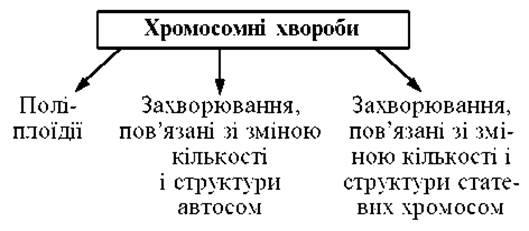
Depending on the type of Cells in which Mutations occur (and, consequently, the percentage of cells with an altered karyotype), full and mosaic forms of chromosomal disorders are distinguished. Full forms result from a parental germline mutation (i.e., mutations occurring during gametogenesis in the parents). All Cells of the embryo have the altered karyotype. Mosaic forms result from a somatic mutation that arises within the embryo itself during embryonic development. Therefore, a portion of the patient's cells has a normal chromosome Complement, while the rest are altered. Mosaic forms generally have a milder clinical course than full forms. The Emergence of a mosaic form with a Clinical presentation identical to that of the full form requires at least 10% of cells with an abnormal karyotype. However, it should be noted that there is no strict parallelism between the proportion of affected cells and the severity of the disease. Occasionally, a low percentage of abnormal cells may still lead to a severe clinical course, and vice versa.
Table 5.2. Classification of chromosomal disorders
|
Classification principle |
Forms of chromosomal disorders |
|
By the nature of karyotype alteration (etiological principle, i.e., characteristics of chromosomal or genomic mutation) |
— polyploidies — alterations in autosome number and structure — alterations in sex chromosome number and structure |
|
— full forms — the result of a parental germline mutation — mosaic forms — the result of a somatic mutation in the embryo itself |
|
|
Time of mutation occurrence (across generations) |
— sporadic — the result of a de novo mutation — inherited — transmitted from parents with balanced chromosomal rearrangements or from parents with chromosomal disorders |
Depending on when the mutation arose across generations, chromosomal disorders are classified as sporadic (resulting from a de novo mutation) and inherited (transmitted from parents with a balanced mutation or a chromosomal disorder). Cases have been described where children were born to individuals with Klinefelter syndrome, female X polysomy, male Y polysomy, and women with Down syndrome. Men with Down syndrome are generally infertile due to impaired Spermatogenesis.
Thus, accurate Diagnosis of a chromosomal disorder requires determining:
1) the type of mutation;
2) the specific chromosome involved;
3) the form (full or mosaic);
4) the Nature of the case (sporadic occurrence or inherited form).
Such a diagnosis is only possible through cytogenetic testing performed on the patient, and occasionally on their parents and siblings.
Last update: 11/08/2026
Editorial and Educational Adaptation: This material has been compiled based on the primary/original source text. The project team performed an editorial review, corrected technical inaccuracies, structured sections, and adapted the content for an educational format.
What was processed:
- elimination of formatting defects (OCR errors, structural breaks, corrupted characters);
- editorial organization of content;
- standardization of terminology in accordance with academic sources;
- verification of factual statements against the original source text.
All mentions of the author, publication year, and origin of the primary text have been preserved in accordance with the source.