Human Anatomy - Kotsan I. Y. 2009
Brain
Superolateral surface of the hemispheres
The frontal lobe (lobus frontalis) is located in the anterior part of each cerebral hemisphere. It is bounded inferiorly by the lateral sulcus (sulcus lateralis), posteriorly by the deep central sulcus (sulcus centralis), and terminates anteriorly in the frontal pole. The central sulcus lies in the frontal plane; it begins at the upper part of the Medial surface of the cerebral hemisphere, cuts across its superior margin, extends uninterrupted down the superolateral surface of the hemisphere, and ends just short of the lateral sulcus (Fig. 241).
Anterior to the central sulcus and running almost parallel to it is the precentral sulcus (sulcus precentralis), which also terminates inferiorly just before reaching the lateral sulcus. In some cases, the precentral sulcus is interrupted in its middle section, thereby consisting of two separate sulci. Extending forward from the precentral sulcus are the superior and inferior frontal sulci (sulcus frontalis superior et sulcus frontalis inferior), which run almost parallel to each other on the superolateral surface of the frontal lobe.
These sulci divide the superolateral surface of the frontal lobe into gyri. The precentral gyrus (gyrus precentralis) lies between the central and precentral sulci. Superior to the superior frontal sulcus is the superior frontal gyrus (gyrus frontalis superior), which occupies the upper part of the frontal lobe. The middle frontal gyrus (gyrus frontalis medius) extends between the superior and inferior frontal sulci, while the inferior frontal gyrus (gyrus frontalis inferior) is situated inferior to the inferior frontal sulcus. The Branches of the lateral sulcus—namely, the ascending ramus (ramus ascendens) and the anterior ramus (ramus anterior)—extend into the inferior frontal gyrus, dividing the lower portion of the frontal lobe (which overhangs the anterior part of the lateral sulcus) into smaller gyri: the opercular, triangular, and orbital parts. The opercular part (pars opercularis), or frontal operculum, is located between the ascending ramus of the lateral sulcus and the lower section of the precentral sulcus. It is so named because it overlies the insular lobe (insula), which is situated deep within the sulcus. The triangular part (pars triangularis) lies between the ascending and anterior rami of the lateral sulcus. The orbital part (pars orbitalis) is situated inferior to the anterior ramus of the lateral sulcus and continues onto the Inferior surface of the frontal lobe. At this site, the lateral sulcus widens and is therefore referred to as the lateral fossa of the cerebrum (fossa lateralis cerebri).
Class="center">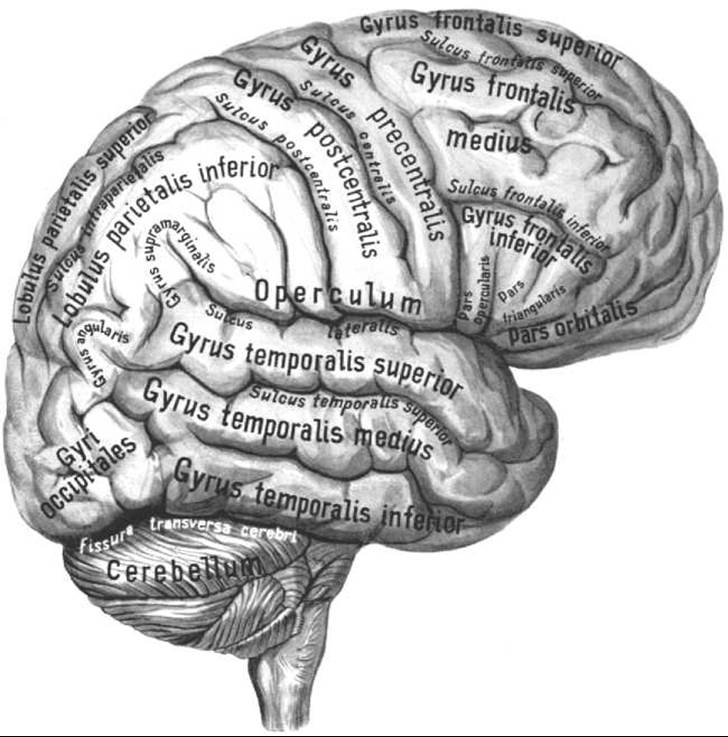
Fig. 241. Brain; lateral view (after R. D. Sinelnikov)
Posterior to the central sulcus lies the parietal lobe (lobus parietalis), the posterior boundary of which is the parieto-occipital sulcus (sulcus parietooccipitalis). This sulcus is located on the medial surface of the hemisphere, deeply cuts across the superior margin of the cerebral hemisphere, and extends onto its superolateral surface. The boundary between the parietal and occipital lobes is represented by an imaginary line extending downward as a continuation of the parieto-occipital sulcus. The inferior boundary of the parietal lobe is the lateral sulcus, which separates it from the temporal lobe.
Within the parietal lobe, the postcentral sulcus (sulcus postcentralis) originates inferiorly from the lateral sulcus and terminates superiorly without reaching the superior margin of the hemisphere. The postcentral sulcus lies posterior to the central sulcus and runs almost parallel to it. The postcentral gyrus (gyrus postcentralis) is located between the central and postcentral sulci. Superiorly, the postcentral gyrus extends onto the medial surface of the cerebral hemisphere, where it connects with the precentral gyrus of the frontal lobe, together forming the paracentral lobule (lobulus paracentralis). Inferiorly, on the superolateral surface of the hemisphere, the postcentral gyrus also continues into the precentral gyrus, enclosing the central sulcus from below. Extending posteriorly from the postcentral sulcus is the intraparietal sulcus (sulcus intraparietalis), which runs parallel to the superior margin of the hemisphere. Superior to the intraparietal sulcus lies a group of small gyri known as the superior parietal lobule (lobulus parietalis superior). Inferior to this sulcus is the inferior parietal lobule (lobulus parietalis inferior), which comprises two gyri: the supramarginal gyrus (gyrus supramarginalis) and the angular gyrus (gyrus angularis). The supramarginal gyrus arches over the end of the lateral sulcus, whereas the angular gyrus arches over the end of the superior temporal sulcus. The lower part of the inferior parietal lobule, along with the adjacent lower sections of the postcentral gyrus and the inferior part of the precentral gyrus that overhang the insular lobe, form the frontoparietal operculum of the insula (operculum frontoparietale).
The occipital lobe (lobus occipitalis) is situated posterior to the parieto-occipital sulcus and its imaginary continuation on the superolateral surface of the hemisphere. Compared to the other lobes, it is relatively small in size. Posteriorly, the occipital lobe terminates in the occipital pole. The sulci and gyri on the superolateral surface of the occipital lobe are highly variable. Most frequently and prominently expressed is the transverse occipital sulcus (sulcus occipitalis transversus), which appears as a posterior continuation of the intraparietal sulcus of the parietal lobe.
The temporal lobe (lobus temporalis) occupies the inferolateral Regions of the hemisphere and is separated from the frontal and parietal lobes by the deep lateral sulcus (sulcus lateralis). The margin of the temporal lobe covering the insular lobe is termed the temporal operculum (operculum temporale). The anterior part of the temporal lobe forms the temporal pole. Two sulci are visible on the lateral surface of the temporal lobe: the superior and inferior temporal sulci (sulcus temporalis superior et sulcus temporalis inferior), which run almost parallel to the lateral sulcus. The superior temporal gyrus (gyrus temporalis superior) is located between the lateral and superior temporal sulci. On the superior surface of this gyrus, concealed deep within the lateral sulcus, lie two to three short transverse temporal gyri (gyri temporales transversi), which are separated by transverse temporal sulci (sulci temporales transversi). The middle temporal gyrus (gyrus temporalis medius) is situated between the superior and inferior temporal sulci. Inferior to the inferior temporal sulcus lies the inferior temporal gyrus (gyrus temporalis inferior), the posterior end of which continues into the occipital lobe.
The insular lobe, or insula (lobus insularis — insula), lies deep within the lateral sulcus. This lobe can be exposed by parting or removing the overlapping PARTS OF THE frontal, parietal, and temporal lobes, collectively known as the opercula. The deep circular sulcus of the insula (sulcus circularis insulae) separates the insula from the surrounding regions of the brain. The surface of the insula features long and short gyri (gyri longus et breves insulae). The central sulcus of the insula (sulcus centralis insulae) is located between the long gyrus—which is situated in the posterior part of the insula and oriented anteroinferiorly—and the short gyri, which occupy the anterosuperior part of the insula. The anteroinferior part of the insula lacks sulci and instead presents a small elevation termed the threshold of the insula (limen insulae).
Last update: 08/08/2026
Editorial and Educational Adaptation: This material has been compiled based on the primary/original source text. The project team performed an editorial review, corrected technical inaccuracies, structured sections, and adapted the content for an educational format.
What was processed:
- elimination of formatting defects (OCR errors, structural breaks, corrupted characters);
- editorial organization of content;
- standardization of terminology in accordance with academic sources;
- verification of factual statements against the original source text.
All mentions of the author, publication year, and origin of the primary text have been preserved in accordance with the source.