Human Anatomy - Kotsan I. Y. 2009
Brain
Inferior surface of the hemispheres
The relief of the inferior surface of the cerebral hemisphere is quite complex (Fig. 243). The anterior PARTS OF THE inferior surface are formed by the frontal lobe of the hemisphere, behind which protrude the temporal pole, as well as the inferior surfaces of the temporal and occipital lobes, which transition into one another without distinct boundaries.
On the inferior surface of the frontal lobe, slightly lateral and parallel to the longitudinal cerebral fissure, lies the olfactory sulcus (sulcus olfactorius). The olfactory bulb and olfactory tract adhere to it from below, passing posteriorly into the olfactory trigone, in the region of which the medial and lateral olfactory striae (striae olfactoriae medialis et lateralis) are visible. The area of the frontal lobe between the longitudinal cerebral fissure and the olfactory sulcus is called the straight gyrus (gyrus rectus). The surface of the frontal lobe lateral to the olfactory sulcus is divided by shallow orbital sulci (sulci orbitales) into several orbital gyri (gyri orbitales) that vary in shape, size, and arrangement.
In the posterior part of the inferior surface of the hemisphere, the collateral sulcus (sulcus collateralis) is clearly visible; it is located inferior to the lingual gyrus on the inferior surface of the occipital and temporal lobes, lateral to the parahippocampal gyrus. Slightly anterior to the anterior end of the collateral sulcus lies the rhinal sulcus (sulcus rhinalis), which delimits laterally the curved end of the parahippocampal gyrus—the uncus (uncus). Lateral to the collateral sulcus lies the medial occipitotemporal gyrus (gyrus occipitotemporalis medialis). Between this gyrus and the lateral occipitotemporal gyrus (gyrus occipitotemporalis lateralis) situated external to it lies the occipitotemporal sulcus (sulcus occipitotemporalis). The boundary between the lateral occipitotemporal and inferior temporal gyri is not a sulcus, but the inferolateral border of the cerebral hemispheres.
Class="center">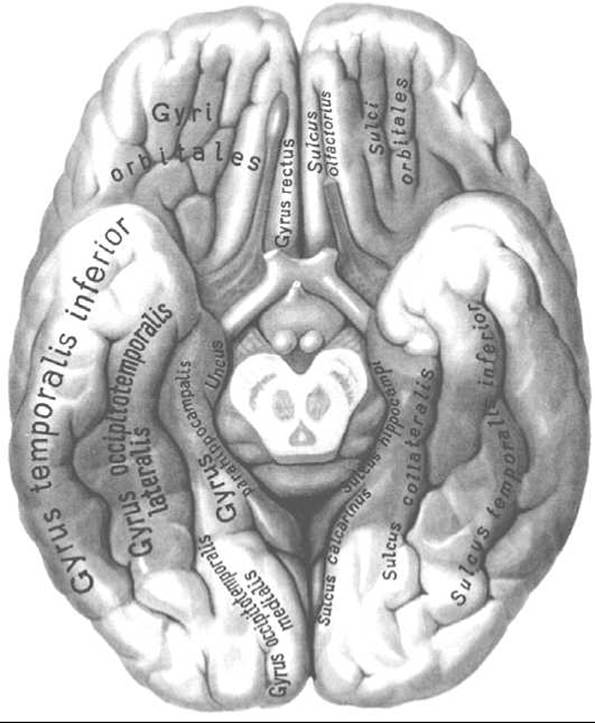
Fig. 243. Base (inferior surface) of the cerebrum (according to R. D. Sinelnikov)
A number of Brain regions located on the medial and inferior surfaces of the hemispheres, which serve as a substrate for The formation of general states such as wakefulness, Sleep, emotions, behavioral motivation, and others, are grouped under the name "limbic system." Since these reactions evolved in connection with primary olfactory Functions (in phylogenesis), their morphological substrate consists of brain regions that develop from the lower parts of the cerebral vesicle and belong to the so-called olfactory brain (rhinencephalon).
The limbic system comprises the olfactory bulb, olfactory tract, olfactory trigone, and anterior perforated substance, which are located on the inferior surface of the frontal lobe (the peripheral part of the olfactory brain), as well as the cingulate and parahippocampal (along with the uncus) gyri, dentate gyrus, hippocampus (the central part of the olfactory brain), and several other structures. The inclusion of these brain regions in the limbic system became possible due to the Selection/11.html">General features of their Structure (and origin), the presence of mutual connections, and the similarity of their functional responses.
Last update: 08/08/2026
Editorial and Educational Adaptation: This material has been compiled based on the primary/original source text. The project team performed an editorial review, corrected technical inaccuracies, structured sections, and adapted the content for an educational format.
What was processed:
- elimination of formatting defects (OCR errors, structural breaks, corrupted characters);
- editorial organization of content;
- standardization of terminology in accordance with academic sources;
- verification of factual statements against the original source text.
All mentions of the author, publication year, and origin of the primary text have been preserved in accordance with the source.