Human Anatomy, Part 1 - K. A. Dyubenko, A. K. Kolomiyytsev, Yu. B. Chaykovsky 2002
Special Section
Myology, myologia [the study of muscles] — Muscles and fasciae of the upper limb
Muscles of the upper limb, musculi membri superioris — Muscles of the free upper limb — Muscles of the arm — Anterior group
Anterior group:
1. Biceps brachii Muscle, m. biceps brachii.
2. Coracobrachialis muscle, m. coracobrachialis.
3. Brachialis muscle, m. brachialis.
Posterior group:
1. Triceps brachii muscle, m. triceps brachii.
2. Anconeus muscle, m. anconeus.
1. The biceps brachii muscle, m. biceps brachii (Fig. 155), is a biarticular, spindle-shaped muscle located on the anterior surface of the arm directly beneath the Skin and deep fascia. It has two heads: the caput longum, which originates from the supraglenoid tubercle of the scapula, and the caput breve, which arises from the coracoid process of the scapula. Both bellies unite into a single tendon that inserts into the tuberositas radii. A bundle of fibers detaches from the proximal end of the tendon as a thin sheet, the aponeurosis m. bicipitis brachii, or fibrous expansion known as the lacertus fibrosus.
Function: flexes the forearm at the elbow joint and supinates the forearm. The Functions of the long and short heads regarding shoulder movements differ. The long HEAD facilitates flexion and abduction of the arm, whereas the short head contributes to flexion and adduction of the arm.
Blood supply: aa. collateralis ulnaris superior et inferior, a. recurrens radialis, a. brachialis.
Innervation: n. musculocutaneus (C VI-C VII).
2. The coracobrachialis muscle, m. coracobrachialis (Fig. 156), originates from the apex of the processus coracoideus scapulae and inserts below the middle of the Medial surface of the humerus.
Function: flexes the shoulder joint, adducts, and laterally rotates the arm.
Blood supply: aa. circumflexae humeri anterior et posterior.
Innervation: n. musculocutaneus (C VI-C VII).
3. The brachialis muscle, m. brachialis, lies beneath the biceps brachii (see Fig. 156). It originates from the anterior surface of the lower half of the humerus, crosses the elbow joint, and inserts into the ulnar tuberosity, occasionally attaching to the capsule of the elbow joint.
Class="center">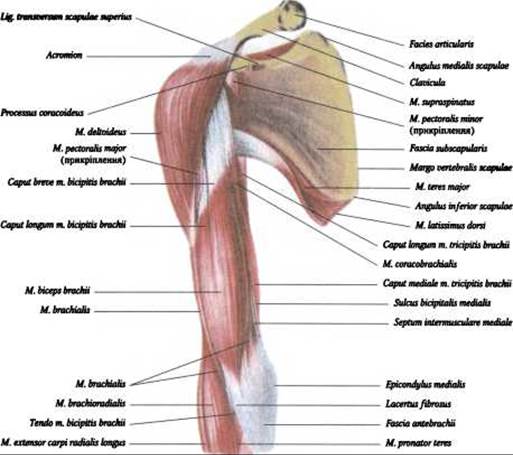
Fig. 155. Muscles of the shoulder girdle and arm — anterior view: the arm is supinated (after V. P. Vorobyov)
Function: flexes the forearm at the elbow joint and tightens the articular capsule.
Blood supply: aa. collateralis ulnaris superior et inferior, aa. brachialis et recurrens radialis.
Innervation: n. musculocutaneus (C V-C VII).
Last update: 08/08/2026
Editorial and Educational Adaptation: This material has been compiled based on the primary/original source text. The project team performed an editorial review, corrected technical inaccuracies, structured sections, and adapted the content for an educational format.
What was processed:
- elimination of formatting defects (OCR errors, structural breaks, corrupted characters);
- editorial organization of content;
- standardization of terminology in accordance with academic sources;
- verification of factual statements against the original source text.
All mentions of the author, publication year, and origin of the primary text have been preserved in accordance with the source.