Fundamentals of General and Pharmaceutical Hygiene - Dykyy I.L. 2003
Lighting and ventilation of premises
Hygienic assessment of indoor ventilation
Ventilation of residential, public, and industrial premises is an effective means of maintaining air purity and preventing disease. It must also ensure the body's thermal equilibrium with the environment. Ventilation is of great importance in ensuring the required storage conditions for medicinal products and medical devices.
To maintain the required parameters of the air environment in both residential and industrial premises, various ventilation systems are employed. They are differentiated by the method of air supply (natural and mechanical), area of effect (local and general), and purpose (supply, exhaust, and supply-and-exhaust).
Pharmacy facilities utilize both natural ventilation (through transoms, window vents, and windows) and mechanical ventilation systems—general dilution, supply-and-exhaust, and local (at individual workstations).
Industrial premises of pharmaceutical enterprises are equipped with turbulent and laminar ventilation systems. Thus, in accordance with Good Manufacturing Practice (GMP) requirements, The production of sterile products employs laminar ventilation systems that provide directed flows of sterile air toward the working area of the room (having preliminarily passed through filters of varying degrees of purification), displacing all mechanical and microbial contaminants present in the indoor air.
The indicators of ventilation are the volume and rate of air exchange.
Objective: to know the ventilation requirements for pharmacy production premises, to be able to assess the state of natural and mechanical ventilation in rooms, and to develop measures to improve air exchange and increase the efficiency of ventilation systems.
QUESTIONS FOR SELF-PREPARATION
1. Structure/19.html">The Importance of ventilation in the production premises of pharmacies and pharmaceutical enterprises, and hygienic requirements for it.
2. Natural ventilation and its design.
3. Mechanical ventilation, types, and design.
4. Local ventilation System and Its design.
5. Recirculating air purifiers.
6. Air conditioning.
7. METABOLISM/2.html">THE CONCEPT OF turbulent and laminar ventilation.
8. Indicators of ventilation.
9. Determination of ventilation air volume based on carbon dioxide.
10. Determination of the air exchange rate under natural and mechanical ventilation.
Task 1. Determination of the air volume required for room ventilation based on carbon dioxide
This method is used when indoor air quality deteriorates solely due to the presence of people. The determination of ventilation air volume is carried out using carbon dioxide as an indirect indicator of indoor air purity. In this case, the purpose of ventilation is to maintain a 2 content that does not exceed the permissible standard (0.1%). The calculation is performed using the formula
Class="center">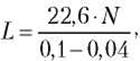
where L is the required air volume, m3/h;
22.6 is The amount of carbon dioxide exhaled by an adult during light physical work over the course of an hour (L);
N is the number of people in the room;
0.1 is the permissible concentration of carbon dioxide in the indoor air (%);
0.04 is the average carbon dioxide content in atmospheric air (%).
Knowing the actual carbon dioxide content in the air allows one to determine the ventilation rate and compare it with the amount required to maintain a normal level (0.1%).
Task 2. Determination of air exchange rate
The air exchange rate is a value that indicates how many times per hour the air in a given room is replaced with outside air. There are two Methods for calculating this indicator, depending on the type of ventilation (natural or mechanical).
2.1. Determining the air exchange rate under natural ventilation (based on carbon dioxide content)
The calculation is performed using the formula
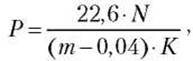
where P is the air exchange rate;
22.6 is the amount of carbon dioxide exhaled by a person per hour (L);
N is the number of people in the room;
m is the concentration of carbon dioxide in the indoor air (%);
0.04 is the average carbon dioxide content in atmospheric air (%);
K is the room volume (m3).
2.2. Determining the air exchange rate under mechanical ventilation
In mechanical ventilation, the air exchange rate serves as an indicator of the ventilation system's efficiency. The calculation is performed using the formula

where K is the air exchange rate;
Q is the volume of air supplied or extracted, depending on the type of ventilation (L);
Q is the room volume (L).
The volume of air supplied (supply ventilation) or extracted (exhaust ventilation) is determined by the formula
Q = V ∙ b ∙ 3600,
where Q is the air volume (m3/h);
V is the air velocity in the ventilation opening (m/s);
b is the area of the ventilation opening (m2);
3600 is the conversion factor from hours to seconds.
The air velocity is measured using an anemometer. To do this, the anemometer is moved across the entire area of the ventilation opening for 3 minutes.
The air exchange rate for supply is denoted as << + >>, and for exhaust as << - >>.
Air exchange rate standards for pharmacy premises are given in Table 11 of the Appendix.
PROTOCOL SCHEME
Topic of the practical class:
1. Determination of the air volume (L) required for room ventilation based on carbon dioxide.
Number of people in the room ... .
CO2 content in the indoor air (%) ... .
Calculation of L using the formula ... .
2. Determination of the air exchange rate.
Determination of the air exchange rate under natural ventilation. Number of people in the room ... .
CO2 content in the indoor air (%) ... .
Room volume (l) ... .
Calculation of the air exchange rate using the formula ... .
Determination of the air exchange rate under mechanical ventilation.
Type of ventilation opening ... .
Type of ventilation opening ... .
Instrument for measuring air velocity in the ventilation opening ... .
Air velocity in the ventilation opening ... .
Area of the ventilation opening ... .
Room volume ... .
Calculation of the air exchange rate ... .
Conclusion: based on the Sanitary and hygienic studies conducted in the room, it has been established that the volume of air supplied through natural ventilation is ... m3, which (does not) meet the standard; the air exchange rate is ..., which (does not) meet the standard; the supply (exhaust) air exchange rate is ..., which (does not) meet hygienic requirements. Recommendations.
TASKS FOR INDEPENDENT WORK
1. Test control of knowledge.
2. Solving situational problems.
TESTS
1. According to the method of air supply, ventilation is classified into:
A. Supply ventilation.
B. Exhaust ventilation.
Г. Natural ventilation.
2. According to the area of operation, ventilation is classified into:
A. Supply ventilation.
Б. Local ventilation.
B. Exhaust ventilation.
Г. General ventilation.
3. An indicator of the efficiency of natural ventilation is the air content of:
A. Oxygen.
Б. Carbon dioxide.
B. Ozone.
Г. Carbon monoxide.
4. In the pharmacy compounding room, general supply and exhaust ventilation is installed:
A. With exhaust prevailing over supply.
Б. With equal supply and exhaust rates.
B. With supply prevailing over exhaust.
Г. Local exhaust ventilation.
5. In the customer service area, the ventilation installed is:
A. General ventilation with supply prevailing over exhaust.
Б. Local exhaust ventilation.
B. General ventilation with exhaust prevailing over supply.
Г. Local supply ventilation in the vestibule.
6. General ventilation in the aseptic unit should be installed with:
A. Air supply exceeding exhaust.
Б. Local exhaust.
B. Balanced supply and exhaust.
Г. Air exhaust exceeding supply.
7. Air exchange rate indicates how many times the air in a room is replaced within:
A. One hour.
Б. One minute.
B. One second.
Г. One day.
8. According to GMP (Good Manufacturing Practice) requirements for sterile production, cleanrooms are equipped with:
A. General ventilation.
Б. Natural ventilation.
B. Laminar airflow.
Г. Turbulent airflow.
9. The efficiency of a fume hood is determined by:
A. Carbon dioxide concentration in the air.
Б. Air exchange rate.
B. Concentration of hazardous substances in the air.
Г. Oxygen concentration in the air.
10. Local exhaust ventilation must be installed in:
A. The analytical pharmacist's office.
Б. The washing room.
B. The aseptic unit.
Г. The customer service area.
SITUATIONAL PROBLEMS
Problem 1.
A public service area in a pharmacy has a floor area of 20 m2 and a height of 4.5 m, with 4 staff members working simultaneously. The average customer traffic is 60 persons per hour, with each visitor staying for an average of 3 minutes. The carbon dioxide concentration in the air rose to 0.3% by the end of one hour of operation. Calculate the air exchange rate and provide a Hygienic assessment of the room ventilation.
Problem 2.
An amount of 1000 m3 of air is supplied to a dispensing room at a velocity of 4.5 m/s. The air velocity in the ventilation duct is 4.5 m/s. Calculate the area of the ventilation opening and provide a hygienic Assessment of the room ventilation.
Problem 3.
A pharmacy packaging room is equipped with an exhaust ventilation system that removes 350 m3 of air per hour. The room volume is 10 m3. Calculate the air exchange rate and provide a hygienic assessment of the room ventilation.
Problem 4.
The packaging room has a floor area of 10 m2 and a height of 3.3 m. Calculate the air velocity in the ventilation opening measuring 20 X 20 cm, assuming the air exchange rate meets the established standards.
Problem 5.
In a pharmacy dispensing room with a floor area of 12 m2 and a height of 3.4 m, 5 people are working. The carbon dioxide concentration is 0.3%. Calculate the volume of mechanical ventilation and the air exchange rate, and provide a hygienic assessment of the room ventilation.
Problem 6.
In a washing room with a floor area of 8 m2 and a height of 3 m, 2 people are working. Ventilation is natural. Calculate the carbon dioxide concentration and the air exchange rate. Provide a hygienic assessment of the room ventilation.
Problem 7.
In a storage room for medicines and medical supplies with a floor area of 8 m2 and a height of 2.2 m, the air flow velocity in the ventilation duct is 5 m/s. Calculate the area of the ventilation opening if 980 m3 of air per hour needs to be supplied to the room. Provide a hygienic assessment of the room ventilation.
Problem 8.
In a washing room with a floor area of 10 m2 and a height of 3.3 m, 120 m3 of air per hour is supplied, and 180 m3 per hour is exhausted. Calculate the air exchange rate and provide a hygienic assessment of the room ventilation.
Problem 9.
In a cleanroom of a pharmaceutical facility, the air velocity is 0.3 m/s for vertical laminar flows and 0.45 m/s for horizontal laminar flows, with an air exchange rate of 20. Calculate the area of the ventilation openings for a room with a volume of 70 m3 and provide a hygienic assessment of the room ventilation.
Problem 10.
In a cleanroom of a pharmaceutical facility with a volume of 90 m3, the air velocity is 0.1 m/s for vertical laminar flows and 0.2 m/s for horizontal laminar flows, with an air exchange rate of 10. Calculate the area of the ventilation openings and provide a hygienic assessment of the room ventilation.
Last update: 08/08/2026
Editorial and Educational Adaptation: This material has been compiled based on the primary/original source text. The project team performed an editorial review, corrected technical inaccuracies, structured sections, and adapted the content for an educational format.
What was processed:
- elimination of formatting defects (OCR errors, structural breaks, corrupted characters);
- editorial organization of content;
- standardization of terminology in accordance with academic sources;
- verification of factual statements against the original source text.
All mentions of the author, publication year, and origin of the primary text have been preserved in accordance with the source.