MEDICAL BIOLOGY, HUMAN ANATOMY, PHYSIOLOGY AND PATHOLOGY - Ya.I. Fedoniuk 2010
BIOLOGY
CHAPTER 1. BIOLOGICAL BASES OF HUMAN VITAL ACTIVITY
1.4. ONTOGENETIC LEVEL OF LIFE ORGANIZATION
1.4.1. Reproduction
Human Sex Cells
Sex cells (Gametes) — spermatozoa and egg cells — are highly specialized cells that perform a unique function: they ensure the transmission of Genetic information from generation to generation during sexual reproduction. They differ from somatic cells by: 1) a single (haploid) set of Chromosomes; 2) a drastically altered nuclear-cytoplasmic ratio; in egg cells, the nuclear-cytoplasmic ratio is low (abundant Cytoplasm), whereas in spermatozoa it is high (cytoplasm is almost absent); 3) a minimized METABOLISM; 4) the complete loss of The ability to reproduce.
Spermatozoa (sperms) are very small (up to 70 µm in humans) motile male gametes capable of Fertilization, which are much smaller than egg cells. They are produced in vast quantities (millions). A mature spermatozoon consists of a HEAD, neck, middle (intermediate) piece, and tail (Fig. 1.51). The head is almost entirely occupied by The Nucleus. The nucleus contains a haploid set of chromosomes (23), including 22 autosomes and one sex chromosome: X or Y. An acrosome containing hydrolytic Enzymes (hyaluronidase, mucinase), which are necessary to penetrate the egg Cell membranes, is located above the nucleus. The neck contains two centrioles — proximal and distal.
Class="center">
Fig. 1.51. Mammalian spermatozoon
a) diagram of the sperm Structure based on Electron Microscopy data: 1 - acrosome; 2 - nucleus; 3 - proximal centriole; 4 - distal centriole; 5 — axial filament; 6 - mitochondrial spiral; 7 - dense fiber; b) general view: 8 - head; 9 - neck; 10 - middle piece; 11 - tail.
The proximal centriole (located closer to the nucleus) participates in The formation of the Cleavage spindle of the fertilized egg cell. The axial filament of the tail originates from the distal centriole. The middle piece is enlarged and contains Mitochondria gathered in a spiral around the axial filament. Mitochondria supply energy for the tail's movement. By means of the tail (flagellum), spermatozoa move, reaching speeds up to 5 cm/h in human seminal fluid. They are capable of moving against the fluid flow (rheotaxis) and toward substances secreted by the egg cell (positive chemotaxis).
The egg cell (ovum) is a non-motile female gamete that, upon fertilization by a spermatozoon, forms a zygote, which gives rise to a new generation. The human egg cell is spherical, with a diameter of about 130 µm, and is surrounded by a transparent (zona pellucida) membrane and a granular layer (corona radiata) consisting of follicular cells. It contains cytoplasm, a nucleus, a cytoplasmic membrane (Plasmalemma), and all typical Organelles (Fig. 1.52). The nucleus contains a haploid set of chromosomes (23), including 22 autosomes and one X chromosome. A cortical layer of granules is located at the periphery of the cytoplasm; their contents participate in the Formation of the fertilization membrane. Egg cells contain inclusions — yolk (nutritive material). The human egg cell is secondarily oligolecithal (low yolk content) and isolecithal (yolk is evenly distributed throughout the cytoplasm).
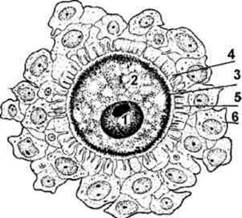
Fig. 1.52. Mammalian egg cell. 1 - nucleus; 2 - cytoplasm; 3 - cortical layer; 4 - plasmalemma;
5 - zona pellucida; 6 - corona radiata.
Last update: 08/08/2026
Editorial and Educational Adaptation: This material has been compiled based on the primary/original source text. The project team performed an editorial review, corrected technical inaccuracies, structured sections, and adapted the content for an educational format.
What was processed:
- elimination of formatting defects (OCR errors, structural breaks, corrupted characters);
- editorial organization of content;
- standardization of terminology in accordance with academic sources;
- verification of factual statements against the original source text.
All mentions of the author, publication year, and origin of the primary text have been preserved in accordance with the source.