MEDICAL BIOLOGY, ANATOMY, HUMAN PHYSIOLOGY AND PATHOLOGY - Ya.I. Fedonyuk 2010
BIOLOGY
SECTION 1. BIOLOGICAL FOUNDATIONS OF HUMAN VITAL ACTIVITY
1.4. ONTOGENETIC LEVEL OF LIFE ORGANIZATION
1.4.1. Reproduction
Prospects for Organism Cloning
In relation to organisms, a clone refers to an individual or a group of genetically identical organisms derived from a single common ancestor through Vegetative Reproduction. The potential for cloning sexually reproducing organisms is illustrated by the experiments conducted by the English embryologist J. Gurdon in 1964–1966 on the African clawed frog Xenopus laevis. By transplanting intestinal epithelial Cell nuclei obtained from a frog tadpole into frog eggs whose own nuclei had been previously destroyed by ultraviolet irradiation, and stimulating them to undergo Cleavage, he successfully produced normal adult frogs (Fig. 1.50). Each descendant organism obtained in this manner can be considered a genetic clone of the original donor organism.
Class="center">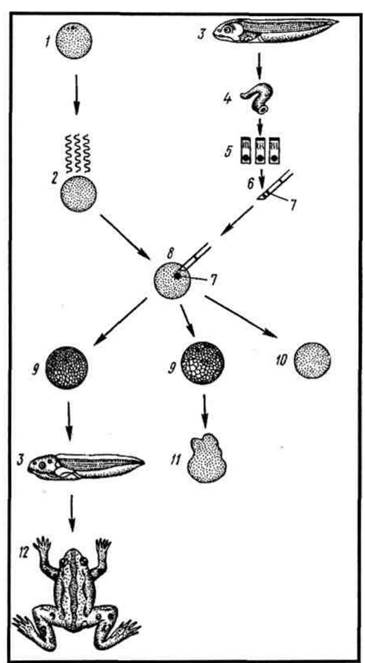
Fig. 1.50. Cloning of the frog Xenopus laevis — development of an adult individual from an egg cell whose Nucleus was replaced by a nucleus from a somatic cell of the tadpole's intestinal epithelium (J. Gurdon's experiments):
1 - unfertilized egg cell; 2 - UV irradiation; 3 - tadpole; 4 - tadpole intestine; 5 - intestinal epithelial Cells; 6 - micropipette; 7 - epithelial Cell Nucleus; 8 - recipient egg; 9 - blastula; 10 - undivided cell; 11 - abnormal embryo; 12 - adult frog.
In 1997, Dolly the sheep was born, created through cloning (without the involvement of a ram's Germ Cells). To achieve this, scientists transferred The Nucleus of an adult sheep's somatic cell into an unfertilized egg cell harvested from another ewe. The resulting embryo was subsequently implanted into the Uterus of a surrogate (non-biological) mother ewe. Dolly lived for 6 years (the average lifespan for this animal species is 12 years). The mechanism used to "create" Dolly can, in principle, be applied to obtain clones of other mammals, including humans. The possibility of human cloning has raised A number of moral and ethical issues. Currently, research related to human cloning is prohibited by law in many countries.
Last update: 08/08/2026
Editorial and Educational Adaptation: This material has been compiled based on the primary/original source text. The project team performed an editorial review, corrected technical inaccuracies, structured sections, and adapted the content for an educational format.
What was processed:
- elimination of formatting defects (OCR errors, structural breaks, corrupted characters);
- editorial organization of content;
- standardization of terminology in accordance with academic sources;
- verification of factual statements against the original source text.
All mentions of the author, publication year, and origin of the primary text have been preserved in accordance with the source.