MEDICAL BIOLOGY, HUMAN ANATOMY, PHYSIOLOGY AND PATHOLOGY - Ya.I. Fedoniuk 2010
ANATOMY, PHYSIOLOGY, PATHOLOGY
CHAPTER 5. BLOOD AND LYMPH CIRCULATION PROCESSES AND THEIR PATHOLOGY
FETAL CIRCULATION FEATURES
The fetus receives oxygen and all nutrients from the maternal Blood via the Placenta, from which the umbilical vein carrying arterial blood extends and enters the fetal body in the umbilical region (Fig. 5.38). Near the porta hepatis, it divides into two branches: one carries arterial blood to the Liver, while the other (the ductus venosus) empties into the INFERIOR VENA CAVA. Consequently, the inferior vena cava then contains mixed blood that enters the right atrium. From the right atrium, this mixed blood flows through the foramen ovale in the interatrial septum into the left atrium.
Class="center">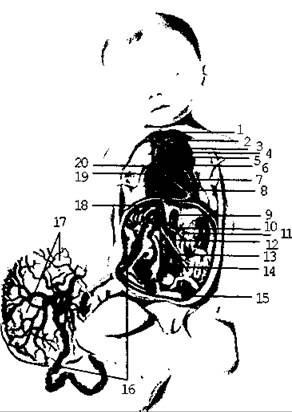
Fig. 5.38. Fetal Circulation
From the left atrium, blood flows into the left ventricle, and from there into the aorta, bypassing the Pulmonary Circulation, which is not yet functional.
In addition to the inferior vena cava, the SUPERIOR VENA CAVA empties into the right atrium. Venous blood from it enters the right ventricle, and from there into the pulmonary trunk. However, this blood enters the pulmonary parenchyma in very small quantities because the Lungs are not yet functioning as a respiratory organ. The bulk of the blood from the pulmonary trunk passes through the ductus arteriosus into the aorta, and from there to all Organs and Tissues, where metabolic exchange takes place in the capillaries.
Renewal of fetal blood occurs via the umbilical Arteries, through which blood is driven into the placenta by cardiac contractions. Here, it is cleared of carbon dioxide and other Metabolic waste products, becomes arterialized, and returns to the fetus via the umbilical Veins.
As a result, the upper half of the body receives blood that is more rich in oxygen and nutrients. For this reason, it develops more rapidly than the lower half of the body.
After birth, the umbilical cord is ligated, blood from the placenta ceases to flow, and carbon dioxide accumulates in the newborn's body, stimulating the respiratory center. This triggers the first breath and the expansion of the lungs. The pulmonary and systemic circulations begin to function just as in adults. The foramen ovale closes, while the ductus arteriosus and ductus venosus collapse and subsequently form their respective ligaments.
Last update: 08/08/2026
Editorial and Educational Adaptation: This material has been compiled based on the primary/original source text. The project team performed an editorial review, corrected technical inaccuracies, structured sections, and adapted the content for an educational format.
What was processed:
- elimination of formatting defects (OCR errors, structural breaks, corrupted characters);
- editorial organization of content;
- standardization of terminology in accordance with academic sources;
- verification of factual statements against the original source text.
All mentions of the author, publication year, and origin of the primary text have been preserved in accordance with the source.