HUMAN MEDICAL BIOLOGY, ANATOMY, PHYSIOLOGY AND PATHOLOGY - Ya.I. Fedoniuk 2010
ANATOMY, PHYSIOLOGY, PATHOLOGY
CHAPTER 3. ANATOMIC AND PHYSIOLOGICAL ASPECTS OF BODY FUNCTION SELF-REGULATION
ENDOCRINE GLANDS AND THEIR PATHOLOGY
THYMUS GLAND
The Thymus gland (thymus), is a central organ of immunogenesis. Within it, T-lymphocyte precursors, which arrive via the bloodstream from the Bone Marrow, undergo a series of stages and transform into T-lymphocytes. The thymus is located in the superior part of the superior Mediastinum, between the right and left mediastinal pleurae. Its upper portion sometimes extends into the cervical region. The anterior surface of the gland lies against the posterior surface of the manubrium and body of the Sternum; its lower parts reach the III-IV Ribs (sometimes the V) in children, and the II intercostal space in adults.
The gland consists of two asymmetrical lobes—left and right—externally covered by a Connective Tissue capsule (Fig. 3.75). Septa extend from the capsule, dividing the thymic parenchyma into lobules. Each lobule consists of a cortex and a medulla.
The stroma of the thymus is formed by reticuloepitheliocytes. Thymic lymphocytes (thymocytes) are located within the meshwork formed by reticular fibers and Cell processes. Thymocytes are packed more densely in the cortex than in the medulla. The medulla contains thymic corpuscles (Hassall's corpuscles)—dense structures formed by concentrically arranged, highly flattened epithelial Cells.
Class="center">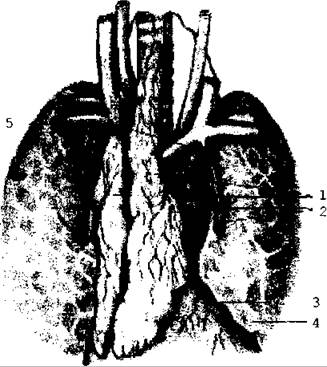
Fig. 3.75. Thymus gland
The gland achieves its maximum development at 10-15 years of age, and with Aging is gradually replaced by adipose tissue.
The gland produces and secretes the Hormones thymosin, thymopoietin I, thymopoietin II, homeostatic thymic hormone, and thymic humoral factor.
There is a definite relationship between age and the functioning of the thymus. The gland is most active during childhood, after which its influence on the body diminishes. Prior to Puberty, thymic hormones suppress the function of the Gonads and promote somatic growth.
It is believed that, In addition to this, the thymus regulates Mineral METABOLISM, specifically calcium metabolism. Following thymectomy, bones become soft, and Muscle weakness and psychiatric disorders easily develop.
Thymic hormones play a major role in The Development of the body's protective immunological responses. It has been proven that the proliferation and differentiation of T-lymphocytes—cells involved in cell-mediated Immunity—take place specifically within the thymus.
Thymic function is regulated by the hypothalamic-pituitary system via somatotropic hormone.
In children, enlargement of the thymus can lead to a highly dangerous condition—thymic-lymphatic status—which may unexpectedly manifest as a sharp drop in Blood pressure and even acute Heart Failure, posing a life-threatening risk.
Hypertrophy of the thymus may lead to the development of blood system disorders, such as leukemia and anemias.
кової (альдостерома, кортикостерома), так і мозкової речовини (феохромоцитома).Last update: 08/08/2026
Editorial and Educational Adaptation: This material has been compiled based on the primary/original source text. The project team performed an editorial review, corrected technical inaccuracies, structured sections, and adapted the content for an educational format.
What was processed:
- elimination of formatting defects (OCR errors, structural breaks, corrupted characters);
- editorial organization of content;
- standardization of terminology in accordance with academic sources;
- verification of factual statements against the original source text.
All mentions of the author, publication year, and origin of the primary text have been preserved in accordance with the source.