GENETICS - Textbook - A.V. Sivolob - 2008
CHAPTER 8. Population Genetics
GENETIC STRUCTURE OF A POPULATION. HARDY-WEINBERG LAW
The genetic Structure of a population refers to The ratio of individuals with different genotypes, the patterns of genetic relationships (mating system), and the distribution of populations into a series of groups (subpopulations) interconnected by allele flows. The primary parameters of population genetic structure are Selection/33.html">Gene and genotype frequencies.
A population may contain one, two, three, or even more (unlimited) alleles of a given gene. A specific diploid individual within a population possesses two alleles (identical in homozygotes and different in heterozygotes) for autosomal genes. Genes on sex Chromosomes in the XY sex-determination system are represented by a single allele in males and two in females; the reverse is true for the ZW system (see Chapter 6).
Allele frequency is defined as the ratio of the number of copies of a given allele to the total number of alleles of that gene across all individuals in the population. If a population contains two alleles of a particular gene (say, A and a), their frequencies can be denoted as $p_A$ and $q_a$, or simply p and q. Genotype frequency is the proportion of individuals with a specific genotype in the population, which can be denoted as f(AA), f(Aa), f(aa).
In 1908, Godfrey Hardy and Wilhelm Weinberg independently concluded that, under certain conditions, the Mendelian mechanism of inheritance maintains a constant ratio of genotypes in a population from generation to generation, regardless of allele frequencies.
Let us consider an example. A group of N = 200 individuals has the following composition:
Class="center">
Let us find the frequency of the dominant allele. Homozygotes carry two identical alleles, while heterozygotes carry only one; the total number of alleles in a diploid population is equal to twice the number of individuals. We have

Similarly, for the recessive allele
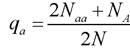
or, yielding the same result,

After calculation by either method, we obtain

Under conditions of panmixia, in accordance with probability theory, the genotype frequencies of the first filial generation are as follows:

Thus, in the case considered, the genotype frequencies of the first filial generation differ from the genotype ratios in the original parental group. Let us determine the frequencies of Gametes carrying alleles A and a produced by individuals of this generation

Unlike genotype frequencies, allele frequencies have remained unchanged. Therefore, In the second filial generation, the genotype frequencies will be identical to those in the first:

Calculating the allele frequencies will again yield 0.6 and 0.4, and in subsequent generations neither these allele frequencies nor the genotype frequencies will change. Such a genotype ratio in a population that is capable of automatically persisting over an indefinitely large number of generations is called an equilibrium genotype ratio, and The phenomenon of maintaining a constant genotype ratio across generations is known as
genetic equilibrium. In the example examined, the genotype frequencies of the initial generation were not in a state of equilibrium, but reached equilibrium after the very first panmictic mating.
Thus, genotype frequencies in a population remain constant over an infinite number of generations for any allele frequencies. This principle, known as the Hardy-Weinberg law, describes a key feature of populations: their ability to maintain constant genotype frequencies (genetic equilibrium). The Hardy-Weinberg law holds true only for ideal (Mendelian) populations: infinitely large, panmictic populations of a diploid sexually reproducing species, assuming equal viability of all genotypes and the absence of other population dynamics factors—factors that alter genotype and/or allele frequencies (see below).
Equilibrium genotype frequencies are determined by squaring the sum of allele frequencies. For two alleles, the Hardy-Weinberg equation is expressed as follows:

In the presence of three alleles

If genotype frequencies in a population (or a group of individuals) are not in equilibrium (i.e., actual genotype frequencies do not match those theoretically expected under the Hardy-Weinberg law for given allele frequencies), the population will reach a state of genetic equilibrium after the very first panmictic mating (as in the example discussed above). This applies to genes located on autosomes.
Let us examine the establishment of genetic equilibrium for sex-linked genes, specifically those on the X chromosome under the XY sex-determination system. In this case, females (the homogametic sex) carry 2/3 of all genes present in the population (located on the X chromosome), while males carry 1/3. In the offspring generation, due to the criss-cross Inheritance of sex chromosomes, males receive all their X chromosomes from their mothers, whereas females receive one from their mother and the other from their father. Consequently, if allele frequencies are not identical in males and females, then in each subsequent generation, the allele frequency in males will equal the allele frequency of females from the previous generation, and in females, it will equal the arithmetic mean of the allele frequencies of males and females from the previous generation. Since females possess 2/3 of the total number of alleles (X chromosomes) in the population and males possess 1/3, the equilibrium allele frequency values are as follows:

where the index f denotes the frequency (equilibrium or non-equilibrium) of the respective allele in females, and m in males. At genetic equilibrium, allele frequencies in females and males are equal. For the example considered in Fig. 8.4, the equilibrium allele frequency value is q = (2/3)qf + (1/3)qm = 2/3. It is important to understand that when genetic equilibrium is established for X-linked genes, allele frequencies change within each sex while remaining constant for The population as a whole.

Fig. 8.4. Establishment of genetic equilibrium for X-linked genes.
The abscissa axis represents the generation number t, and the ordinate axis represents the allele frequency q.
Initial allele frequency values: qm = 0 for males, qf = 1 for females.
With each generation, the difference between qm and qf decreases, and the allele frequency approaches the equilibrium value of 2/3.
Testing a population for equilibrium involves comparing (using the %2 test, see Chapter 3) the actual genotype distribution with the expected genotype frequencies calculated According to the Hardy-Weinberg law. Such testing is only feasible when the frequency of heterozygotes can be determined experimentally, specifically in cases of codominance.
Under complete dominance, AA homozygotes and Aa heterozygotes exhibit the same phenotype; therefore, direct counting cannot determine either the frequency of heterozygotes or the allele frequencies. This can be accomplished using the Hardy-Weinberg law by assuming that the population is in genetic equilibrium. Naturally, in this case, the actual allele frequency values may differ significantly from the hypothetical ones obtained.
Last update: 07/08/2026
Editorial and Educational Adaptation: This material has been compiled based on the primary/original source text. The project team performed an editorial review, corrected technical inaccuracies, structured sections, and adapted the content for an educational format.
What was processed:
- elimination of formatting defects (OCR errors, structural breaks, corrupted characters);
- editorial organization of content;
- standardization of terminology in accordance with academic sources;
- verification of factual statements against the original source text.
All mentions of the author, publication year, and origin of the primary text have been preserved in accordance with the source.