Genetics - A. V. Sivolob 2008
Formal genetics: patterns of trait inheritance
Chromosomes as linkage groups of genes
Inheritance of sex-linked traits
A crucial factor that also affects the distribution of phenotypic classes is that non-homologous sex Chromosomes contain different sets of genes. One should not assume these are genes determining sexual traits: the majority of genes on the human and insect X chromosome encode traits common to both sexes, whereas the Y chromosome is practically inert, as it contains almost no active genes. The Inheritance of Traits whose genes are located on the sex chromosomes is called Sex-Linked Inheritance, and it exhibits significant DEVIATIONS FROM MENDELIAN segregation ratios.
Such inheritance was first studied by Morgan using the fruit fly Drosophila melanogaster, an Organism that played a pivotal role in the Selection/4.html">Development of Genetics and remains highly relevant today.
The X chromosome of Drosophila carries one of the genes responsible for The Development of red eye color ("normal" flies—wild-type flies—have red eyes). A mutation in this Gene converts it into the recessive mutant allele white (abbreviated as w, with the corresponding wild-type allele designated as w+)—homozygotes for the recessive allele are characterized by white eyes. Morgan performed two so-called reciprocal crosses (Fig. 3.10): a red-eyed female crossed with a white-eyed male (direct cross), and conversely, a white-eyed female crossed with a red-eyed male (reciprocal cross).
Class="center">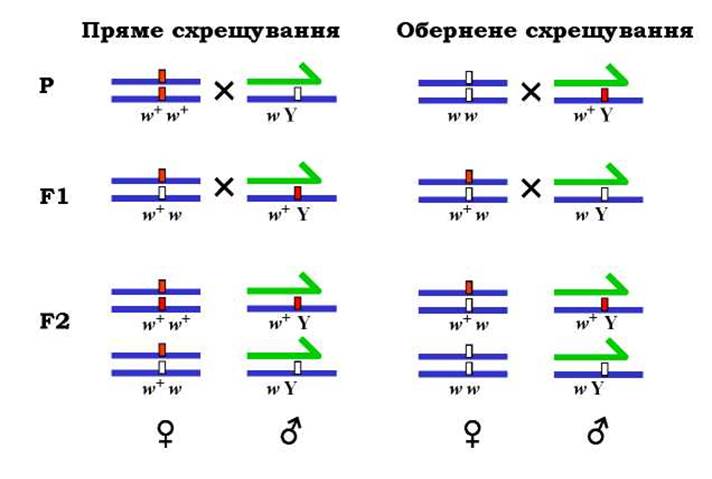
Fig. 3.10. Diagram of reciprocal crosses in Drosophila carrying the recessive w mutation (white eyes) and the corresponding wild-type w+ allele (red eyes). The X chromosome is indicated in blue, and the Y chromosome in green.
In the direct cross, all first-generation offspring were red-eyed, meaning Mendel's first law held true. However, in the reciprocal cross, segregation into red-eyed and white-eyed individuals was observed already in the first generation, such that all females were red-eyed and all males were white-eyed. This pattern of inheritance, where parental traits are transmitted to offspring of the opposite sex, is called criss-cross inheritance.
When crossing the first-generation individuals to obtain F2, the direct cross yielded an overall segregation ratio of 3 : 1, but all females were red-eyed, while males were red-eyed and white-eyed in a 1 : 1 ratio. In the reciprocal cross, a 1 : 1 ratio was observed for both males and females.
Since these segregation patterns correlate entirely with The behavior of sex chromosomes, this experiment became one of the key historical proofs of The Role of chromosomes in heredity.
Last update: 11/08/2026
Editorial and Educational Adaptation: This material has been compiled based on the primary/original source text. The project team performed an editorial review, corrected technical inaccuracies, structured sections, and adapted the content for an educational format.
What was processed:
- elimination of formatting defects (OCR errors, structural breaks, corrupted characters);
- editorial organization of content;
- standardization of terminology in accordance with academic sources;
- verification of factual statements against the original source text.
All mentions of the author, publication year, and origin of the primary text have been preserved in accordance with the source.