BOTANY WITH THE BASICS OF HYDROBOTANY (AQUATIC PLANTS OF UKRAINE) - B.Ye. Yakubenko - 2011
X. SEED PLANTS
Grass Family (Poaceae)
The global flora includes 900 genera and about 11,000 species, while the flora of Ukraine comprises 331 species and 90 genera. The plants possess several specific features: the stems are hollow, occasionally filled with parenchyma, and unlike sedges, they have distinct nodes and internodes; at the Base of the nodes, there is an intercalary (inserted) meristem—a zone where adventitious roots form and axillary buds develop. The leaves are alternate and distichous (two-ranked); the lower part of the leaf is an open sheath, and at the junction with the leaf blade, There is a membranous ligule, with -Gtwo auricles on the sides of the blade that clasp the stem and hold the leaf against it. The leaves are linear, varying in width from broad-linear to setaceous (bristle-like), with parallel venation. The flowers are small and bisexual, except for maize, which has staminate and pistillate flowers on the same plant. The inflorescence is a panicle or a compound spike. The elementary inflorescence is a spikelet (simple spike), which has two, or more rarely one, glumes. The flowers have a reduced membranous perianth and are wind-pollinated. Each flower has a lemma (actually a bract), often with an awn, and a palea, which is formed by the fusion of two bracteoles, and contains two lodicules that cover the Ovary. There are usually three stamens, with filaments dangling downwards. The pistil consists of two or three carpels, occasionally two or one, with two or three, usually plumose, stigmas. The floral formula for most grasses is ↑Р(2)G(3). The fruit is a caryopsis. The embryo is weakly differentiated, with its parts overlapping in a cone-like manner, and is situated laterally adjacent to the endosperm.
Grasses are of immense importance in the biosphere and agriculture. They are the dominant species in plant communities of meadows, steppes, prairies, pampas, and savannas. Together with legumes, they are the Main Components of hayfields and pastures, providing excellent forage for animals. They include the major food crops—the genera wheat, rice, maize, sorghum, millet, barley, and oats. Many wild grasses have been domesticated, have a breeding base, and are cultivated as forage plants. Among them are many aquatic plants, which form an important food source for aquatic fauna.
The family is divided into two subfamilies: Bambusoideae and Pooideae.
Subfamily Bambusoideae. Mostly woody plants or grasses. In Ukraine, they are grown in greenhouse cultivation as ornamental plants.
Subfamily Pooideae. Glumes two, rarely one. Spikelets one- to many-flowered. Inflorescence is a compound spike or a panicle.
Creeping bentgrass (Agrostis stolonifera L.). A perennial plant with stems up to 70 cm tall (Fig. 198). The stems and emergent shoots are decumbent over a considerable length in their lower part, rooting at the nodes, and ascending above. Leaves are linear-lanceolate, 2-7 cm long, light green, with a membranous ligule 1-3.5 mm long. The inflorescence is a panicle, 5.5-9 cm long. Spikelets are grayish-violet, single-flowered, small, and laterally compressed. Glumes are pointed, longer than the florets, with the lower glume longer than the upper. The lemma is membranous with distinct Veins, awnless or with a short awn. The palea is much shorter than the lemma or rudimentary; it flowers in May-June. It grows in wet meadows, forest bogs, riparian and coastal sands, sometimes along the shores of lakes and rivers, in Polissia, the Forest-Steppe, the Carpathians, and rarely in the Steppe and Crimea.
An ornamental plant, one of the best turfgrass species, an excellent green manure, and readily consumed by waterfowl such as geese and ducks.
Velvet bentgrass (A. canina L.). A perennial rhizomatous plant that forms loose tufts (Fig. 199). Stems are 15-40 cm tall, capable of rooting at the nodes. Leaves have long, smooth or slightly rough sheaths. The inflorescence is a panicle up to 15 cm long, with slender and scabrid branches. Spikelets are single-flowered and small. Glumes are equal; there is only one lemma, with a geniculate awn, rarely awnless. It flowers in June-July.
Class="center">Water/water.files/image200.jpg" width="317"/>
Fig. 199. Velvet bentgrass
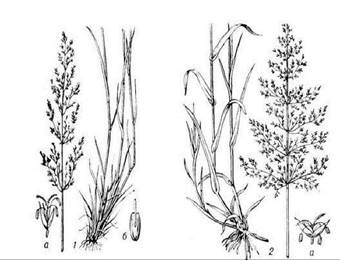
Fig. 198. Creeping bentgrass
It grows in wet meadows and bogs in Polissia and the Carpathians, commonly in the Forest-Steppe, and rarely in the Steppe. It is recommended for establishing all types of lawns.
Shortawn foxtail (Alopecurus aequalis Sobol.). An annual plant, 20-45 cm tall. Stems are geniculately ascending or nearly decumbent, rarely erect. Leaves are short-linear, up to 10 cm long, glaucous-green. The inflorescence is an extremely contracted panicle, 2-6 cm long and up to 5 mm wide. Spikelets are arranged 4-5 on slender branches,
2.5 mm long, oval. The awn is short, barely protruding from the spikelet. The lemma is narrowed towards the apex, obliquely truncate. Anthers are up to 1 mm long, orange. It flowers in May-June. Caryopses are small.
It grows in bogs, wet and damp meadows, and along the shores of water bodies and ditches.
Distributed throughout Ukraine, but rare in the south.
Among other species, creeping foxtail (A. arundinaceus Poir.)—a plant with a long, creeping rhizome and stems 50-150 cm tall—and water foxtail (A. geniculatus L.)—an annual plant with geniculately bent stems (Fig. 200)—occur sporadically in damp meadows and along water bodies throughout Ukraine.
All foxtails are ornamental and forage plants of varying quality; they spread rapidly and are long-lived.
Slough grass (Beckmannia eruciformis (L.) Host.). A perennial plant with a long rhizome and stems 50-150 cm tall, bulbous-thickened at the base. Leaves are 3-7 mm wide, stiff; ligule up to 6 mm long. The inflorescence consists of spike-like branches appressed to the main axis. Spikelets are two-flowered, obovate, laterally compressed,
2.5 mm long, arranged in two rows on one side of the branches. Glumes are inflated and boat-shaped. Lemmas are lanceolate, slightly pubescent on the back.

Fig. 200. Marsh foxtail
It grows in wet and waterlogged meadows, and shallow waters with groundwater and surface flooding. It is widespread throughout Ukraine.
It is a valuable forage, ornamental, and food plant. The green mass contains Proteins (up to 11%), fats (3.7%), and fiber (34.3%).
Purple small-reed (Calamagrostis canescens (Weber) Roth). A rhizomatous plant with erect stems, 50- 100(130) cm tall, branched at the lower nodes. Leaves are gray-green, linear, 4 mm wide, with a prominent midrib. Leaf sheaths are long, smooth or rough at the top. Ligule is obtuse, split. The inflorescence is a panicle, 12-16 cm long, with slightly rough branches in spreading tufts. Spikelets are green or purple, up to 6 mm long. Glumes are acute, longer than the lemmas. The lemma is obtuse, dentate, with a short awn. It flowers in May-July.
It grows in mires, waterlogged meadows, and swampy thinned forests throughout Ukraine, except for Crimea, and is rare in the Steppe zone.
Among other species, the narrow small-reed (C. stricta (Timm) Koeler) is occasionally found in the upper and middle reaches of the Southern Bug, the upper reaches of the Ros River, and the Left-Bank Dnieper region; it is distinguished by a shorter panicle (7-10) cm long and a straight awn arising from the base of the lemma.
There are reports regarding The Use of small-reed roots as a diuretic. In ancient times, the stems of small-reeds were used for roofing, weaving mats, rugs, and strong ropes. The seeds contain fats, proteins, calcium, phosphorus, and magnesium.
Water whorl-grass (Catabrosa aquatica (L.) P. Beauv.). A perennial plant (Fig. 201). Stems are 20-70 cm tall, decumbent at the base and ascending, often rooting at the base. Leaves are linear, 2-9 mm wide. The inflorescence is a diffuse panicle, 10-20 cm long, with long smooth branches. Spikelets are one-, two-, or rarely three-flowered, 2.5-3 mm long. Glumes are unequal, significantly shorter than the lemmas, obtuse; the lemma is broad and membranous at the apex, with three distinct veins. It flowers in May-June.

Fig. 201. Water whorl-grass
It grows on swampy banks of rivers, water bodies, and streams, often in water throughout Ukraine, and is rare in the southern Steppe. It is an indicator of groundwater flooding zones, groundwater discharge sites, and newly formed shallow water areas with a gradual decrease in water level. It is a forage, bank-stabilizing, and ornamental plant.
Tufted Hair-grass (Deschampsia caespitosa (L.) P. Beauv.). A perennial plant, stems 70-150 cm tall, forming tussocks (Fig. 202). Leaves are rough on the upper side, ligule is membranous, up to 8 mm long. The inflorescence is a diffuse, many-spiked panicle with long branches. Spikelets are two- to three-flowered, 3.5-5 mm long, light purple, white, or golden. Glumes are unequal. It flowers in June-July.
It grows in wet meadows, mires, and alder forests throughout Ukraine, and is only occasionally found in the northern part of the Left-Bank Forest-Steppe.
An ornamental and medicinal plant. It is suitable for decorating water bodies. Flavonoid Glycosides isolated from the leaves of tufted hair-grass and bushgrass are part of the antiviral drug "Proteflazid", which is used to treat herpes infections, mixed bacterial-viral infections, and chronic Viral Hepatitis.
Reed sweet-grass (Glyceria maxima (C. Hartm.) Holmberg). A perennial plant with a tall, thick, erect stem, 100-200 cm high, up to 1 cm in diameter at the base. Leaves are 10-20 mm wide, linear, keeled, short-acuminate, and covered with scattered spinules.
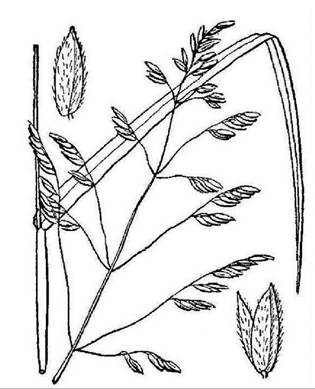
Fig. 202. Tufted hair-grass
The inflorescence is a dense panicle, 20-40 cm long; spikelets are numerous, many-flowered, green or more or less purple, up to 8 mm long. Lemmas are 3-4 mm long, obtuse, with strongly prominent veins and relatively large spinules. The lower glume is 2-3 mm long, and the upper glume is 3-4 mm long. It flowers in May-June.
It grows in swampy areas, lakes, oxbow lakes, waterlogged meadows, and coastal waters, often forming dense stands. Under conditions of significant flooding, it forms non-flowering forms with floating and elongated leaves. It is widespread throughout Ukraine, except for Crimea.
Plicate sweet-grass (G. notata Chevall). A perennial plant, distinguished from the previous species by a denser panicle, having three to five branches at the bottom, of which the shortest bears two to four spikelets; spikelets are up to 25 mm long. It grows in the same conditions as the previous species.
Floating sweet-grass (G. fluitans (L.) R. Br). It has a narrow, almost one-sided panicle, bearing 2 branches in the lower part, of which the shorter one bears only one spikelet.
Reed mannagrass (Glyceria arundinacea Kunth). Panicle with a triquetrous axis and mostly rough branches. Sheaths are closed along their entire length. Leaves are 5-12 mm wide, with well-defined transverse anastomoses. Spikelets are 2-6 flowered, up to 5 mm long. It grows along the banks of rivers, lakes, and ponds. It is occasionally distributed in the Forest-Steppe and Steppe zones.
All sweet-grass species are forage, water-protecting, bank-stabilizing, food, and ornamental plants, suitable for decorating ponds and pools. They have The ability to absorb chemical compounds and purify water. Young shoots of sweet-grasses contain protein (11.4%), fats (1.8%), fiber (31%), micro- and macroelements. The caryopses contain starch and sugars (75%), proteins (9.7%), and fats (0.47%). They are consumed by grass carp and rudd. In summer, beavers feed on them. A disadvantage of sweet-grasses is their ability to release phytoncides, which negatively affect the embryos of aquatic zooplankton.
Rice cutgrass, wild rice (Leersia oryzoides (L.) Sw.). A perennial plant with creeping rhizomes (Fig. 203). Stem is 50-150 cm tall. Leaves are linear, up to 10 mm wide, and, like the sheaths, rough.
Ligule is short. The inflorescence is a loose panicle with thin, wavy branches. Spikelets are one-flowered, strongly laterally compressed, 4-6 mm long; glumes are absent. Lemmas are leathery, the lemma with five veins and a spinulose-Ciliate keel. Stamens are three, rarely one to six. It flowers in May-June. The fruit is a caryopsis. It grows in swamps, on the banks of rivers and streams, and in flooded areas, often forming dense stands. It is widespread throughout Ukraine, common in Polissya and the Forest-Steppe, rarer in the Carpathians and the south, and absent in Crimea.

Fig. 203. Leersia oryzoides, rice cutgrass
A shore-protection plant, suitable for floral arrangements and bouquet decoration.
Purple moor grass (Molinia caerulea (L.) Moench). A perennial with stems 40–150 cm tall, often forming quite loose tussocks; rhizomes are short and creeping (Fig. 204). Stems are erect, node-free; leaf blades are linear, 3–8 mm wide, flat, rigid, with prominent veins; leaf ligules transition at the base into densely set, flexible, long hairs. The inflorescence is a narrow panicle, contracted after flowering, 8–25 cm long; spikelets are small, 3–4 mm long, 2–5-flowered, typically purple; lower lemmas are 3–6 mm long, longer than the glumes, lanceolate, awnless. Flowers from June to August.
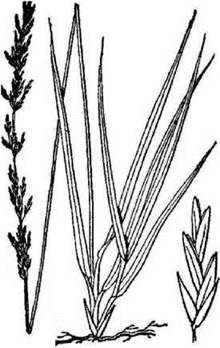
Fig. 204. Purple moor grass
Grows in bogs, waterlogged peat meadows, damp forests, along banks, and in terrace-edge and central parts of river floodplains. Distributed in Polissya, sporadically in the Left-Bank Forest-Steppe, and rarely in the Right-Bank Forest-Steppe.
An ornamental plant with green biomass of low forage quality, suitable as feed only in its young stage.
It contains proteins (15.6%), fats (2.2%), crude fiber (up to 31%), and nitrogen-free extractives (47%). A poisonous plant; various PARTS OF THE shoots, especially the panicles during flowering, contain hydrocyanic acid, which is absent in young plants. Suitable for decorating the banks of water bodies, it deserves to be introduced into cultivation, especially in waterlogged areas.
Reed canary grass (Phalaroides arundinacea (L.) Rausch.). A perennial plant with stems 50–200 cm tall. Leaves are broadly linear, up to 20 mm wide; ligule up to 6 mm long. The inflorescence is a dense, more or less lobed panicle, 8–20 cm long. Spikelets are linear, 6 mm long, single-flowered. There are four glumes: the two outer ones are oblong-lanceolate, unwinged along the keel, equal in length to the spikelet; the two inner ones are linear, up to 1 mm long, hairy. Lemmas are leathery, glossy, up to 3 mm long. Grows along riverbanks, springs, sand quarries, ditches, and in waterlogged meadows. Frequently forms dense thickets. Distributed throughout Ukraine, except for the southern Crimea.
An ornamental, water-conserving, bank-strengthening, and promising forage plant. There is an ornamental form with striped leaves cultivated in gardens and parks under the name "ribbon grass" (silk grass). During the vegetative phase, the green biomass contains protein (up to 8%), crude protein (6.8%), fats (2%), crude fiber (24.4%), micro- and macroelements, and carotene (33.3 mg/kg).
Common reed (Phragmites australis (Cav.) Trin. ex Steud.). A perennial rhizomatous plant (Fig. 205) with stems 80–500 cm tall; leaves are typically broadly linear, 10–50 mm wide, rigid, sharply scabrous along the margin, with a sheath capable of rotating around the stem so that, depending on the wind direction, the leaf blade faces one side—hence the plant's vernacular name "weather vane". The inflorescence is a panicle whose color depends on the flowering stage, ranging from light brown to dark brown; a contracted panicle is significantly darker than an open one. Generative shoots die off after flowering. Spikelets are 6–17 mm long, dark purple. Glumes are membranous, acute, unequal: the lower glume is 2.5–5 mm long, and the upper glume is up to 3–9 mm long, awl-shaped acute, with a point 2–3 times exceeding the glume itself. Flowers in May–June. Grains remain in the panicle for a long time after ripening.

Fig. 205. Common reed
Grows along the banks of rivers and lakes, in bogs, and in river floodplains, forming extensive thickets.
Distributed throughout Ukraine.
A technical, food, medicinal, phytoremediative, and forage plant. Reed stems are used as building and roofing material and fuel, for constructing fences; finely chopped stems are added to adobe (mudbrick), and pressed stems serve as a cork substitute for insulation. They are also used to craft souvenirs such as pipes and mouthpieces, and to weave mats, baskets, and other household items. The stems are suitable for paper production. Young leaves and shoots contain 3,000–5,000 mg of Vitamin C and can be used in salads. Dried rhizomes are ground into flour, while roasted ones are used as a coffee surrogate. In folk medicine, an infusion of the leaves and stems is recommended as a diuretic and diaphoretic agent. For forage, only stems harvested before the onset of flowering are used, yielding 8–9 tons of green mass per hectare of thickets. They are consumed in early summer by common carp, grass carp, and perch; the plant is also suitable for ensilage. It holds significant ecological importance: its thickets transpire large amounts of water, helping to drain waterlogged areas. Where groundwater tables are shallow, it can be used for sand stabilization.

Fig. 206. Fowl bluegrass
Fowl bluegrass (Poa palustris L.). A perennial plant with stems 30–120 cm tall (Fig. 206). Leaves are narrow-linear; ligules of the upper stem leaves are obtuse-triangular. The inflorescence is a panicle; spikelets are multi-flowered, 4 mm long; the spikelet axis is smooth. The lemma is short-pubescent along the marginal veins, 2–3 mm long, with an obtuse or rounded apex, green, without prominent intermediate veins. Flowers in May–June.
Grows in floodplain meadows and bogs throughout Ukraine. All bluegrasses are valuable forage and ornamental plants, suitable for establishing standard lawns under high-moisture conditions.
In similar habitats in Ukraine, rough bluegrass (Poa trivialis L.) is also widespread, distinguished by stems that are rough just below the inflorescence and sharply pointed leaf ligules. The plant is consumed by grass carp and rudd.
Last update: 07/08/2026
Editorial and Educational Adaptation: This material has been compiled based on the primary/original source text. The project team performed an editorial review, corrected technical inaccuracies, structured sections, and adapted the content for an educational format.
What was processed:
- elimination of formatting defects (OCR errors, structural breaks, corrupted characters);
- editorial organization of content;
- standardization of terminology in accordance with academic sources;
- verification of factual statements against the original source text.
All mentions of the author, publication year, and origin of the primary text have been preserved in accordance with the source.