BOTANY WITH BASICS OF HYDROBOTANY (AQUATIC PLANTS OF UKRAINE) - B.Ye. Yakubenko - 2011
X. SEED PLANTS
Hornwort Family (Ceratophyllaceae)
Perennial herbs that float in the Water Column and lack roots. They are entirely submerged in water at all times and never grow on land. They feature solitary axillary branches, jointed, brittle, slender stems, and sessile leaves arranged in whorls without stipules, forked into thread-like cartilaginous segments. By autumn, the stem growing tips become covered by leaves that are clustered and darker green than the others; some botanists consider these to be functional equivalents of winter buds (turions). They overwinter at the bottom of the water body, and new plants grow from them in spring. Hornworts have an optimally developed leafy stem that rises upright in the water. The leaves are sessile, repeatedly dichotomously divided, whorled, and never rise above the water surface. Their ultimate segments range from linear to thread-like, often with finely serrated margins and a rigid texture. However, unlike all other members of the order, they are characterized by a poorly developed Vascular System. Mineral absorption is carried out across the entire surface of the plant body. The reduction of xylem as an adaptation to an aquatic lifestyle has gone so far that tracheids have completely lost their water-conducting function and transformed into entirely unlignified storage Cells that accumulate starch.
Flowers are small, inconspicuous, sessile, unisexual, apetalous, and arranged in reduced inflorescences. Staminate and pistillate flowers are located at different nodes of the plant; pollination occurs underwater.
The perianth is simple and calyx-like: in staminate flowers, it consists of 12 (8–15) whitish segments, while in pistillate flowers, it consists of nine to ten greenish segments fused at the base. Some botanists suggest these are bracteoles rather than sepals, meaning the flowers of hornworts lack a perianth altogether. There are 10–16 (5–27) free stamens arranged spirally on a convex receptacle, with short filaments and long anthers. Pollen grains are large, elongate-rounded, inaperturate, with a thin exine and weakly developed surface sculpture. The pistillate flower contains a single carpel. The Ovary is superior, unilocular, with a single orthotropous pendulous ovule. The style is long and acute, persisting on the fruit as a spine. Floral formulas: staminate — *P8–15A5–27, pistillate — *P9–10G1. The fruit is a nutlet, sometimes featuring a winged margin or two to four additional spines. The seed contains a large embryo with fleshy cotyledons, lacking both endosperm and perisperm, and is covered by a thin seed coat.
Hornworts grow at various depths, with their lower depth limit sometimes reaching up to 9 m. The plants are shade-tolerant and extremely sensitive to light. At optimal depths, they often develop a large biomass, outcompeting all other aquatic plants and forming dense thickets that frequently impede boat navigation.
The family is monotypic, represented by a single genus comprising about 10 species distributed almost worldwide, except for the Arctic and Antarctica. Four species are known in Ukraine.
In cultivation, hornworts are used as aquarium plants as well as in garden ponds. They are best suited for cold-water aquariums. Hornwort leaves have The ability to purify water, a property that aquarists can utilize as a natural filtration system.
All hornwort species serve as a food source for fish, particularly cyprinids, as well as amphipods, narrow-winged moths, crayfish, and waterfowl, including domestic birds.
Don hornwort (Ceratophyllum tanaticum Sapjeg.). A perennial plant, 30–100 cm long, hydrophyte, hydrophile, hydrochore, ornithochore. Roots are absent. The stem is smooth, extremely slender, thread-like, and dichotomously branched. Leaves are light green, 1.0–1.5 cm long, gathered in groups of four to six (eight) in dense whorls, and repeatedly forked into 8–15 thread-like, distantly toothed segments.
Flowers are unisexual, and the plant is monoecious. The fruit is a nutlet, 5 mm long, with a dentate-winged, oval, flattened margin and two flattened spines at the base. It blooms in May underwater. Unlike other species of this genus, it is distinguished by high seed productivity, which is associated with its confinement to shallow ecotopes that dry up at the end of the vegetative season.
A rare, relict plant requiring protection. It grows in marshes and well-warmed lakes. Known in the Forest-Steppe zone (Cherkasy Region, Chornobai District, near the village of Velyka Buromka in the Sula River valley; Kharkiv Region, Zmiiv District, near Lyman village in the "Gorila Dolyna" tract) and the Steppe zone (Dnipropetrovsk Region, near Novomoskovsk, Samara River; Kherson Region).
Submersed hornwort (Ceratophyllum submersum Cham.). A perennial plant, 20–30 (100) cm long, hydrophyte, hydrophile, hydrochore, ornithochore. Roots are absent. The stem is thread-like, dichotomously branched in the upper part. Leaves are light green (sometimes reddish or brownish), 4–8 (10) per whorl, 2–3 cm long, forked-ternately divided into delicate, thread-like, distantly spiny, toothed segments.
Flowers are unisexual, and the plant is monoecious. The fruit is a nutlet with only an apical spine. Underwater flowering occurs from June to September. Vegetative Reproduction predominates over seed reproduction.
Distributed sporadically in the water bodies of the Dnipro, Siverskyi Donets, and Southern Bug river basins.
Broad-spined hornwort (Ceratophyllum platyacanthum Cham.). A perennial plant, 30–100 cm long, hydrophyte, hydrophile, hydrochore, ornithochore. Roots are absent. The stem is thread-like, dichotomously branched in the upper part. Leaves are dark green, 6–8 per whorl, 1.5–2.0 cm long, once or twice forked into thread-like segments.
Flowers are unisexual, and the plant is monoecious. The fruit is a nutlet, 4–5 mm long, elongate-oval, with a flat winged, dentate margin, three main long awl-shaped outgrowths, and two short additional ones. It blooms underwater from June to September.
Distributed sporadically, mainly in water bodies of the Dnipro river basin, in Polissia (Kyiv), and the Steppe zone (Mariupol, Kherson).
Rigid hornwort / Common hornwort (Ceratophyllum demersum L.). A perennial submerged aquatic plant, 20–100 cm tall, hydrophyte, hydrophile, hydrochore, ornithochore, anthropochore (Fig. 105). Roots are absent, but the plant anchors itself in bottom silt using the lower part of the SHOOT, which loses its green color in this process. Stems are
thread-like, dichotomously branched, and brittle. Leaves are dark green, rigid, 1.5–2.0 cm long, arranged in whorls of four to ten along the stem, once or twice forked into spine-toothed, thread-like-linear segments, with fine Teeth along the margins.
Class="center">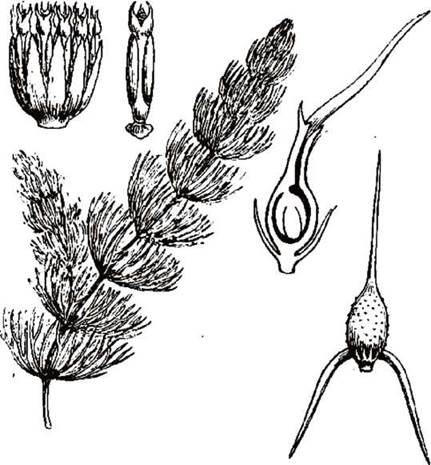
Fig. 105. Common hornwort (Ceratophyllum demersum).
Internode length decreases toward the apex of the shoot, measuring 1.0–1.5 (2.5) cm. Crowded, thickened whorls of leaves form in autumn at the tips of shortened shoots, resembling turions. Vegetative reproduction prevails over generative reproduction, and the plant is more frequently found in a vegetative state.
Flowers are extremely small, unisexual, and located underwater in the leaf axils. The plant is monoecious. The perianth is reduced. Staminate flowers are reddish in bud, grouped in small rosette-like clusters at the nodes within the leaf axils. Pistillate flowers are solitary in the leaf axils. The fruit is a single-seeded, oblong or oblong-oval nutlet up to 5 mm long, with three spines: an apical spine equal to or longer than the fruit, and two downward-pointing lateral spines. Fruits ripen in water. It blooms from June to September.
Vegetative reproduction (via shoot fragments) prevails over seed propagation. In autumn, specialized vegetative propagules are formed: shortened shoots, 2–2.5 cm long, with closely spaced internodes and leaves thickened due to the accumulation of starch grains. However, true turions have not been observed.
This species serves as a food source for gastropods (pond snails, hydrobiids), freshwater shrimp, crayfish, aquatic sow bugs, amphipods, insects (diving beetles, scavenger beetles, narrow-winged moths, Lepidoptera, Diptera, including mosquitoes), fish (family Cyprinidae), birds (family Rallidae, as well as geese and ducks), and nutrias.
It grows in freshwater standing, slow-flowing, and flowing water bodies at depths of (20) 50–100 (250) cm throughout Ukraine.
The plant is suitable for cold-water aquariums.
Last update: 07/08/2026
Editorial and Educational Adaptation: This material has been compiled based on the primary/original source text. The project team performed an editorial review, corrected technical inaccuracies, structured sections, and adapted the content for an educational format.
What was processed:
- elimination of formatting defects (OCR errors, structural breaks, corrupted characters);
- editorial organization of content;
- standardization of terminology in accordance with academic sources;
- verification of factual statements against the original source text.
All mentions of the author, publication year, and origin of the primary text have been preserved in accordance with the source.