Plant Physiology - Lecture Notes - O. M. Tarnopilska 2019
5. Plant Respiration
5.7 Stage III of Respiration. Respiratory Electron Transport Chain (ETC) and Oxidative Phosphorylation
The Mitochondrial Electron Transport chain consists of electron carriers that transfer electrons from substrates to oxygen. The spatial arrangement of these carriers is determined by their redox potentials. The chain begins with NADH, which has a potential of -0,32 V, and terminates with oxygen, possessing a potential of +0,82 V. The carriers are embedded within and span both sides of The inner mitochondrial membrane. On the inner side of the membrane, facing the mitochondrial matrix, two protons and two electrons from NADH are transferred to flavin mononucleotide and iron-sulfur Proteins. Upon accepting the protons, flavin mononucleotide is reduced and shuttles them to the outer side of the membrane, releasing the protons into the intermembrane space. The iron-sulfur proteins, located within the membrane, pass the electrons from NADH to oxidized ubiquinone Q. After picking up two additional protons, ubiquinone diffuses through Cell/29.html">The Lipid Bilayer to the Cytochromes. Cytochrome b560 donates two electrons to ubiquinone, which then accepts two more protons from the matrix, transfers two electrons to cytochrome b556 and two electrons to cytochrome c1, while releasing protons into the intermembrane space. On the outer surface of the membrane, cytochrome c accepts two electrons from cytochrome c1 and passes them to cytochrome a, which translocates them across the membrane to cytochrome a3. Cytochrome a3 binds
oxygen and donates electrons to it. Oxygen then combines with two protons to form Water (Fig. 5.5).
Class="center">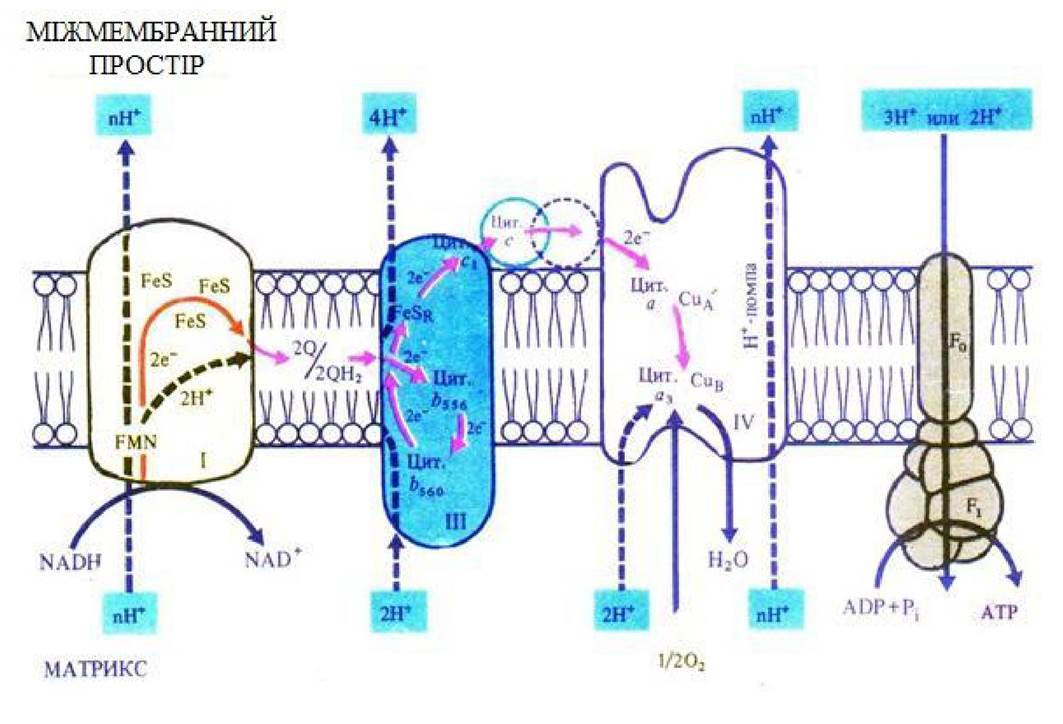
Figure 5.5 - Localization of electron and proton transport reactions in the inner mitochondrial membrane (adapted from V. V. Polevoy)
Thus, Electron transport along the Respiratory Electron Transport chain is coupled with the Transmembrane Translocation of protons. The resulting Electrochemical Potential difference across the inner mitochondrial membrane drives ATP synthesis (Oxidative Phosphorylation), as detailed in Section 4.3. The passage of a pair of electrons through the chain yields 3 molecules of ATP.
Last update: 07/08/2026
Editorial and Educational Adaptation: This material has been compiled based on the primary/original source text. The project team performed an editorial review, corrected technical inaccuracies, structured sections, and adapted the content for an educational format.
What was processed:
- elimination of formatting defects (OCR errors, structural breaks, corrupted characters);
- editorial organization of content;
- standardization of terminology in accordance with academic sources;
- verification of factual statements against the original source text.
All mentions of the author, publication year, and origin of the primary text have been preserved in accordance with the source.