Plant Physiology - Musiyenko M.M. 2001
Water regime of plants
Molecular structure and physical properties of water
Water is the only substance on Earth that concurrently occurs in abundant amounts in liquid, solid, and gaseous states.
In its liquid state, alongside simple molecules, water also contains more complex associates (Н2О)n. It is this unique capacity of water that dictates its characteristic specific properties.
A water molecule consists of one oxygen atom and two hydrogen atoms. Hydrogen has a positively charged Nucleus (proton) and a single negatively charged electron (Fig. 21).
Class="center">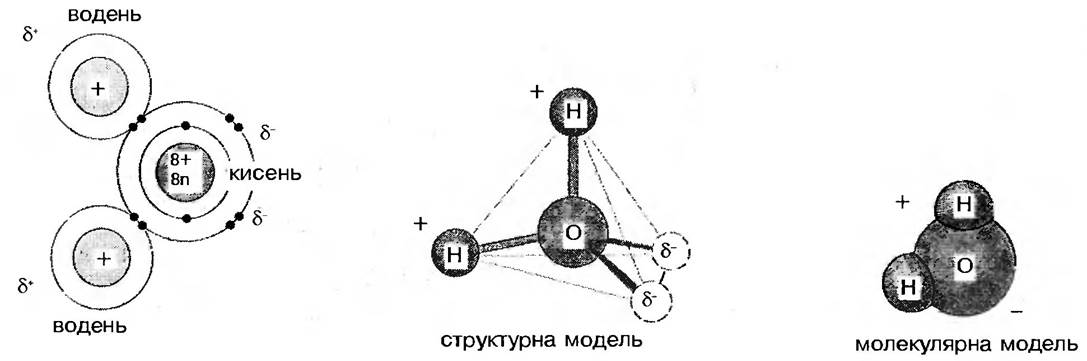
Fig. 21. Structure of a water molecule
An oxygen atom contains 8 protons and 8 electrons. Its inner and outer orbits contain 2 and 6 electrons, respectively. Hydrogen lacks a single electron to complete its stable 2-electron outer shell, whereas oxygen lacks two, creating a mutual affinity between them. In a water molecule, this is expressed through The formation of two -O-H bonds. The center of the water molecule is the oxygen nucleus, with the hydrogen nuclei positioned at an angle of about 105° (Fig. 22). The Displacement of the hydrogen atoms to one side of the oxygen atom makes the water molecule polar and, consequently, electrically active.
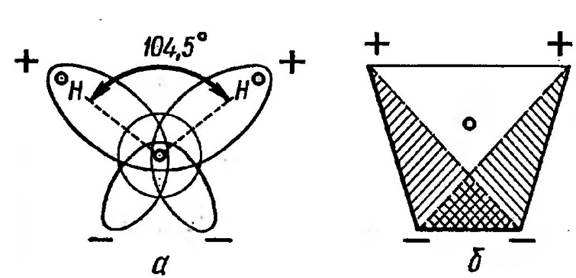
Fig. 22. Polarity of the water molecule
In a water molecule, an excess positive charge is concentrated on the hydrogen atoms, while a negative charge is concentrated on the two unshared pairs of the oxygen atom. Therefore, the water molecule as a whole acts as a dipole (from the Greek word meaning two poles). Thus, a dipole is a system of two point electrical charges equal in magnitude and opposite in sign. The attraction of such charges leads to the formation of Hydrogen Bonds between water molecules:
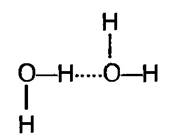
This is a relatively weak bond, given that in liquid water the energy required to break it is 18.84 kJ per mole (by comparison, the energy of the covalent H-O bond in a water mole-
cule is 460.4 kJ per mole). Hydrogen bonds are constantly forming and breaking. Because electrons are more strongly bound to oxygen atoms within the water molecule, proton dissociation occurs, meaning the dissociation of water into hydrogen ions (Н+) and hydroxyl ions (OH ). At 25° C, the hydrogen ion concentration in pure water is 1x10⁷ moles per liter, which corresponds to a pH of 7. Each water molecule can be linked by 4 hydrogen bonds to 4 corresponding neighboring molecules, resulting in a pentagonal structure.
According to modern concepts, The structure of water is based on an ordered framework representing a crystal lattice, blurred by the thermal motion of its constituent particles: water molecules.
The quasicrystalline (quasi meaning imaginary, not genuine) structure of water is the principal feature that distinguishes it from other liquids. The structural peculiarities of water in both solid (Fig. 23) and liquid (Fig. 24) states determine its unique properties.
Thus, water's versatility as a solvent is driven by the polarity of its molecules and their ability to form hydrogen bonds. The dissolution of inorganic salt crystals occurs due to the Hydration of these salt ions.
Organic substances containing carboxyl, hydroxyl, and other functional groups also dissolve readily in water, forming hydrogen bonds with it.
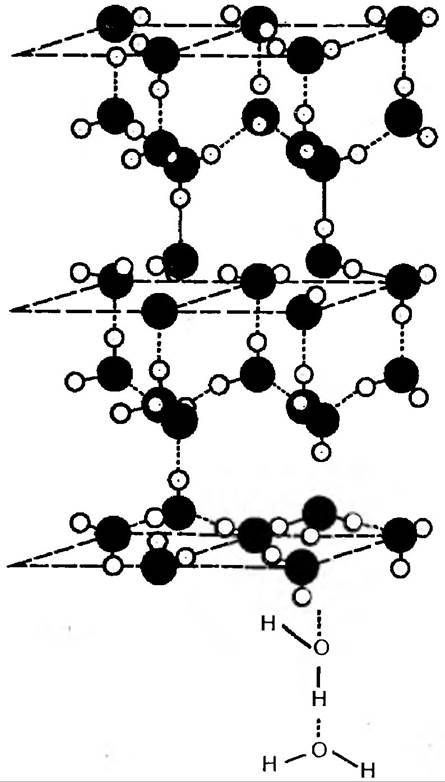
Fig. 23. Arrangement of hydrogen bonds between water molecules in the spatial lattice of ice. Bottom: directionality of the Hydrogen bond
The Physiological Role of water is determined primarily by its physical properties.
Water is the most anomalous substance, despite serving as the reference standard for density and volume among liquids. All substances increase in volume when heated while decreasing in density. However, at a pressure of 1 atm (0.1013 MPa), water within the Temperature range of 0 to 4 °C exhibits a decrease in volume with rising temperature, reaching its maximum density at 4 °C (at this
temperature, 1 cm3 of water has a mass of 1 g, and its density equals 1). This property of water — whereby it achieves maximum density at 4 °C and, upon further cooling, ceases to contract and instead expands — is of critical importance for aquatic life. Otherwise, all water in bodies of water would cool down to 0 °C and freeze solid. Thanks to this anomaly, as bodies of water cool, their surface density increases because the surface layers cool first. These cooled water layers, being denser, sink downwards until the water temperature throughout the entire depth reaches the density threshold, i.e., 4 °C. Upon further cooling, the water becomes lighter and therefore does not sink to the bottom, meaning it does not mix with the deeper layers, protecting them from dropping to lower temperatures. At 0 °C, the water body becomes covered with ice. During freezing, the volume of water increases sharply, while during ice melting, it decreases just as sharply. These volumetric changes in water are a major factor influencing parent rock during soil formation. Water is capable of exerting pressures up to 2,400 atmospheres, thereby fracturing rock.
The presence of hydrogen bonds leads to an elevated boiling point and heat of vaporization due to the additional energy required to break or alter them.
As a result of hydrogen bonds, water exhibits several anomalies compared to other liquids, such as a remarkably high boiling point (100 °C) and the highest specific heat capacity of any liquid or solid. The heat capacity of water (i.e., The amount of heat required to raise the temperature by 1 °C) is 5 to 10 times higher than that of other substances. The boiling point of water increases with rising pressure, whereas its melting (freezing) point, which is 0 °C, decreases.
Water's high heat capacity protects plants from abrupt temperature spikes when ambient air temperature rises, while its high heat of vaporization (2.3 kJ per 1 g) ensures Organism thermoregulation.
Water possesses an exceptionally high surface tension driven by powerful cohesive forces between its molecules; only mercury has a higher surface tension. Water is also characterized by adhesion, which manifests when it is drawn upward against gravitational forces, for instance, in plant Vascular Tissues. This pronounced adhesive capacity plays a vital role in water's interactions with other cellular components.
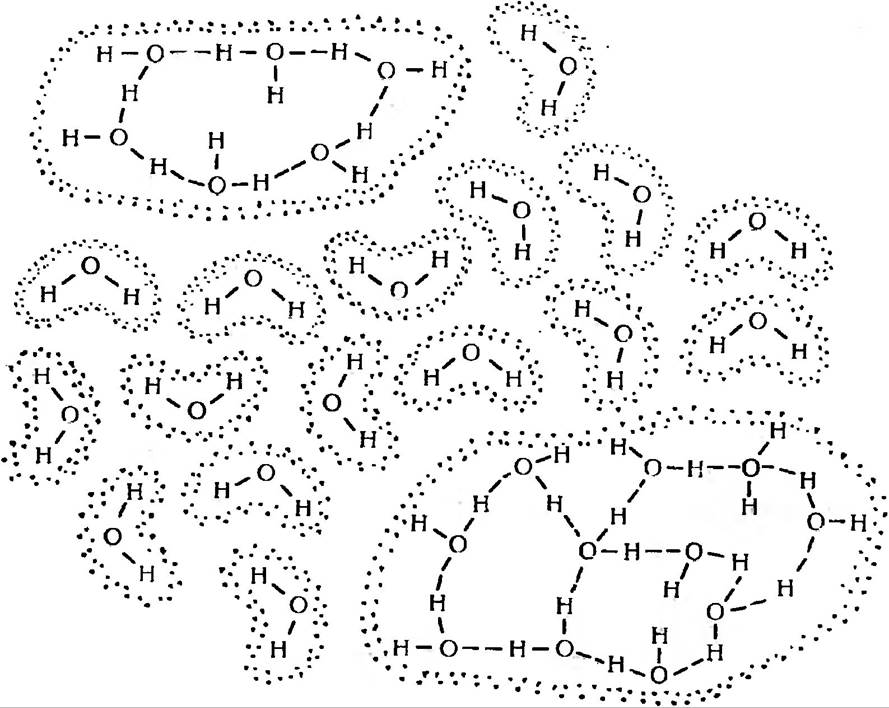
Fig. 24. Model of the cluster structure of liquid water
Water also possesses high thermal conductivity (The transfer of energy from warmer to cooler areas of a body via thermal motion and the interaction of microparticles), which enables it to evaporate even at 0 °C.
Another paramount property is water's well-known ability to dissolve gases.
Due to these unique physicochemical properties, water has proven to be the most suitable internal environment for All living organisms, including plants.
To study various processes of plant water relations—including water Uptake and Transport, and membrane permeability—labeled (isotopic) water is widely used. The indicators employed include the stable hydrogen isotope deuterium (D), the radioactive isotope tritium (T), as well as water labeled with the stable oxygen isotope 18O.
Deuterium is heavy hydrogen, a stable hydrogen isotope with a mass number of 2 (D or 2Н). Its atomic nucleus (deuteron) consists of a proton and a neutron. With oxygen, it forms heavy water (D2О). Heavy water (D2O) is present in trace amounts (approximately 0.015%) in rivers, lakes, and seas.
The radioactive hydrogen isotope is tritium (T, 3Н), a heavy beta-radioactive hydrogen isotope with a mass number of 3. Its atomic nucleus consists of a proton and two neutrons.
The stable oxygen isotope 18О accounts for only 0.003% of natural oxygen relative to 16О.
The Essence of the isotopic method is that isotopic water is added to the regular water used to study plant water relations. At specific intervals, water samples are taken from the studied plant parts and the isotope content is determined. Based on the obtained data, one can evaluate The rate of Water uptake and transport within the plant, Cell membrane permeability, the rate of cellular water exchange, and other parameters.
Last update: 07/08/2026
Editorial and Educational Adaptation: This material has been compiled based on the primary/original source text. The project team performed an editorial review, corrected technical inaccuracies, structured sections, and adapted the content for an educational format.
What was processed:
- elimination of formatting defects (OCR errors, structural breaks, corrupted characters);
- editorial organization of content;
- standardization of terminology in accordance with academic sources;
- verification of factual statements against the original source text.
All mentions of the author, publication year, and origin of the primary text have been preserved in accordance with the source.