Plant Physiology - Musiyenko, M. M. 2001
General principles of regulation of plant growth and morphogenesis
Integration of regulatory mechanisms at the organism level
Integration is The process of ordering, coordinating, and combining structures and Functions—essentially, a system of connections for functionally uniting individual physiological reactions into the complex, mutually coordinated activity of a plant Organism. All intercellular regulation systems—trophic, hormonal, and electrophysiological—are interconnected. Each of these systems acts upon The Cell through intracellular regulation systems, thereby collectively creating a unified regulatory network. However, the interaction of parts alone does not ensure the holistic behavior of a plant organism; centralized control is required for each distinct period of ontogenesis.
As is well known, plants exhibit a bipolar Structure featuring SHOOT and ROOT poles. These serve as zones of Tissue and organ formation, as well as sensory and attracting centers. The shoot apex can be replaced by auxin and the root apex by cytokinin—phytohormones produced by these dominant centers. How do these dominant centers influence the other PARTS OF THE whole organism? Primarily, this is achieved through the establishment of physiological fields (gradients). Physiological gradients (polarity) and channeled connections (conducting vessels, bundles) participate in spatial coordination. Their MECHANISM OF ACTION is as follows: receptor Cells receive a signal -> the signal is transformed into a hormonal or electrical one → transmitted via channeled connections to competent cells → --- functional activity as a response to the signal. Thus, the Organismal Level of integration occurs through the interaction of parts operating via regulatory loops and centralized management elements. Dominant centers, utilizing fields, channeled connections, and oscillations (rhythms), ensure the integrity of the plant organism.
Class="center">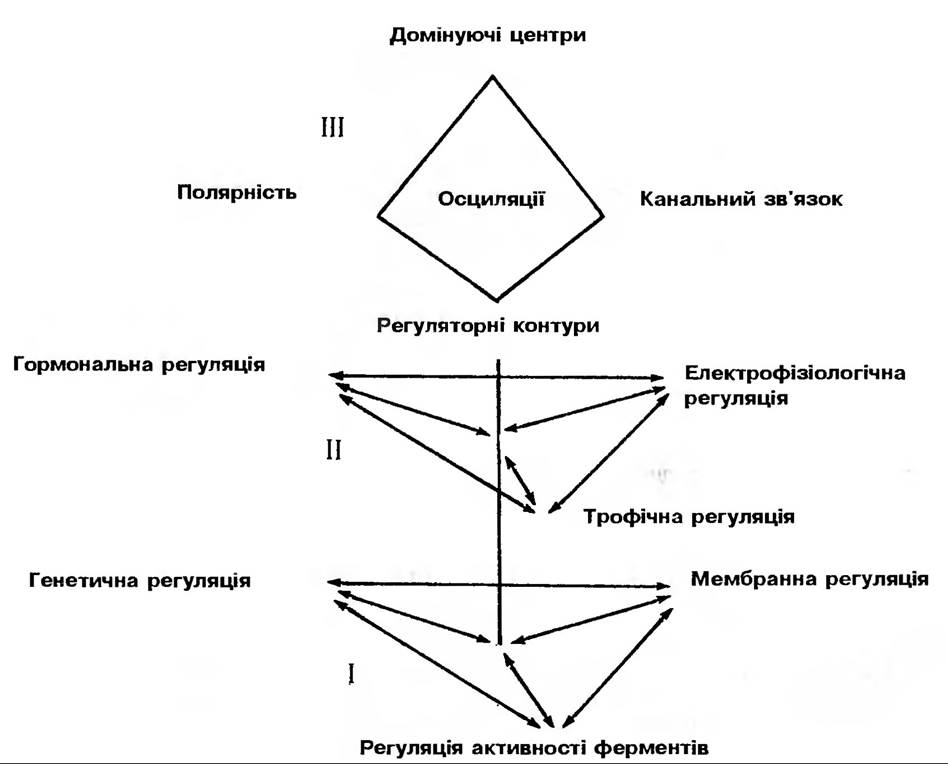
Fig. 185. Hierarchy of regulatory systems in multicellular plants: I — Intracellular regulatory systems; II — Intercellular regulatory systems; III — organism-level regulation
and physiological rhythms in the Temporal Organization of plant life activity. The interaction within and between intercellular regulatory systems takes the form of regulatory loops (Fig. 185).
Last update: 07/08/2026
Editorial and Educational Adaptation: This material has been compiled based on the primary/original source text. The project team performed an editorial review, corrected technical inaccuracies, structured sections, and adapted the content for an educational format.
What was processed:
- elimination of formatting defects (OCR errors, structural breaks, corrupted characters);
- editorial organization of content;
- standardization of terminology in accordance with academic sources;
- verification of factual statements against the original source text.
All mentions of the author, publication year, and origin of the primary text have been preserved in accordance with the source.