Plant Physiology - Musiyenko, M. M. 2001
Physiology of Plant Growth and Development
Correlative Growth
At all stages of higher plant ontogeny, The regulation of growth processes, morphogenesis, and all Functions of the plant Organism takes place. The constant restructuring of correlative relationships ensures the execution of the genotype's program. A rather significant role in these processes is played by correlative growth. The dependence of the growth of one tissue on another, or of one SHOOT on another—that is, the relative growth of different Organs of the plant organism—is referred to as correlative growth. V.V. Polovyi and T.S. Salamatova (1991) summarized the interdependence of growth in various plant organs, emphasizing The Role of the shoot apex (functional apical bud) and the ROOT tip (root apex with root cap):
Class="center">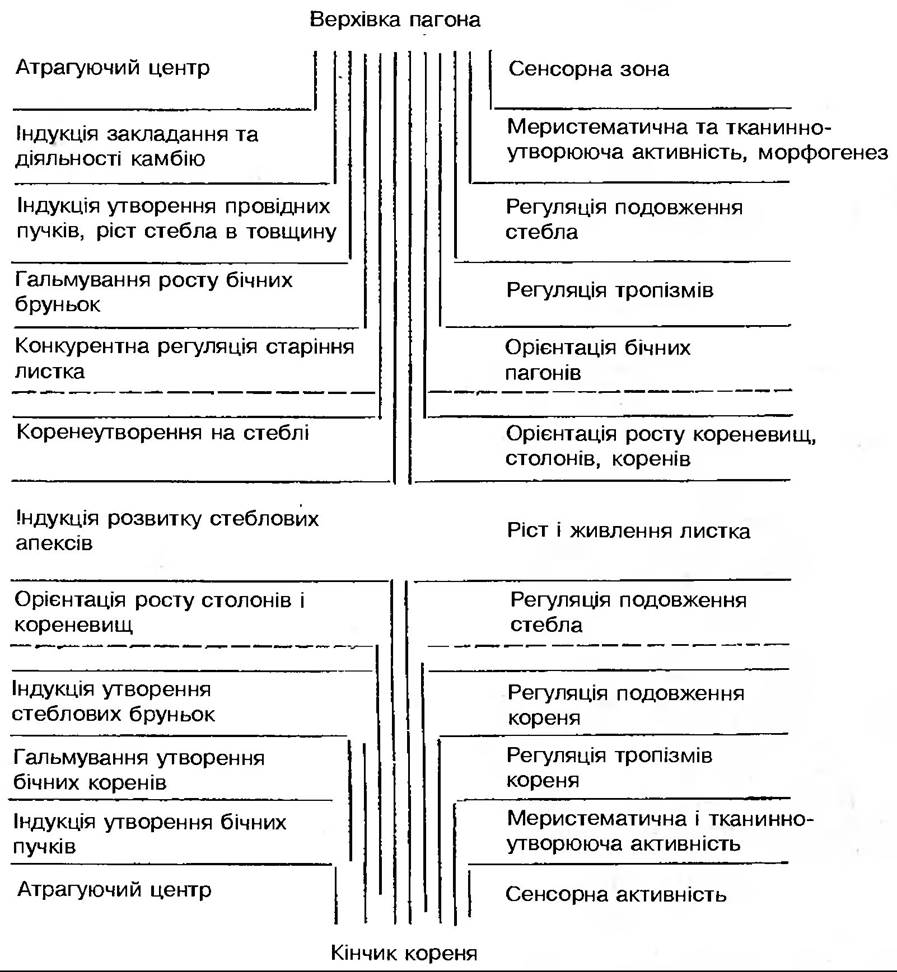
The main factor governing these correlative interactions is the phytohormonal status of the shoot and root. The shoot apex ensures the synthesis and outflow of Auxins, which trigger the general genetic program of root formation, whereas the root tip produces Cytokinins that, upon reaching the aerial part of the plant, trigger the program for leaf formation, growth, and activity. Overall, the interaction between the shoot and the root is far more complex. Electrical gradients and action potentials under various conditions exist between the shoot and the root.
Donor-acceptor relations also act as one of the most important mechanisms of correlative growth. Donors of assimilates—and more broadly, of organic nutrients—can be leaves as well as the storage compounds of Tissues and organs. A developing bud serves as an acceptor of assimilates from photosynthetic leaves. When a leaf reaches approximately half of its final size, its photosynthetic output begins to exceed its own needs, and the leaf transforms into a donor of assimilates. Competition for nutrients among the heterotrophic PARTS OF THE organism is the driving force behind correlative growth.
Thus, correlative growth is ensured by a multi-factor system of interrelationships involving phytohormonal, trophic, and electrical components, as well as corresponding receptors in the Cells of various plant tissues.
Understanding the features of correlative growth is widely applied in agricultural production. Thus, through practices such as de-shooting (removal of lateral shoots), pricking out (pinching off the root tip during
transplanting seedlings), and topping (removal of the inflorescence), agricultural practice achieves an increased yield of high-quality plant products.
Last update: 07/08/2026
Editorial and Educational Adaptation: This material has been compiled based on the primary/original source text. The project team performed an editorial review, corrected technical inaccuracies, structured sections, and adapted the content for an educational format.
What was processed:
- elimination of formatting defects (OCR errors, structural breaks, corrupted characters);
- editorial organization of content;
- standardization of terminology in accordance with academic sources;
- verification of factual statements against the original source text.
All mentions of the author, publication year, and origin of the primary text have been preserved in accordance with the source.