PLANT REPRODUCTION BIOLOGY - N. L. Kolyasnikova - 2017
SECTION 5. CARPOLOGY
The science of fruits is called carpology. A fruit is an organ that develops from a flower after Fertilization, containing one or more seeds, ensuring their protection and facilitating their dispersal.
A fruit consists of a pericarp and seed(s). The pericarp develops from the Ovary wall as well as from other sterile PARTS OF THE flower. It can be dry or fleshy, dehiscent or indehiscent. The pericarp is differentiated into an outer layer (exocarp), a middle layer (mesocarp), and an inner layer (endocarp). The seed develops from the ovule after fertilization. A seed consists of an embryo, nutrient reserves, and a seed coat.
Seeds are specialized multicellular structural units for the reproduction, propagation, and dissemination of seed plants.
Seeds vary in their ovule type, size, shape, surface sculpture and color, CHARACTERISTICS OF THE hilum, and other features. The morphological and physiological properties of seeds evolve over time. Methods of seed dissemination are diverse.
5.1 Seed Dormancy
Essential conditions for the germination of all seeds include adequate moisture, oxygen availability, and a favorable Temperature. There are minimum and maximum temperatures below and above which seeds fail to germinate. The optimal temperature range is generally between +5 and +35°C.
When germination conditions are absent, seeds enter enforced dormancy. However, many plants exhibit organic dormancy—a state where seeds fail to germinate or show reduced viability even under favorable conditions.
Organic seed dormancy is classified into three types: exogenous, endogenous, and combined.
Exogenous dormancy is related to The properties of the seed coat or pericarp. It can be either mechanical or chemical. Mechanical dormancy involves a hard stone or a rigid seed coat layer that prevents the uptake of Water or air. Chemical dormancy is caused by the release of growth inhibitors. Often, these influences occur simultaneously.
Depending on its intensity, dormancy can be weak or strong. Hardseededness (or physical dormancy) is caused by an impermeable seed coat, a phenomenon characteristic of families such as Fabaceae and Tiliaceae, among others. Hardseededness develops gradually as seeds lose water. A cuticle and a protective layer subsequently form On the surface. The primary factor that breaks hardseededness is temperature fluctuation. A temperature drop down to -10°C increases seed germination. In addition to temperature treatments, chemical methods are applied, such as scarification in concentrated sulfuric acid or scalding with boiling water.
Endogenous seed dormancy is governed by the Properties of the embryo itself, such as its underdevelopment or physiological state. Endogenous dormancy is subdivided into morphological, physiological, and deep (complex) dormancy.
Morphological dormancy is characterized by embryos that require a period of post-maturation after being shed from the parent plant. This is primarily found in tropical and subtropical plants.
Physiological dormancy is marked by reduced growth activity and is categorized into non-deep, intermediate, and deep types. Non-deep dormancy is observed in freshly harvested seeds; after dry storage ranging from a few days to 12 months, the seeds break dormancy. Some seeds in this group also acquire photosensitivity, with Phytochrome acting as the light receptor. Typical Examples include pine and birch seeds. Non-deep dormancy can be overcome by growth stimulators, such as cytokinin or nitrate treatments. Intermediate dormancy requires prolonged cold stratification (1–3 months), as seen in maples and ashes. Deep dormancy requires a longer cold exposure, preceded by a period necessary for embryo development. Plant examples include spindle tree (Euonymus) and ginseng.
Combined dormancy is a combination of exogenous and endogenous dormancy, typical of species such as linden, apricot, and hawthorn.
5.2 Methods for Presowing Treatment of Dormant Seeds
Scarification — mechanical damage to the seed coats (stone fruits).
Impaction — shaking seeds so they strike against each other and container walls (legumes).
Stratification — maintaining imbibed seeds in a moist medium at a specific temperature.
Thermal Treatment — heating and freezing (clover), or soaking in hot water (Gleditsia).
Chemical treatment (lupine, linden).
Fruits can also develop without fertilization, in which case they are seedless. This phenomenon is knownv as parthenocarpy. It typically occurs in plants with a very high number of ovules in the ovary. Frequently, parthenocarpy can manifest even without pollination (peppers, pumpkins). Alongside genetically fixed parthenocarpy, there is also stimulative parthenocarpy, triggered by mechanical damage, chemical irritants, and other factors.
Sowing qualities of seeds are characterized by a set of indicators, the principal ones being: germination capacity, germination energy, weight of 1000 air-dry seeds, purity, moisture content, and pathogen infection rate. For cultivated crops, there are national standards for determining seed sowing qualities (GOSTs). The International Seed Testing Association (ISTA) has developed the International Rules for Seed Testing. A core mission of the Organization is seed lot certification.
A distinction is made between laboratory and field (soil) seed germination (Fig. 30).
Class="center">Fig. 30. Seed germination of various plant species under laboratory conditions: 1 - white clover, 2 - blue spruce, 3 - white mustard, 4 - red fescue
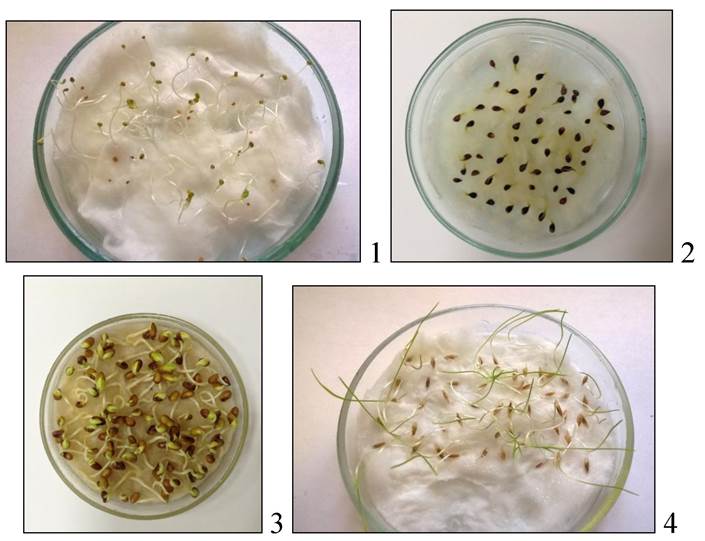
Laboratory seed germination refers to the percentage of seeds that germinate under optimal conditions. Germinated seeds are generally defined as those with a radicle length equal to half the seed length, or twice the seed length for small seeds. According to ISTA standards, the determination of laboratory germination should account for germinated seeds that have developed into normal seedlings. Field emergence is calculated as the number of seedlings on the soil surface, expressed as a percentage of the total number of seeds sown.
5.3 Classification of Fruits
There are several classifications of fruits: 1 - by gynoecium type (apocarpous, coenocarpous), 2 - by the number of carpels in apocarpous fruits (monomerous and polymerous), 3 - by seed number (unseeded/single-seeded and multi-seeded), 4 - by ovary position (superior, inferior, and half-inferior), 5 - by pericarp Structure (dry and fleshy), 6 - by dehiscent mechanism, 7 - by dispersal mechanism.
Apocarpous fruits (Fig. 31):
Polyfollicle - typically a dry fruit with a spiral arrangement of individual fruitlets (Ranunculaceae family).
Follicle - a dry, multi-seeded fruit formed by a single carpel and dehiscing along a suture.
Fleshy polyfollicles are characteristic of most species in the subtropical Annonaceae family. Fleshy follicles generally do not dehisce.
Aggregate nut (polyachene) - a derivative of a polyfollicle in which the number of ovules in the ovary is reduced to one and the dehiscent mechanism is lost (Rosaceae family).
Nutlet - a monomerous, single-seeded fruit (Typha, Agrimonia, Sparganium).
Fig. 31. Apocarpous fruits: pods of Gleditsia - 1; pods of Acacia - 2; pods of carob - 3

Aggregate drupe (etaerio of drupes) - fleshy, single-seeded fruitlets typical of the genus Rubus. Several drupes sit on a common receptacle.
Legume (pod) - a monomerous fruit, typically dry and multi-seeded, dehiscing along both the dorsal and ventral sutures. Legumes can be articulated (lomentaceous - breaking into segments, as in Hedysarum) or single-seeded (clover). In some plants, the legumes are fleshy (Gleditsia, Sophora, carob tree).
Drupe - a fleshy, single-seeded, monomerous fruit with a sharply differentiated pericarp: exocarp is leather-like and typically thin, mesocarp is juicy or fleshy, and endocarp is hard, forming a "stone" or pit (peach, cherry, plum).
Coenocarpous fruits (Fig. 32). Coenocarpous fruits include all types of fruits formed by two or more fused carpels.
Fig. 32. Coenocarpous fruits: single-seeded samara of ash - 1; coconut - 2; oak acorn - 3; winged nutlet of birch - 4; achene of Calligonum - 5

Capsule - a multi-seeded, dehiscing, usually dry fruit. The number of locules indicates the number of fused carpels. Capsules are divided into superior (tulip, Oxalis) and inferior (Epilobium, Aristolochia).
Berry - a fleshy, multi-seeded fruit with a thin, leathery exocarp and a fleshy mesocarp and endocarp. Berries are also divided into superior (grape, tomato) and inferior (lingonberry, honeysuckle).
Pome - a fleshy, multi-seeded fruit with a leathery exocarp, fleshy mesocarp, and cartilaginous endocarp. This is an inferior fruit in The formation of which the floral tube participates (apple, pear).
Hesperidium - a fleshy, multi-seeded fruit with a leathery exocarp containing numerous essential oil glands, a white spongy mesocarp, and a membranous endocarp surrounding juicy segments. The pulp consists of overgrown epidermal hairs from the inner layer of the pericarp.
Siliqua - a dehiscing, multi-seeded, elongated-cylindrical fruit, uniform throughout its length (Brassicaceae family); its length is many times greater than its diameter. Shortening of the siliqua and a reduction in seed number led to the formation of a silicula, where the length is roughly equal to the width.
Samara - a dry, single-seeded fruit with a well-developed wing-like outgrowth of various shapes. They can be superior (elm, ash) and inferior (birch, alder).
A nut is a dry, single-seeded fruit with a heavily sclerified pericarp and a cupule (involucre) of varying degrees of development formed by bracts.
An achene is a single-seeded fruit with a thin yet firm, leathery pericarp that easily separates from the seed. Achenes are distinguished as superior (nettle, sedge) and inferior (aster, dandelion, etc.).
A caryopsis is a dry, single-seeded, superior fruit with a membranous pericarp completely or partially fused with the seed coat.
Multiple fruit (Fig. 33). A multiple fruit is generally understood as a group of closely clustered and fused fruits forming a single diaspora. Sometimes, a multiple fruit refers to the aggregate of mature fruits from a single inflorescence that is clearly distinct from the vegetative part of the SHOOT. Such multiple fruits are characteristic of the plane tree, bur-reed, and hop.
Fig. 33 Multiple fruit: plane tree - 1; linden - 2; osage orange - 3

The proliferation and enlargement of perianths frequently leads to the formation of a multiple fruit (beet, spinach).
5.4 Dispersal of Fruits and Seeds
Methods of fruit and seed dispersal are presented in Table 7.
Plant characteristics consist of a combination of various dispersal methods that have emerged As a result of ecological adaptation. Such a diversity of dissemination mechanisms allows plants to occupy different ecological niches.
Table 7. Classification of fruit and seed dispersal mechanisms
No. p/p |
Dispersal mechanism |
Type |
Characteristics |
Plant examples |
1 |
Autochory |
Mechanochory |
Active scattering of seeds due to a specific mechanism of fruit dehiscence |
Caragana, geranium, sage |
Barochory |
Spontaneous shedding of fruits under METABOLISM/18.html">The Influence of gravity |
Coco de mer, chestnut |
||
Self-burial |
Self-burial of fruits through specialized adaptations: spindle-like shape, pointed lower end, spirally twisted hygroscopic awn |
Feather grass, pasque flower |
||
2 |
Hydrochory |
Presence of air-bearing parenchyma, non-wettability. |
Water plantain, pondweed, water chestnut |
|
3 |
Anemochory |
Euanemochory |
Capable of flight due to low absolute mass and specialized adaptations such as outgrowths |
Dandelion, salsify, maple, tree of heaven |
Anemogeochory |
Capable of rolling along the soil surface |
Astragalus, baby's breath, peppergrass |
||
Hemianemochory |
Low aerodynamic qualities; the wind merely carries them a short distance from the parent plant |
Bluegrass, bentgrass, wormwood, toadflax, yellow rattle |
||
4 |
Zoochory |
Epizoochory |
Attach to the body surface using various outgrowths or adhere via sticky glands |
Beggarticks, burdock, hound's Tongue, stickseed |
Endozoochory |
Eaten by animals, while undamaged seeds or pits pass through the digestive tract and are excreted with waste |
Raspberry, rose hip, rowan, lingonberry, blueberry, cotoneaster |
||
Myrmecochory |
Equipped with a special succulent appendage—an elaiosome—which serves as food for ants |
Violet, corydalis, wood sorrel, wild ginger |
||
Synzoochory |
Fruits are rich in a concentrated food reserve for the embryo; birds and rodents lose them while transporting food to nests or storage "pantries" |
Oak, chestnut, linden, hazel, beech, walnut |
||
5 |
Anthropochory |
Agestochory |
Dispersal of fruits via transport means |
Plantain, thistle |
Ergasiochory |
Dissemination of weed fruits by agricultural tools and machinery |
Aegilops, knotweed |
||
Speirochory |
Dispersal of crop and weed fruits and seeds through sowing |
Bristlegrass, wild oat |
Dissemination expands the area occupied by a plant population or species, ensures an even distribution of individuals within the population, achieves a higher rate of cross-pollination, facilitates the colonization of vacant land plots, and enables escape from unfavorable environmental factors.
Last update: 07/08/2026
Editorial and Educational Adaptation: This material has been compiled based on the primary/original source text. The project team performed an editorial review, corrected technical inaccuracies, structured sections, and adapted the content for an educational format.
What was processed:
- elimination of formatting defects (OCR errors, structural breaks, corrupted characters);
- editorial organization of content;
- standardization of terminology in accordance with academic sources;
- verification of factual statements against the original source text.
All mentions of the author, publication year, and origin of the primary text have been preserved in accordance with the source.