PLANT BIOPHYSICS - Y. I. Posudin - 2004
I. PHYSICAL PROPERTIES OF PLANT CELLS AND TISSUES
5. OPTICAL PROPERTIES OF PLANTS
5.1. TRANSMISSION OF OPTICAL RADIATION THROUGH A LEAF
A schematic cross-section of a typical plant leaf is shown in Fig. 5.1. The upper and lower surfaces of the leaf feature an epidermis covered by a cuticle. Located between the epidermal layers is the leaf parenchyma, or mesophyll, which consists of spongy and palisade Tissues. Typically, the thickness of a plant leaf is around a few hundred micrometers. The dimensions of palisade Cells are 30x30x120 µm, while spongy cells measure 40x40x60 µm. The Optical Properties of a leaf are influenced by the geometry of its internal structures, their refractive index, and pigment composition. Several theories attempt to explain the mechanisms of optical radiation propagation through a leaf [Plant Ecophysiology, 1996; Posudin, 1998].
Class="center">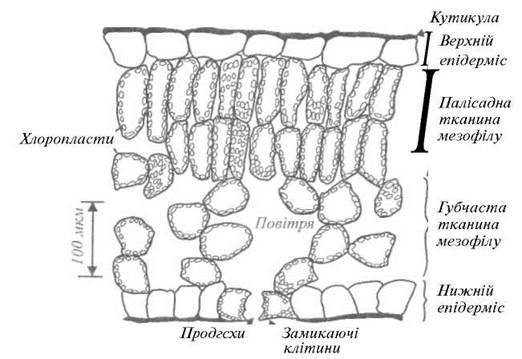
Fig. 5.1. Schematic cross-section of a typical plant leaf.
Lens effect. Certain plant cells can act as plano-convex or cylindrical lenses, focusing optical radiation onto areas of the palisade parenchyma rich in METABOLISM/14.html">Chloroplasts, thereby enhancing Light absorption under low-light conditions. The lens effect is facilitated by Water or oil present within The Cell. The degree of focusing depends on the curvature of the outer Cell wall, cell dimensions, and the internal cellular Structure. Furthermore, the focusing effect is more pronounced under direct optical radiation falling on the leaf compared to diffuse radiation. Overall, the lens effect leads to a more efficient utilization of optical radiation by the plant.
Sieve effect. Pigments in plant tissues are crucial structural components that affect the propagation of optical radiation within the tissue. If these pigments were distributed uniformly, the transmission level of optical radiation would be directly proportional to the pigment concentration. In reality, however, pigments are distributed unevenly, which leads to an increase in optical radiation transmission by the tissue, acting in this case like a sieve. Figure 5.2 illustrates this effect: if the transmittance of a layer with uniformly distributed pigments is 50%, then 50% of the optical radiation will pass through the tissue. In the case of an uneven distribution, the transmittance of one part of the tissue (the left side) is 50% x 50% = 25%. Then, assuming 100 units of optical radiation fall on the tissue, the total amount of radiation passing through such tissue can be calculated as: 25% x 50 + 100% x 50 = 62.5 units. Thus, the heterogeneous distribution of pigments contributes to an increase in optical radiation transmittance by the tissue.

Fig. 5.2. The sieve effect, consisting in the non-uniform Distribution of plant pigments, which causes an increase in the transmission of optical radiation by the tissue.
Lightguide effect. When optical radiation propagates between two parallel surfaces, it is successively reflected from each surface and travels parallel to the surfaces. A similar transmission of optical radiation occurs in optical fibers; in plants, The ROOT System, stem, and certain elongated cells perform the Functions of lightguides.
Propagation of optical radiation inside the tissue. Optical radiation incident on a leaf is reflected by the cuticle in negligible amounts; the major fraction of the radiation penetrates into the spongy mesophyll, where it can be reflected from internal leaf structures, absorbed by them, or transmitted through them. Depending on the angle of incidence, either reflection and refraction or total internal reflection may occur, where radiation is reflected back into the same medium from which it propagates. Due to multiple reflections at the boundaries between cells and air spaces, optical radiation travels along a "random" trajectory inside the leaf; a fraction of the radiation is reflected by the leaf, and another fraction is transmitted through it. Transmission dominates in thin leaves, whereas reflection prevails in thick ones. Further research aimed to develop theories and model the pathways of optical radiation propagation within the cell.
Several models have been proposed to explain the interaction of optical radiation with a leaf [Ustin et al., 1999].
Plate model treats The Leaf as one or several rough-surfaced layers capable of absorbing optical radiation and scattering it diffusely. The parameters of this model are the refractive index and the absorption coefficient. This model is used to simulate the reflectance spectrum of a compact corn leaf characterized by multiple air-cell interfaces.
N-flux model represents the leaf as multiple layers of diffusely scattering and absorbing material. The parameters of this model are the scattering and absorption coefficients. For instance, a two-layer model was used to study the EFFECT OF WATER, Proteins, Cellulose, Lignin, and starch on leaf reflectance in the mid-infrared region of the spectrum. The advantage of the model that treats the leaf as four parallel layers formed by the upper cuticle, palisade parenchyma, spongy mesophyll, and lower cuticle is The ability to correlate the absorption coefficient in the visible spectrum with chlorophyll content.
Radiative transfer model considers the interaction of incident, reflected, absorbed, and transmitted optical radiation by two layers: the palisade parenchyma and the spongy mesophyll. Computer Processing of all possible interactions with each layer is assumed.
Last update: 07/08/2026
Editorial and Educational Adaptation: This material has been compiled based on the primary/original source text. The project team performed an editorial review, corrected technical inaccuracies, structured sections, and adapted the content for an educational format.
What was processed:
- elimination of formatting defects (OCR errors, structural breaks, corrupted characters);
- editorial organization of content;
- standardization of terminology in accordance with academic sources;
- verification of factual statements against the original source text.
All mentions of the author, publication year, and origin of the primary text have been preserved in accordance with the source.