BIOLOGY Volume 3 - A Guide to General Biology - 2004
26. EVOLUTION, OR THE HISTORY OF LIFE ON EARTH
26.7. Evidence for Evolution
26.7.6. Adaptive Radiation
Homologous structures and divergent evolution
Adaptive radiation refers to the diversification of a homologous Structure in various representatives of a given group along different lines, in accordance with the distinct Functions it performs. For example, insect mouthparts are made up of the same basic structures: a labrum (upper lip), a pair of mandibles, a hypopharynx, a pair of maxillae, and a labium (formed by the fusion of a second pair of maxillae). Insects are able to utilize A wide variety of food sources because, in different species, some of the structures listed above are enlarged and modified, while others are reduced or lost entirely (Fig. 26.13). As a result, the insect mouthpart apparatus is remarkably diverse.
Class="center">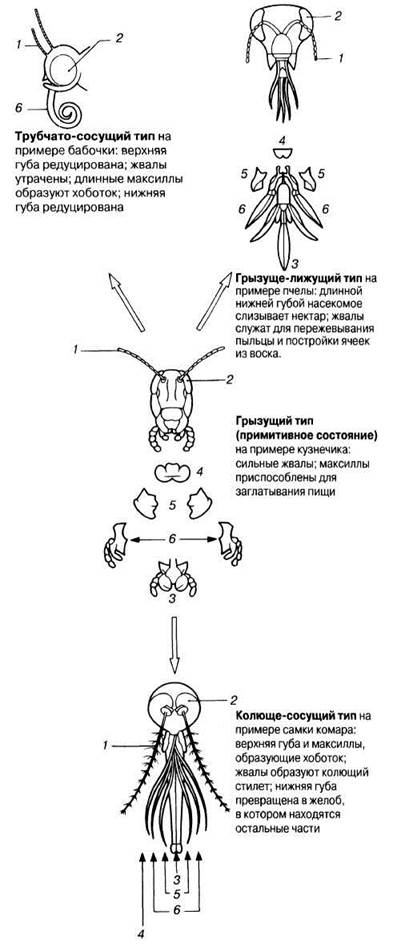
Fig. 26.13. Adaptive radiation illustrated by insect mouthparts.
1 — antennae; 2 — compound eye; 3 — labium; 4 — labrum; 5 — mandibles; 6 — maxillae.
The relatively high degree of adaptive radiation observed in insects reflects the high adaptive capacity of basic structures within this group. It is precisely this high "evolutionary plasticity" that has allowed them to occupy such a broad range of ecological niches.
The presence in an ancestral Organism of a structure or physiological function that appears in a heavily modified form in more advanced, presumably related organisms can be interpreted as an indication that the latter originated through the Modification of the former. This forms The basis of The Theory of evolution, as defined in Section 26.6. The Significance of adaptive radiation lies in the fact that it demonstrates the possibility of divergent evolution based on the modification of homologous structures.
Analogous structures and convergent evolution
Similar structures, physiological processes, or life-history traits found in organisms that are not closely related phylogenetically, yet possess adaptations to perform the same functions, are called analogous. Examples include the eyes of vertebrates and cephalopods (squids and octopuses), the wings of insects and bats, the jointed legs of insects and higher vertebrates, plant thorns and animal spines, and the presence of vertebrate neurohormones (acetylcholine, 5-hydroxytryptamine, and histamine) in the stinging hairs of nettles. The resemblance between analogous structures is purely superficial; for instance, insect wings are supported by rigid Veins, whereas bird and bat wings are supported by hollow bones. Similarly, the eyes of cephalopods and vertebrates develop differently. In cephalopods, the retina is non-inverted, and the photoreceptors face toward the incoming light, whereas in vertebrates, the retina is inverted, and the photoreceptors are separated from the incoming light by the connecting Neurons (see Fig. 17.36). Consequently, the vertebrate eye has a blind spot, while the cephalopod eye does not.
The existence of analogous structures points to the possibility of convergent evolution. Convergent evolution can be explained as the result of environmental action via natural Selection, which favors changes that enhance an organism's survival and reproductive potential.
The significance of divergent evolution, which indicates an evolutionary process, and convergent evolution, which points to The Mechanism of evolutionary change, is particularly well illustrated by the parallel evolution of marsupial and placental mammals. It is believed that both groups underwent convergent evolution and consequently occupied identical ecological niches in different PARTS OF THE globe (Fig. 26.14 and Table 26.5).

Fig. 26.14. Adaptive radiation of marsupials in Australia (based on various sources).
Table 26.5. Examples of parallel evolution in marsupial and placental mammals
Marsupials (Australia) |
Placentals (other Regions of the world) |
Marsupial mole |
Mole |
Marsupial mouse |
Mouse |
Numbat (marsupial anteater) |
Anteater |
Wombat |
Prairie dog |
Kangaroo |
Antelope |
Bandicoot |
Rabbit |
Sugar glider |
Flying squirrel |
Koala |
Sloth |
Thylacine (marsupial wolf) |
Hyena |
Last update: 06/08/2026
Editorial and Educational Adaptation: This material has been compiled based on the primary/original source text. The project team performed an editorial review, corrected technical inaccuracies, structured sections, and adapted the content for an educational format.
What was processed:
- elimination of formatting defects (OCR errors, structural breaks, corrupted characters);
- editorial organization of content;
- standardization of terminology in accordance with academic sources;
- verification of factual statements against the original source text.
All mentions of the author, publication year, and origin of the primary text have been preserved in accordance with the source.