BIOLOGY Volume 3 - A Guide to General Biology - 2004
26. EVOLUTION, OR THE HISTORY OF LIFE ON EARTH
26.7. Evidence for Evolution
26.7.5. Comparative Anatomy
A comparative anatomical study of animal or plant groups reveals a fundamental similarity in A number of structural features. For example, all flowers possess sepals, petals, stamens, stigma, style, and Ovary, yet each individual species differs from others in size, color, number of these parts, and fine details of Structure. Similarly, the limb Skeleton of all tetrapods, from amphibians to mammals, is built on a single plan—the pentadactyl limb plan (see Fig. 18.11). This basic structure is modified in various ways in different animals (Fig. 26.10) and adapted in each case to a specific mode of locomotion in a particular habitat.
Class="center">
Fig. 26.10. Adaptive modifications of the pentadactyl limb in certain mammals.
Organs built on the same plan, occupying a similar position in the animal's body, having a comparable histological structure, and developing from the same embryonic primordia are called homologous—a term introduced in 1843 by Richard Owen.
Homologous structures adapted to different environmental conditions and varied lifestyles serve as Examples of adaptive radiation. The ecological significance of such processes is discussed in Section 26.7.6. The specific Functions performed by homologous structures may differ among organisms. These differences reflect the particular ways each Organism has adapted to its environment and lifestyle. Several examples of Homology are given below.
Gill arches and ear ossicles. It can be traced how certain jaw bones of fish, which in other vertebrates evolve into the suspensorium of the lower jaw, have transformed in mammals into the ear ossicles—the malleus, incus, and stapes (Fig. 26.11).

Fig. 26.11. Skeletal structures of fish and mammals that evolved into ear ossicles in mammals.
Halteres. The hind pair of wings, present in most insects, is modified in Diptera into small rod-like structures called halteres, which serve as organs of balance during flight.
Pericarp. In flowering plants, the ovary wall after Fertilization of the ovules undergoes various modifications to facilitate seed dispersal (Fig. 26.12).
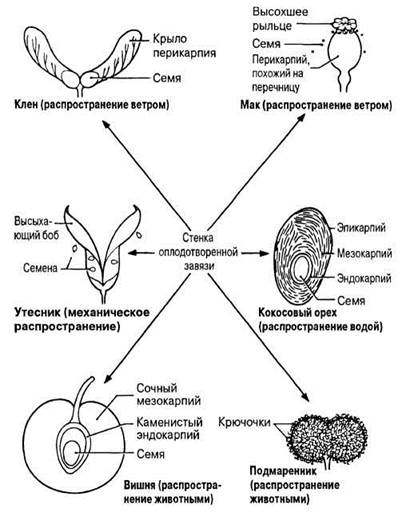
Fig. 26.12. Structural modifications of the pericarp (the wall of the fertilized ovary) for various modes of seed dispersal.
While The phenomenon of homology alone cannot serve as direct proof of evolution, the existence of homology within a given group of organisms is regarded as evidence of their common ancestry and an indicator of close phylogenetic relationship.
Linnaeus used homology as the foundation for his system of Classification. The more specific the homologous features shared by two organisms, the closer their evolutionary relationship. For instance, butterflies and moths belong to the same order (Lepidoptera), whereas wasps and bees belong to another (Hymenoptera).
Certain structures in many species apparently serve no function and are referred to as vestigial organs. The human Appendix, which plays no part in Digestion, is homologous to a functional appendix found in herbivorous mammals. Likewise, certain clearly non-functional bones in snakes and whales are considered homologs of the pelvic bones of tetrapod vertebrates. The human coccyx is considered a vestige of the tail possessed by our ancestors and retained in embryos. The existence of vestigial traits would be difficult to explain outside the context of the evolutionary process.
Last update: 06/08/2026
Editorial and Educational Adaptation: This material has been compiled based on the primary/original source text. The project team performed an editorial review, corrected technical inaccuracies, structured sections, and adapted the content for an educational format.
What was processed:
- elimination of formatting defects (OCR errors, structural breaks, corrupted characters);
- editorial organization of content;
- standardization of terminology in accordance with academic sources;
- verification of factual statements against the original source text.
All mentions of the author, publication year, and origin of the primary text have been preserved in accordance with the source.