BIOLOGY Volume 2 - A Guide to General Biology - 2004
18. THE ANIMAL SKELETOMUSCULAR SYSTEM
18.4. The Muscular System
Muscles are composed of numerous elongated Cells—Muscle fibers—capable of contraction and relaxation. A relaxed muscle can be stretched, but due to its elasticity, it returns to its original size and shape once the stretching force is removed. Muscles have a rich Blood supply that delivers nutrients and oxygen while removing metabolic end-products. Blood flow to muscles is regulated so that the tissue receives an adequate supply at all times. All muscles possess an independent nerve supply. In vertebrates, three histological types of muscle are distinguished:
1. Skeletal Muscle (Section 18.4.1); also referred to as striated or voluntary muscle. These muscles are attached to bones, facilitate locomotion, contract rapidly, but fatigue quickly; they are innervated by the somatic Nervous system.
2. Smooth muscle (also referred to as involuntary muscle). These muscles are found in the walls of tubular body Organs, such as the digestive tract or Urinary Bladder, where they propel the contents along. They contract spontaneously and slowly, and are innervated by the Autonomic nervous system.
3. Cardiac muscle (myocardium). Found exclusively in The Heart, it contracts spontaneously and is resistant to fatigue; it is innervated by the autonomic nervous system (Ch. 14).
18.4.1. Characteristics of Skeletal Muscles
Every skeletal muscle attaches to the Skeleton at at least two points—to its stationary and movable parts. The site of attachment to the stationary part is termed its origin, and the opposite site is its insertion. Muscles attach via dense, inextensible tendons—Connective Tissue structures composed almost entirely of Collagen fibers (sec. 6.4). One end of the tendon merges seamlessly with the outer Sheath of the muscle, while the other is firmly anchored to the periosteum (Fig. 18.15).
Class="center">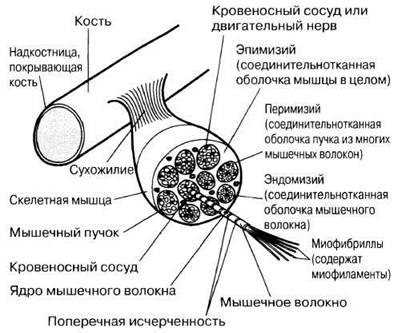
Fig. 18.15. Diagram of a skeletal muscle, showing its connective tissue and other structures.
Since muscles can generate force only by shortening (i.e., they can only pull, never push), moving a bone and subsequently returning it to its original position requires at least two muscles or groups of muscles. Pairs of muscles acting in this manner are called antagonists. Muscles can be classified by the type of movement they produce. For example, flexors bend limbs by drawing skeletal elements closer together. Thus, the biceps flexes the arm by bringing the radius and ulna of the forearm closer to the humerus. The antagonists to flexors are extensors. For instance, the triceps is the antagonist of the biceps: it extends the forearm away from the upper arm. The action of the leg flexor and extensor muscles is discussed in sec. 18.6.4.
It is very rare for only a single pair of antagonistic muscles to be involved in a movement. Typically, each discrete movement is brought about by groups of muscles known as synergists.
Last update: 06/08/2026
Editorial and Educational Adaptation: This material has been compiled based on the primary/original source text. The project team performed an editorial review, corrected technical inaccuracies, structured sections, and adapted the content for an educational format.
What was processed:
- elimination of formatting defects (OCR errors, structural breaks, corrupted characters);
- editorial organization of content;
- standardization of terminology in accordance with academic sources;
- verification of factual statements against the original source text.
All mentions of the author, publication year, and origin of the primary text have been preserved in accordance with the source.