BIOLOGY Volume 2 - A Guide to General Biology - 2004
15. HEALTH AND DISEASE
15.6. Malignant Neoplasms
15.6.2. Combating Cancer
Management in any workplace must ensure continuous monitoring for potential carcinogenic hazards. Workers in high-risk industries should be aware of the causes of Cancer and the early warning signs of the disease. The earlier a Diagnosis is made, the higher the chances of successful Treatment.
The fight against cancer involves three key components:
1) Prevention, i.e., protection against Carcinogenic Factors;
2) early diagnosis, including screening programs;
3) treatment — prompt medical intervention following diagnosis.
Methods for the prevention, diagnosis, and treatment of cervical, breast, and Colorectal Cancer are discussed below. Lung Cancer was covered in Section 9.7.
England and Wales have a very high mortality rate from cervical cancer (Fig. 15.18). The risk of developing the disease is doubled in smokers. It is estimated that population-wide screening could reduce mortality from this disease by more than 80%. By the early 1990s, deaths from cervical cancer exceeded 1,500 per year.
The primary method of combating this disease is the Structure/175.html">Implementation of an effective screening program, as early diagnosis in this case almost always leads to success. The basis of screening is cytologic analysis of epithelial Cells obtained by a cervical scrape. In 1988, a nationwide computerized system was established in the UK to process the resulting data. Women aged 20 to 64 are invited for a smear test every 5 years. The smears are carefully examined under a Microscope, and if signs of malignant Cell transformation are detected (Fig. 15.19), the patient is immediately referred for treatment. At this stage, treatment is straightforward, free of charge, and generally curative.
Class="center">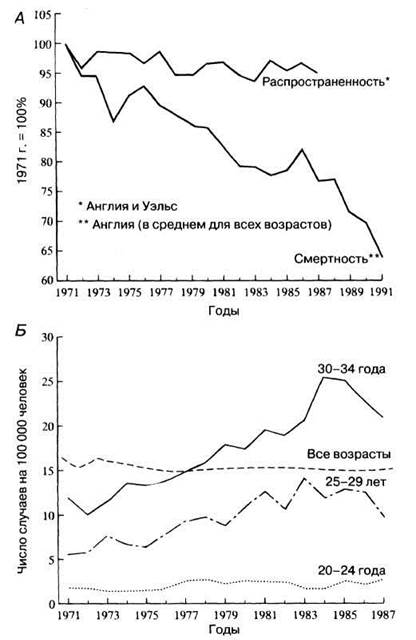
Fig. 15.18. A. Incidence of and mortality from cervical cancer, 1971–1991. B. Incidence of cervical cancer across different age groups, 1971–1987. (After OPCS (ICD 1 80), figs 3, 4.)
15.1. What information, in your opinion, should be included in a public information leaflet emphasizing The Need for regular cervical screening?
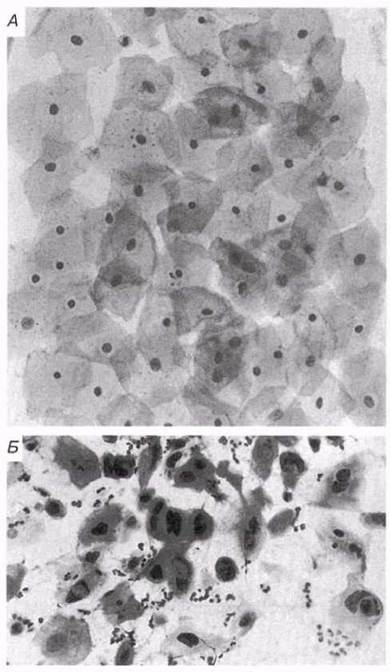
Fig. 15.19. Results of a Cervical smear test. A. Normal epithelial cells, characterized by small nuclei and abundant clear Cytoplasm. B. Malignant epithelial cells with large, dark nuclei (indicating active division) surrounded by a thin layer of cytoplasm.
Breast cancer
This is the most common type of cancer in women in developed countries (Table 15.12). In 1993, malignant breast tumors caused the deaths of 15,000 British women, approximately 90% of whom were over 50 years old. However, as with cervical cancer, early detection of breast tumors offers hope for effective treatment. A national screening program has been established, offering routine mammography (X-ray imaging of the breasts; Fig. 15.20) every three years to all women aged 50 to 64. Women over 64 can be screened upon request.
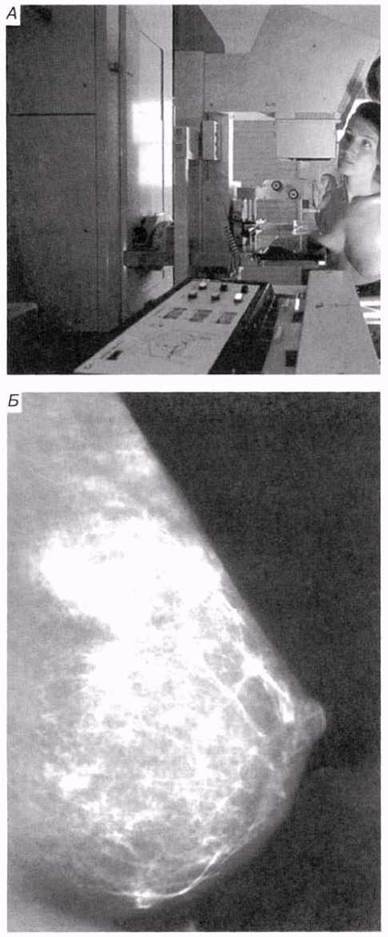
Fig. 15.20. A. A woman undergoing a mammogram for the early detection of breast cancer. B. Light areas on the mammogram correspond to clusters of cancer cells.
Experience in the UK shows that Black women and individuals from other ethnic minorities are less likely to participate in screening programs. Therefore, one of the government's objectives is to encourage women from these groups to attend regular screenings.
One of the most effective and accessible methods of early detection is self-examination. Regular Palpation of the breasts can reveal even the smallest lump. Upon discovering one, a woman should immediately consult a doctor for a more detailed examination.
In 5% of cases, breast cancer is linked to a hereditary predisposition. However, it remains unclear how to proceed if genetic screening identifies the BRCA1 and BRCA2 genes in a patient. The efficacy of the preventive drug tamoxifen has not yet been proven, and women at high risk often choose to undergo a prophylactic mastectomy rather than wait for a tumor to develop.
The main treatment options for breast cancer include:
1) surgical removal of the tumor;
2) radiotherapy — irradiation of the breast with X-rays to destroy malignant cells;
3) Chemotherapy — systemic administration of drugs that destroy all dividing cells (both normal and tumor cells);
4) anti-estrogen therapy. Estrogen stimulates breast tumor growth, so suppressing the action of this hormone can halt disease progression.
These methods can be used either alone or in combination. Following tumor remission, reactivation (relapse) remains a possibility. If breast cancer is diagnosed at an early stage, the 5-year survival rate is at least 80%.
Colorectal Cancer
Colorectal cancer (typically affecting its two main sections — the colon and rectum) is the third most common cancer group in the UK, accounting for 14% of cancer-related deaths. Annually, such tumors are diagnosed in one out of every 1,200 people. In its early stages, the disease is usually asymptomatic. Later, bleeding from the intestinal wall occurs, leading to anemia and traces of Blood in the stool. Partial bowel obstruction may also occur, disrupting peristalsis and resulting in constipation or diarrhea. Therefore, to ensure timely diagnosis, one must monitor these symptoms. The tumor can be detected by X-ray imaging, preceded by the patient swallowing a barium suspension to enhance image contrast, or via endoscopy — an internal examination of the bowel using a specialized tube inserted with a miniature TV camera at the tip. With early diagnosis, surgical removal of the tumor leads to a complete recovery in 80% of cases. The affected segment is excised, and the healthy PARTS OF THE intestine are reconnected.
A growing body of evidence suggests that poor diet, particularly an excess of fatty meats, contributes to The Development of certain cancers, including colorectal tumors. Reducing the intake of such foods and increasing the consumption of fiber-rich vegetables, fruits, and whole grains can help lower the risk of the disease. There is a genetic predisposition to colorectal cancer. In the future, individuals with such genotypes can be identified through screening. Such people should take special precautions and undergo regular check-ups. It is important to remember that surgical removal of a tumor in the Cytology/cytology/16.html">Early stages of its development is a relatively straightforward Procedure that offers a high chance of a complete cure.
Last update: 06/08/2026
Editorial and Educational Adaptation: This material has been compiled based on the primary/original source text. The project team performed an editorial review, corrected technical inaccuracies, structured sections, and adapted the content for an educational format.
What was processed:
- elimination of formatting defects (OCR errors, structural breaks, corrupted characters);
- editorial organization of content;
- standardization of terminology in accordance with academic sources;
- verification of factual statements against the original source text.
All mentions of the author, publication year, and origin of the primary text have been preserved in accordance with the source.