BIOLOGY Volume 1 - A Guide to General Biology - 2004
2. DIVERSITY OF LIFE ON EARTH
2.6. Kingdom Protoctista
2.6.2. Phylum Oomycota
Oomycetes (Oomycota) are close relatives of Fungi and share a similar Structure with them, though current scientific consensus views them as an evolutionarily older group. The primary structural material of their Cell walls is Cellulose rather than the Chitin found in true fungi. Their hyphae are aseptate (non-septate). The oomycetes include A number of pathogenic organisms, most notably the CAUSATIVE AGENT OF downy mildew, Plasmopara viticola (commonly referred to as mildew). As a case study, let us examine one such parasitic fungus-like Organism, Phytophthora infestans, which is typically regarded as an obligate parasite. For comparison, we will also look at another obligate parasite, Peronospora. Finally, we will examine Pythium as a typical facultative parasite. Obligate parasites are organisms capable of surviving and reproducing exclusively on living host Cells, unlike facultative parasites, which typically kill their hosts and subsequently live saprophytically on dead organic matter.
Phytophthora infestans
Phytophthora infestans is a plant pathogen of significant economic importance, as it parasitizes potatoes and devastates crops by causing a highly destructive disease known as late blight. P. infestans is unable to grow independently of its host, thus resembling obligate parasites. In its Morphology and infection mechanism, Phytophthora is similar to Peronospora—another member of Oomycota that causes a fairly common, albeit less severe, disease in wallflowers, cabbages, and many other members of the Brassicaceae (Cruciferae) family.
Having overwintered in infected potato tubers, the mycelium of Phytophthora begins to grow on the plant's leaves in the spring, with the first visible symptoms of blight typically appearing around August.
The mycelium, consisting of branched, non-septate hyphae, spreads through the intercellular spaces within the leaves, producing branching haustoria that penetrate mesophyll cells to absorb nutrients (Fig. 2.29). Haustoria are specialized structures typical of obligate parasites, adapted for penetration and absorption. Each haustorium is a modified hyphal outgrowth with a high surface-area-to-volume ratio. These outgrowths penetrate host cells without rupturing the Plasma Membranes or killing the cells. In warm and humid conditions, the mycelium produces sporangiophores that emerge from the lower leaf surface via Stomata or wounds. The sporangiophores branch to give rise to sporangia (Fig. 2.29). In warm weather, sporangia can act directly as spores, being dispersed by wind or rain splashes to other plants, thereby spreading the infection. Alternatively, a germ tube emerges from the sporangium and penetrates the plant tissue through stomata, lenticels, or wounds. Under cold conditions, the Contents of the sporangium divide to form motile zoospores (a characteristic trait of primitive organisms), which are released and swim in a thin film of moisture on the leaf surface. These zoospores can encyst and remain dormant until conditions become favorable for hyphal growth, at which point infection of new plants begins.
Class="center">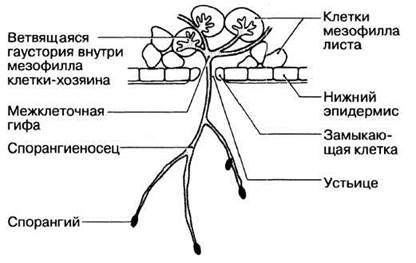
Fig. 2.29. Phytophthora infestans growing within the leaf of an infected potato plant; sporangiophores can be seen hanging from the lower leaf surface.
In infected plants, individual leaves exhibit small, dead, brown necrotic lesions. Upon closer inspection, a fringe of white sporangiophores can be seen around these dead zones on the underside of the leaves. Under warm, humid weather conditions, these necrotic areas rapidly spread across the entire leaf surface and advance to the stem. Some sporangia fall to the ground and infect the potato tubers, where the infection spreads very rapidly, causing a form of dry rot in which the tuber tissue turns a rusty brown color, spreading irregularly from the periphery toward the center.
First the collar (ROOT crown) and subsequently all other PARTS OF THE plant turn into a rotting mush as the necrotic zones are secondarily infected by saprophytic decomposer Bacteria. Thus, Phytophthora ultimately kills the plant entirely, Setting it apart from its closer relative Peronospora, which is a true obligate parasite. In this respect, Phytophthora differs from a typical obligate parasite and is sometimes classified as a facultative parasite, although there is little need to dwell excessively on such semantic nuances.
Phytophthora typically overwinters as dormant mycelium within mildly infected potato tubers. Unlike Peronospora, this fungus is believed to reproduce sexually only in its native regions of origin (Mexico, Central, and South America), where wild potatoes evolved. However, sexual reproduction can be induced in laboratory settings. Like Peronospora, Phytophthora produces resistant resting spores. These thick-walled spores form As a result of the fusion between an antheridium (male reproductive organ) and an oogonium (female reproductive organ). Such spores can overwinter in the soil and initiate a fresh infection the following year.
Historically, epidemics caused by Phytophthora have had catastrophic consequences. It is believed that the disease was accidentally introduced to Europe from America in the late 1830s. This triggered a wave of epidemics across Europe, culminating in the complete destruction of potato crops in Ireland in 1845 and subsequent years. The resulting famine led to widespread loss of life, driven not only by the crop failure itself but also by complex socio-political and economic factors. Consequently, numerous Irish families were forced to emigrate to North America.
This disease is also historically significant because, in 1845, the Reverend M. J. Berkeley first demonstrated its microbial nature. Berkeley proved that the fungus associated with potato blight was the actual causative agent of the disease rather than a mere secondary byproduct of tissue decay.
Elucidating The life cycle of the potato blight pathogen paved the way for The Development of effective control and management strategies. These Methods are outlined below.
1. Careful inspection and Selection of seed potatoes must be carried out to ensure that no infected tubers are planted.
2. Since the fungus can persist in the soil for nearly a year, potatoes should not be planted in fields where the disease occurred the previous year; implementing proper crop rotation is essential.
3. All diseased plant debris should be destroyed before harvesting the tubers, for example, by burning or spraying with a caustic solution such as sulfuric acid. This is crucial because decaying haulms (stems) and other above-ground foliage can easily infect the tubers.
4. Because the pathogen can overwinter in unharvested tubers, care must be taken to ensure that no volunteer tubers are left in infected fields.
5. The fungus can be controlled using copper-based fungicides, such as Bordeaux mixture. Applications must be timed precisely to act as a preventive measure, as infected plants cannot be cured once established. Plants are typically sprayed every two weeks from the time they reach a few centimeters in height until full maturity. Tubers selected for future planting can be surface-sterilized by immersion in a dilute solution of mercury(II) chloride.
6. Continuous monitoring of weather conditions and early warning systems for farmers can help optimize the timing of fungicide applications.
7. At various times, breeding programs have focused on developing blight-resistant potato varieties. The wild potato species Solanum demissum exhibits high resistance to Phytophthora and has been utilized in breeding experiments. The greatest obstacle to achieving durable resistance is the existence of numerous physiological strains of the fungus; to date, no potato variety has been successfully bred that is resistant to all strains. As new potato cultivars are introduced, new pathogenic strains of the fungus frequently emerge. This challenge is well known to plant pathologists and serves as a vital reminder of the need to preserve the Gene pools of the wild ancestors of our modern crops as an invaluable reservoir of disease-resistance genes.
Pythium
Unlike Phytophthora, Pythium is a relatively unspecialized parasite that infects a wide range of plants, causing soft rot. Pythium is responsible for seedling damping-off. It thrives in damp environments, as it produces motile zoospores during asexual reproduction. Because the fungus can grow on both living plants and dead organic matter, it is a facultative parasite. It can also survive as a saprotroph in damp soil. Pythium secretes Enzymes into its external environment, enabling it to rapidly attack and kill its host. Pectinases are the first enzymes produced; diffusing ahead of the growing fungus, they dissolve the pectin in the middle lamella that holds plant cells together. As a result, plant Tissues turn to mush (soft rot) and the plant dies. Later, Other Enzymes are produced to digest the contents of the plant cells. However, unlike Phytophthora, Pythium does not form haustoria. Digestion products are absorbed by hyphae growing between the cells.
Damping-off is caused by the destruction of early seedlings just as they emerge above the soil surface. The initial watery lesions on the stem appear at ground level. As these lesions darken, the stem collapses. Seedling damping-off can pose a serious problem in horticulture, forestry, and agriculture. Members of the Brassicaceae family are particularly susceptible to this disease, especially when seedlings are overcrowded.
Last update: 06/08/2026
Editorial and Educational Adaptation: This material has been compiled based on the primary/original source text. The project team performed an editorial review, corrected technical inaccuracies, structured sections, and adapted the content for an educational format.
What was processed:
- elimination of formatting defects (OCR errors, structural breaks, corrupted characters);
- editorial organization of content;
- standardization of terminology in accordance with academic sources;
- verification of factual statements against the original source text.
All mentions of the author, publication year, and origin of the primary text have been preserved in accordance with the source.