BIOLOGY Volume 1 - A Guide to General Biology - 2004
9. ENERGY UTILIZATION
9.3. Cellular Respiration
9.3.2. Key Reactions
The two MAIN TYPES OF reactions that drive cellular Respiration are oxidation and decarboxylation.
Oxidation
Cells carry out three distinct types of oxidation reactions.
1. OXIDATION BY MOLECULAR OXYGEN.
Class="center">
2. REMOVAL OF HYDROGEN (DEHYDROGENATION). During aerobic respiration, glucose is oxidized through a series of successive dehydrogenation reactions. The hydrogen removed in each step is used to reduce a coenzyme, which acts as a hydrogen carrier:
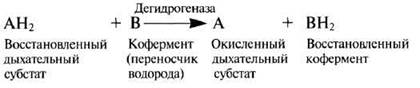
The majority of these reactions take place within the Cell/35.html">Mitochondria, where the hydrogen carrier is typically the coenzyme NAD (nicotinamide adenine dinucleotide):

or, more precisely,

NADH (reduced NAD) is subsequently reoxidized to release energy (Section 9.3.5). The Enzymes that catalyze dehydrogenation reactions are known as dehydrogenases. Through a sequence of dehydrogenation steps, all the hydrogen removed from glucose is transferred to hydrogen carriers. This hydrogen is ultimately oxidized by oxygen to form Water, and The energy released in the process is harnessed for ATP synthesis. The energy-releasing phenomenon of hydrogen oxidation (combustion) can be observed by holding a burning splint near a test tube containing hydrogen, which produces a sharp, muffled pop resembling a miniature explosion. The Cell releases the exact same amount of energy, but it does so gradually through a series of redox reactions as hydrogen is passed from one carrier to another along the so-called Respiratory Chain.
3. ELECTRON TRANSFER. This occurs, for instance, when one ionic form of iron (Fe2+) is converted into another (Fe3+)

Electrons can be transferred from one compound to another in the same manner as hydrogen in the reactions described above (see item 2). The compounds facilitating this transfer are called electron carriers. This process takes place within the mitochondria (Section 9.3.5).
Decarboxylation
Decarboxylation is the removal of carbon from a compound, resulting in The formation of CO2. In addition to hydrogen and oxygen, the glucose molecule contains six carbon atoms. Since the aforementioned reactions require only hydrogen (see item 2 above), the carbon is eliminated via decarboxylation reactions. The carbon dioxide produced As a result serves as a "waste product" of aerobic respiration.
Last update: 06/08/2026
Editorial and Educational Adaptation: This material has been compiled based on the primary/original source text. The project team performed an editorial review, corrected technical inaccuracies, structured sections, and adapted the content for an educational format.
What was processed:
- elimination of formatting defects (OCR errors, structural breaks, corrupted characters);
- editorial organization of content;
- standardization of terminology in accordance with academic sources;
- verification of factual statements against the original source text.
All mentions of the author, publication year, and origin of the primary text have been preserved in accordance with the source.