BIOLOGY Volume 1 - A Guide to General Biology - 2004
7. AUTOTROPHIC NUTRITION
7.6. Biochemistry of photosynthesis
7.6.2. Light-dependent reactions
We have already established that during Photosynthesis, sugars are produced in plants from carbon dioxide and hydrogen (derived from Water). This process requires an input of energy. Both the energy and the hydrogen are supplied by the light-dependent reactions, which synthesize ATP (adenosine triphosphate)—an energy carrier—and reduced NADP.
ATP serves as the primary energy currency within The Cell. Its Structure is detailed in Section 9.2.1, and its significance is discussed at the end of Section 9.2.2. NADP (nicotinamide adenine dinucleotide phosphate) Functions as a hydrogen carrier, operating in much the same way as NAD. The structures of NAD and NADP are shown in Fig. 4.17, while their roles as hydrogen carriers are outlined in Section 4.5.2. It is recommended that you review this material first.
ATP is formed from ADP through The addition of another phosphate group. This process is known as phosphorylation (Section 9.5.4) and requires an energy input. In photosynthesis, the energy source is light, which is why the process is termed Photophosphorylation. The hydrogen required to reduce NADP comes from water. Besides water, this process also demands energy, which is delivered by sunlight. The sole function of ATP and reduced NADP is to supply energy and hydrogen for the METABOLISM/17.html">Light-Independent Reactions.
As we saw earlier (Section 7.5.5), illumination of Photosystems I and II causes high-energy electrons to be released from the chlorophyll molecules contained within these systems. It is the energy of these electrons that is harnessed to produce ATP and reduced NADP. The Mechanism of this process is illustrated in Fig. 7.14. Because this diagram is rich in information, it requires careful study. Note that the vertical axis represents the energy level of the electrons.
Class="center">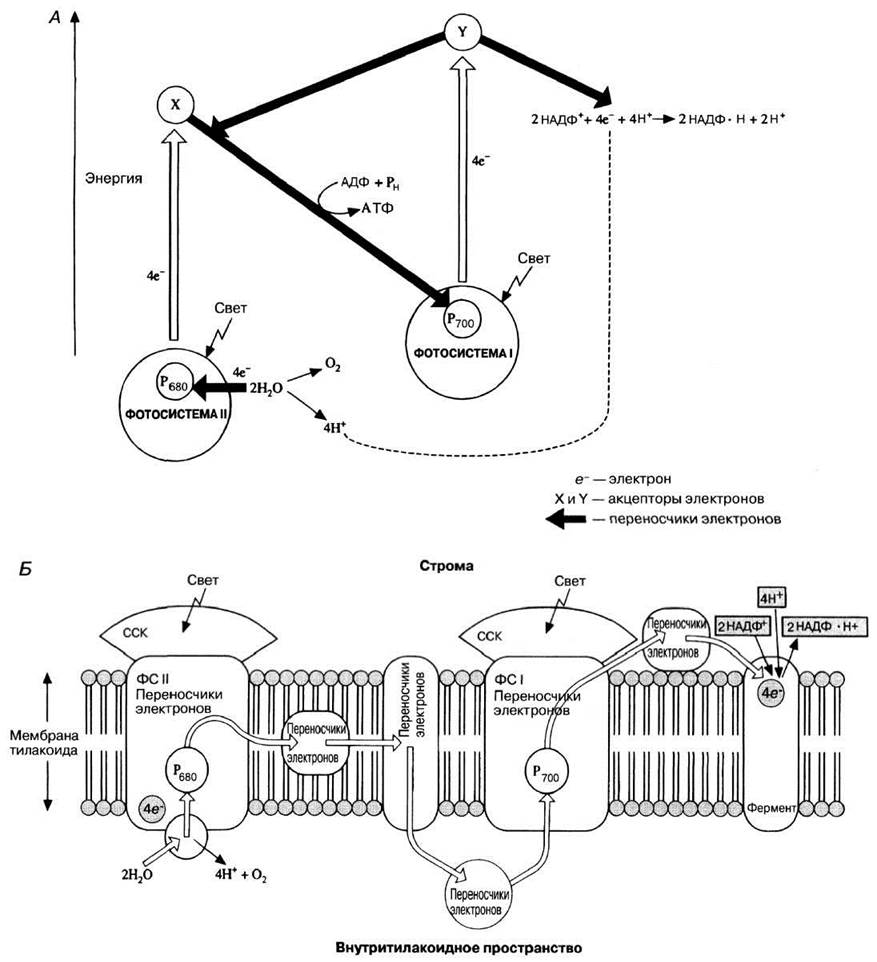
Fig. 7.14. A. Electron flow (white arrows) during cyclic and non-cyclic photophosphorylation. As electrons move along the transport chain, they lose energy (see the vertical scale). The drop in electrons from a higher to a lower energy level is coupled with the synthesis of ATP. The formation of a single oxygen molecule requires two water molecules, releasing four electrons, whose pathway is shown in the diagram. B. The relationship between electron flow and electron carriers in The Plasma Membrane. LHC — light-harvesting complex.
The process relies on the flow of electrons originating from P680 and P700. This flow is driven by energy derived from light. Keep the following expression in mind:

First, an electron from P680 or P700 is promoted to a higher energy level by excitation energy. Instead of falling back into the photosystem and losing this energy, the electron is captured by an electron acceptor (X or Y in Fig. 7.14). This step represents a crucial conversion of light energy into chemical bond energy. As a result, the electron acceptor becomes reduced, while a positively charged (oxidized) chlorophyll molecule remains in the photosystem. Next, the electron figuratively "travels" downhill—meaning with a decrease in energy—from one electron acceptor to another, participating in a series of oxidation-reduction reactions. The energy lost during this transition is coupled with the synthesis of ATP. The pathway taken by the electron may be cyclic (returning to its starting position) or non-cyclic, culminating in the formation of NADP. The interaction of electrons with NADP leads to its reduction.
Non-cyclic photophosphorylation
Excited electrons from P680 (PSII) and P700 (PSI) reduce electron acceptors X and Y, respectively, thereby leaving P680 and P700 positively charged (oxidized). The electron donor that replenishes the lost electrons in P680 is water. Water molecules are split, releasing electrons that enter P680, along with oxygen and hydrogen ions (protons). Oxygen escapes as a byproduct (Fig. 7.14).
The electrons move from X along the Electron Transport Chain, losing a fraction of their energy at each step as they pass from one carrier to the next. Eventually, they fill the electron vacancies (positive holes) left in P700. The energy released by this flow is used to generate ATP. In addition, electrons travel down the energy gradient from Y to NADP along an electron transport chain, where they interact with hydrogen ions (from water) to form reduced NADP.
Cyclic photophosphorylation
In cyclic photophosphorylation, electrons from Y are routed back to P700 via a different electron transport chain. As in non-cyclic photophosphorylation, the excitation energy of the electrons moving along this pathway is channeled into ATP production.
Table 7.3 lists the differences between cyclic and non-cyclic photophosphorylation.
Table 7.3. Comparison of cyclic and non-cyclic photophosphorylation
Non-cyclic |
Cyclic |
|
Electron pathway |
Non-cyclic |
Cyclic |
Initial electron donor (source of electrons) |
Water |
Photosystem I (P700) |
Final electron acceptor (destination of electrons) |
NADP |
Photosystem I (P700) |
Products |
Useful: ATP, reduced NADP Byproducts: O2 |
Useful: ATP only |
Photosystems involved |
I and II |
I only |
The overall equation for non-cyclic photophosphorylation is as follows:

Additional ATP can be generated via cyclic photophosphorylation. The Energy Conversion Efficiency of the light-dependent reactions is high, reaching approximately 39%.
Last update: 06/08/2026
Editorial and Educational Adaptation: This material has been compiled based on the primary/original source text. The project team performed an editorial review, corrected technical inaccuracies, structured sections, and adapted the content for an educational format.
What was processed:
- elimination of formatting defects (OCR errors, structural breaks, corrupted characters);
- editorial organization of content;
- standardization of terminology in accordance with academic sources;
- verification of factual statements against the original source text.
All mentions of the author, publication year, and origin of the primary text have been preserved in accordance with the source.