BIOLOGY Volume 1 - A Guide to General Biology - 2004
2. THE DIVERSITY OF LIFE ON EARTH
2.3. Prokaryotes
2.3.3. Reproduction
Individual growth and asexual reproduction
The surface-area-to-volume ratio of bacterial Cells is very high, which facilitates the rapid absorption of nutrients from the environment via diffusion and Active Transport. Consequently, under favorable conditions, Bacteria are capable of extremely rapid growth. Bacterial Cell growth depends heavily on environmental factors such as Temperature, nutrient availability, pH, and ion concentration. In addition, obligate aerobes require oxygen, whereas obligate anaerobes require its complete absence.
Having reached a certain size—dictated by The ratio of nuclear volume to Cytoplasm—bacteria undergo asexual reproduction by binary fission, meaning they divide into two identical daughter cells (Fig. 2.11). Cell Division is preceded by METABOLISM/36.html">DNA Replication; until replication is complete, mesosomes may anchor the DNA in a specific position (Figs. 2.5 and 2.6, C). Mesosomes can also attach to the new cross-walls forming between daughter cells, playing some role in the Synthesis of cell wall material. In the fastest-growing bacteria, division occurs every 20 min.
Class="center">
Fig. 2.11. Asexual reproduction in bacteria (e.g., E. coli) by binary fission.
Sexual reproduction
In 1946, sexual reproduction was discovered in bacteria, albeit in a most primitive form. No Gametes are produced in this case, yet the most crucial event of sexual reproduction—namely, the EXCHANGE OF GENETIC material—does take place. This process is known as genetic recombination. Genetic recombination was first observed during studies of E. coli. Normally, when adequate amounts of glucose and inorganic salts are present in the medium, E. coli synthesizes all the Amino Acids it requires on its own. Random Mutations occasionally arise in these bacteria As a result of irradiation. Two Types of mutants were isolated: one unable to synthesize biotin (a vitamin) and The amino acid Methionine, and another unable to synthesize the amino acids Threonine and leucine. Aliquots of 108 cells of each mutant strain were placed in a medium lacking all four growth factors. Theoretically, the cells should not have been able to grow on this medium. Nevertheless, several hundred colonies did appear (each colony originating from a single parental cell), and these cells were found to possess all the genes necessary to produce the four growth factors. Consequently, the cells had somehow exchanged Genetic information, although isolating the substance responsible for this process was not possible at the time. Eventually, it was established (using an Electron microscope) that E. coli cells can make direct contact with one another—that is, conjugation can occur between them (Fig. 2.12).
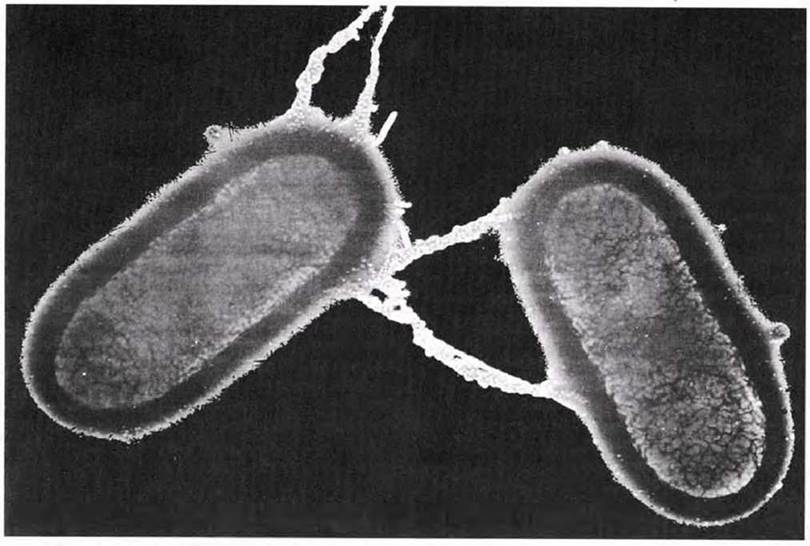
Fig. 2.12. Bacterial conjugation. One "male" cell (left) is conjugating with two "female" cells (× 19,475). The second "female" cell is not visible in the photograph as it is positioned above, out of frame.
Thus, conjugation involves The transfer of DNA between cells through direct contact. In this process, one cell acts as the donor (the "male" cell) and the other as the recipient (the "female" cell). The ability of a cell to act as a donor is determined by genes contained within a specialized plasmid known as the sex factor or F-factor (derived from fertility). These genes encode specific pilus Proteins called F-pili or sex pili. F-pili mediate intercellular contact during conjugation. Because the pili are hollow structures, it is hypothesized that DNA is transferred from the donor (F+) to the recipient (F-) precisely through these channels. This process is illustrated in Fig. 2.13.

Fig. 2.13. Conjugation of two bacterial cells. Numbers 1, 2, and 3 indicate the successive stages of F-factor transfer.
Note that the donor cell retains the F-factor, whereas the recipient cell acquires it and becomes F+. This process proceeds slowly; therefore, before the transfer of the F-plasmid is complete, the originally F- cell manages to replicate once or several times, with the result that F- cells are always preserved within the population.
The F-factor is of particular interest also because, from time to time—roughly in 1 out of 100,000 cases—it integrates into the host cell's main DNA molecule. When this happens, conjugation results in the transfer not only of the F-factor, but of the entire remaining DNA as well. This process takes approximately 90 min, but cells may detach before complete DNA exchange occurs. Such strains continuously transfer all or most of their DNA to other cells. These strains are called Hfr strains (standing for High frequency of recombination) because the donor DNA of these strains readily recombines with the recipient's DNA.
Last update: 06/08/2026
Editorial and Educational Adaptation: This material has been compiled based on the primary/original source text. The project team performed an editorial review, corrected technical inaccuracies, structured sections, and adapted the content for an educational format.
What was processed:
- elimination of formatting defects (OCR errors, structural breaks, corrupted characters);
- editorial organization of content;
- standardization of terminology in accordance with academic sources;
- verification of factual statements against the original source text.
All mentions of the author, publication year, and origin of the primary text have been preserved in accordance with the source.