Protein Structure and Function: Application of Bioinformatics Methods - John Rigden 2014
ab initio Protein Structure Prediction
Introduction
Jooyoung Lee, Sitao Wu, Yang Zhang
Despite fifty years of effort, the Structure/41.html">Cell/13.html">Protein Structure Prediction problem based on Amino acid sequences remains unsolved. If a target protein has a homolog with a known structure, the task is relatively straightforward: by copying the framework of the known structure, a high-resolution model can be built. However, such modeling Procedures do not answer how and why a protein acquires its characteristic native structure. In cases where structural homologs (or sometimes analogs1) of the protein under study do not exist, or exist but their Homology cannot be detected, models must be built "from scratch." This Procedure, known as ab initio modeling, is crucial for solving the protein structure prediction problem and can also help elucidate the physicochemical principles of protein folding in nature. Currently, the accuracy of ab initio modeling Methods remains low, and success is largely limited to small Proteins (fewer than 100 residues). This chapter provides An Overview of ab initio modeling methods, focusing particularly on three core components of modeling algorithms: the energy function, conformational search, and Model Selection. Recent advances and successes of various algorithms are also discussed.
Jooyoung Lee
Center for Bioinformatics and Department of Molecular Bioscience,
University of Kansas, Lawrence, KS, 66047, USA
School of Computational Sciences, Korea Institute for Advanced Study,
Seoul, 130-722, Korea
Sitao Wu and Yang Zhang
Centre for Bioinformatics and Department of Molecular Bioscience,
University of Kansas, Lawreance, KS, 66047, USA
e-mail: yzhang@ku.edu
1 Homologs are proteins sharing a common ancestor, whereas analogs perform a similar function. Translator's Note.
Due to the remarkable success of genome sequencing projects, the number of available protein sequences is growing exponentially. However, owing to technical difficulties, significant time investments, and the labor-intensive nature of experimental protein structure determination, the number of available protein structures lags far behind. By the end of 2007, the UniProtKB database (Bairoch et al. 2005) (http://www.ebi.ac.uk/swissprot) contained 5.3 million protein sequences. Yet, the corresponding number of protein structures in the Protein Data Bank (PDB) (Berman et al. 2000) (http://www.rcsb.org/pdb) was only about 44,000—less than 1% of the number of protein sequences2. As shown in Fig. 1.1, this gap is widening rapidly. Thus, The Development of efficient computational algorithms for predicting 3D protein structures from sequences is arguably the only way to bridge this gap.
Depending on the degree of similarity between the proteins used to build the model and the target protein, protein structure prediction methods fall into two categories. If proteins structurally close to the target can be found in the PDB library, a model of the target protein can be built by copying the framework of known structures (templates). This procedure is known as comparative modeling or template-based modeling (TBM) (Karplus et al. 1998; Jones 1999; Shi et al. 2001; Ginalski et al. 2003b; Skolnick et al. 2004; Jaroszewski et al. 2005; Soding 2005; Zhou and Zhou 2005; Cheng and Baldi 2006; Pieper et al. 2006; Wu and Zhang 2008) and will be discussed in subsequent chapters. Comparative modeling methods generally yield high-resolution models, but this procedure cannot shed light on the physicochemical principles underlying protein folding.
If no protein templates are available, the 3D protein model must be built "from scratch." This procedure goes by several names, such as ab initio modeling (Klepeis et al. 2005; Liwo et al. 2005; Wu et al. 2007), de novo modeling (Bradley et al. 2005), physical modeling (Oldziej et al. 2005), or free modeling (Jauch et al. 2007). In this chapter, to avoid confusion, the term "ab initio modeling" will be used. Unlike comparative modeling, successful ab initio modeling can help answer fundamental questions about how and why a protein adopts its specific native structure out of a vast conformational space.
2 As of early 2013, the UniProt/TrEMBL database contains approximately 29 million sequences, while the PDB database holds 87,000 structures. Translator's note.
Class="center">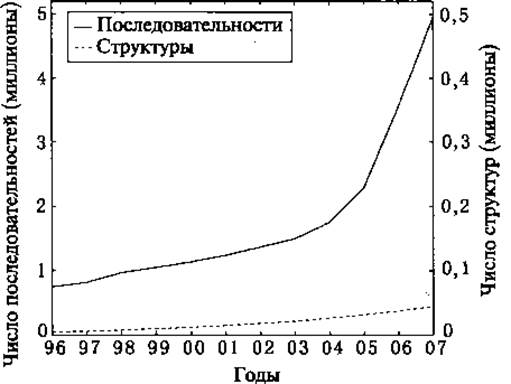
Fig. 1.1. Growth in the number of available protein sequences (left ordinate) and solved protein structures (right ordinate) over the past 12 years. The ratio of sequences to structures is increasing rapidly. Data were obtained from the UniProtKB (Bairoch et al. 2005) and PDB (Berman et al. 2000) Databases.
Typically, ab initio modeling involves a conformational search guided by a custom-defined energy function. The outcome of this procedure is usually an ensemble of Conformations (decoys) from which the final models are selected. Consequently, successful ab initio modeling relies on three key factors: 1) an accurate energy function, ensuring that among a set of structural decoys, the thermodynamically most stable state corresponds to the native protein structure; 2) an efficient search method capable of rapidly locating low-energy states via conformational sampling; and 3) the selection of models closest to the native structure from the pool of decoys.
This chapter reviews the Current state of the art in ab initio Protein Structure Prediction. The review is neither comprehensive (it does not cover all existing ab initio methods) nor exhaustive (it does not provide in-depth details on the fundamentals and Implementation of the methods). For a comparative study of various ab initio modeling approaches, readers are encouraged to consult recent reviews on the topic (Helles 2008). The remainder of the chapter is organized as follows. The three main challenges of ab initio modeling—the energy function, conformational search algorithm, and model selection scheme—are described in detail. New and promising ideas for improving prediction efficiency and accuracy are discussed, and finally, current successes and challenges in ab initio modeling are addressed.
Last update: 06/08/2026
Editorial and Educational Adaptation: This material has been compiled based on the primary/original source text. The project team performed an editorial review, corrected technical inaccuracies, structured sections, and adapted the content for an educational format.
What was processed:
- elimination of formatting defects (OCR errors, structural breaks, corrupted characters);
- editorial organization of content;
- standardization of terminology in accordance with academic sources;
- verification of factual statements against the original source text.
All mentions of the author, publication year, and origin of the primary text have been preserved in accordance with the source.