BIOCHEMISTRY - L. Stryer - 1984
VOLUME 3
PART V. MOLECULAR PHYSIOLOGY
CHAPTER 37. EXCITABLE MEMBRANES AND SENSORY SYSTEMS
37.8. Acetylcholinesterase Inhibitors Are Used as Drugs and Poisons
The therapeutic and toxic properties of acetylcholinesterase inhibitors have found widespread Structure/182.html">Practical Application. Physostigmine (also known as eserine), an alkaloid from the Calabar bean, was once used in trial by ordeal in witch trials. Physostigmine and related inhibitors, such as neostigmine, are carbamoyl esters (Fig. 37.13). They inhibit acetylcholinesterase by forming a covalent intermediate that undergoes very slow Hydrolysis. Neostigmine binds to acetylcholinesterase such that its positively charged trimethylammonium group occupies the anionic site of the enzyme, while the carbamoyl group is positioned adjacent to the reactive Serine residue at the Esterification site. Carbamoylation of the enzyme then takes place, releasing the corresponding alcohol.
Class="center">
Fig. 37.13. Physostigmine and neostigmine inhibit acetylcholinesterase by carbamoylation of serine at the Active Site of the enzyme

Unlike the hydrolysis of the acetyl-enzyme intermediate, the subsequent hydrolysis of the carbamoyl-enzyme derivative proceeds at a very low rate. As a result, the active site of acetylcholinesterase is effectively blocked. Neostigmine is used to treat glaucoma, an eye disease characterized by elevated intraocular pressure. The Mechanism of its therapeutic effect is that neostigmine inhibits acetylcholinesterase, thereby enhancing the action of acetylcholine.
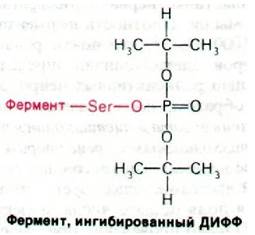
Even more potent acetylcholinesterase inhibitors are organic fluorophosphates, notably diisopropyl fluorophosphate (DFP). These compounds react with acetylcholinesterase to form highly stable covalent phosphoryl-enzyme complexes (Fig. 37.14). As in the interaction with serine proteases, the phosphoryl group of DFP binds to the serine residue at the active site of the enzyme.
Fig. 37.14. Acetylcholinesterase inhibited by diisopropyl fluorophosphate
A variety of organic fluorophosphates have been synthesized for use as agricultural insecticides and as chemical warfare nerve agents (Fig. 37.15). These compounds can cause death by respiratory arrest. The most toxic among them are tabun and sarin. Parathion is an insecticide that has found widespread agricultural use.
Fig. 37.15. Structural formulas of several organophosphate acetylcholinesterase inhibitors.

Using radioactive DFP as a label, the number of acetylcholinesterase molecules at the motor end plate of a mouse Diaphragm Muscle was determined. The enzyme density was found to be 12,000 µm-2, which is nearly equal to the number of acetylcholine receptors determined using radioactive neurotoxins. Thus, the postsynaptic membrane is exceptionally rich in both acetylcholinesterase and acetylcholine receptors. Low-frequency Nerve Impulse transmission utilizes only a small fraction of the total enzyme molecules. However, high-frequency impulse propagation requires the participation of A large number of acetylcholinesterase molecules.
37.9. Development of an Antidote for Organophosphate Poisoning
Acetylcholinesterase inhibited by organic fluorophosphates such as DFP can be reactivated by hydroxylamine (NH2OH) derivatives. The Development of an antidote was based on the discovery by Irvin Wilson that hydroxylamine displaces the phosphoryl group attached to the serine residue of the inhibited enzyme, thereby reactivating it (Fig. 37.16). The challenge was to adapt this reaction for clinical use. However, hydroxylamine cannot be used in vivo because it is toxic at the high concentrations required to reactivate DFP-inhibited acetylcholinesterase. Wilson's approach was to find a compound with the reactivity of hydroxylamine but possessing Specificity and extremely high affinity for acetylcholinesterase. It was known that the enzyme features an anionic site for binding the positively charged Choline moiety of acetylcholine; therefore, it seemed logical to synthesize a hydroxylamine derivative containing a quaternary ammonium group. The question arose, however, as to where the substituent should be placed: on the oxygen or the nitrogen atom of hydroxylamine? It was found that O-methylhydroxylamine lacked The ability to reactivate the enzyme, whereas N-methylhydroxylamine possessed such activity. The hydroxyl group of the reactivator cannot be substituted, because it is the anionic form of the compound that attacks the phosphorus atom in the inhibited enzyme.

Fig. 37.16. Reactivation by hydroxylamine of acetylcholinesterase inhibited by diisopropyl fluorophosphate.

The next and crucial step was to position the quaternary ammonium group at the required distance from the nucleophilic oxygen atom. Furthermore, it was necessary for these groups to be oriented complementary to the anionic site and the phosphorus atom of the inhibited enzyme.

Numerous compounds containing both a quaternary ammonium group and a hydroxylamine function were tested as reactivators. The most effective among them proved to be 2-pyridine aldoxime methiodide (PAM). This compound possesses a Rigid Geometry due to the double bond in the oxime, which helps hold the oxygen atom in the plane of the ring.
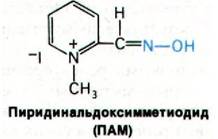

PAM reactivates DFP-inhibited acetylcholinesterase through essentially the same mechanism as hydroxylamine. However, in terms of potency, 10-6 M PAM matches 1 M hydroxylamine. This million-fold increase in efficacy makes PAM suitable for treating organophosphate poisoning. The remarkable effectiveness of PAM stems from the optimal spatial orientation of its quaternary ammonium group relative to the nucleophilic oxygen atom. The development of this drug marked a milestone in the advancement of rational drug design.
37.10. Acetylcholine Receptor Inhibitors
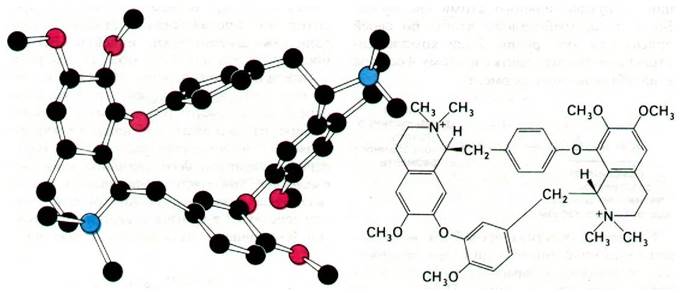
Neuromuscular transmission can also be blocked by compounds that act directly on the Acetylcholine Receptor. These include curare, which was used for centuries by South American Indians. Shortly after Columbus returned from the Americas, d'Anghera wrote in his work De Orbo novo that "the natives poisoned their arrows with the juice of a deadly poisonous herb." One of the active components of curare is d-tubocurarine (Fig. 37.17). Tubocurarine inhibits end-plate depolarization by competing with acetylcholine for receptor binding. Alpha-bungarotoxin and cobratoxin operate via a similar mechanism. In contrast, decamethonium-like substances bind to the acetylcholine receptor and induce persistent end-plate depolarization.
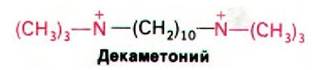
Fig. 37.17. Formula and model of α-tubocurarine
Succinylcholine, an acetylcholine analogue, is widely used in surgery as a muscle relaxant.
Succinylcholine is hydrolyzed extremely slowly by acetylcholinesterase in the postsynaptic membrane, thereby causing prolonged depolarization of the end-plate. At the same time, succinylcholine is hydrolyzed by less specific cholinesterases present in the plasma and Liver; these Enzymes are termed plasma acetylcholinesterases or pseudocholinesterases to distinguish them from the postsynaptic membrane acetylcholinesterase. Succinylcholine is clinically advantageous because neuromuscular transmission recovers shortly after administration of the drug is stopped. However, in certain cases, muscle relaxation and paralysis of the Respiratory Muscles persist for many hours. This occurs because succinylcholine hydrolysis in such patients is extremely sluggish due to a markedly reduced affinity of plasma cholinesterase for the drug. Enhanced sensitivity to succinylcholine (much like that to pamaquine, Section 15.11) serves as a classic example of genetically determined drug idiosyncrasy.
When rabbits are immunized with purified acetylcholine receptors, they develop muscle weakness within a few weeks post-immunization,
along with rapid fatigability. This occurs because the immunization triggers The production of Antibodies that react with the acetylcholine receptors at their own neuromuscular junctions. As a result, the number of functionally active acetylcholine receptors declines, leading to impaired neuromuscular transmission. The condition developing in these rabbits closely mirrors the severe human autoimmune disorder myasthenia gravis; indeed, the serum of myasthenia gravis patients contains antibodies directed against their own acetylcholine receptors. In other words, myasthenia gravis is an autoimmune disease, meaning a condition in which the body becomes a target of its own immune system.
Last update: 06/08/2026
Editorial and Educational Adaptation: This material has been compiled based on the primary/original source text. The project team performed an editorial review, corrected technical inaccuracies, structured sections, and adapted the content for an educational format.
What was processed:
- elimination of formatting defects (OCR errors, structural breaks, corrupted characters);
- editorial organization of content;
- standardization of terminology in accordance with academic sources;
- verification of factual statements against the original source text.
All mentions of the author, publication year, and origin of the primary text have been preserved in accordance with the source.