BIOCHEMISTRY - L. Stryer - 1984
VOLUME 2
PART III. BIOSYNTHESIS OF MACROMOLECULAR PRECURSORS
CHAPTER 22. BIOSYNTHESIS OF NUCLEOTIDES
22.11. Nucleoside Mono-, Di-, and Triphosphates Are Interconvertible
The active forms of NUCLEOTIDES in biosynthetic and energy-yielding reactions are diphosphates and triphosphates. Nucleoside monophosphates are phosphorylated by specific nucleoside monophosphate Kinases, which use ATP as the phosphate donor. For example, UMP is phosphorylated by UMP kinase:
UMP + ATP ⇄ UDP + ADP.
AMP, ADP, and ATP are interconverted by adenylate kinase (also called myokinase). The Equilibrium Constant for these reactions is close to 1:
AMP + ATP ⇄ ADP + ADP.
Nucleoside diphosphates and nucleoside triphosphates are interconverted by nucleoside diphosphate kinase, an enzyme with broad Specificity, unlike the monophosphate kinases. In the following equation, X and Y can be any of A wide variety of ribo- or deoxyribonucleosides:
XDP + YTP ⇄ XTP + YDP.
For example,
UDP + ADP ⇄ UTP + ADP.
22.12. CTP Is Formed by the Amination of UTP
Cytidine triphosphate (CTP) is formed from another major pyrimidine ribonucleotide, uridine triphosphate (UTP). The carbonyl oxygen at C-4 is replaced by an amino group. In mammals, the amino donor is the side chain of glutamine, whereas in E. coli, NH4+ participates in this reaction. Both amination reactions require the consumption of an ATP molecule.
Class="center">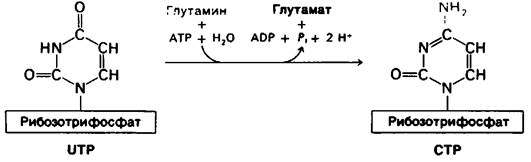
22.13. Pyrimidine Nucleotide Biosynthesis Is Regulated by Feedback Inhibition
The committed step in the Biosynthesis OF PYRIMIDINE nucleotides in E. coli is The formation of N-carbamoylaspartate from aspartate and carbamoyl phosphate. The enzyme catalyzing this reaction, aspartate transcarbamoylase, is inhibited by CTP, the end product of the biosynthetic pathway. Another regulatory element is carbamoyl phosphate synthetase, which is inhibited by UMP, another product of the pathway.
The allosteric properties of ATCase were investigated in detail by John Gerhart and Howard Schachman. The binding of carbamoyl phosphate and aspartate is cooperative, as evidenced by the sigmoidal curve of reaction velocity versus Substrate Concentration (Fig. 22.14). CTP inhibits the enzyme by decreasing its affinity for substrates without affecting Vmax. The degree of inhibition by CTP can reach 90%, depending on substrate concentration. In contrast, ATP activates ATCase. The affinity of the enzyme for substrates increases in the presence of ATP, whereas Vmax is unaffected. Furthermore, the binding of ATP and CTP to the regulatory site of ATCase is competitive. High concentrations of ATP displace CTP from the enzyme, preventing its inhibitory action.
Fig. 22.14. Allosteric properties of aspartate transcarbamoylase. ATP is an activator, and CTP is an inhibitor of the enzyme.

The activation of ATCase by ATP has a twofold physiological significance. First, it coordinates the rates of purine and pyrimidine nucleotide synthesis. Comparable amounts of these Two Types of nucleotides are required for nucleic acid synthesis. Second, activation by ATP signals that a sufficient concentration of ATP is available as a substrate for several reactions in Pyrimidine Nucleotide Biosynthesis, such as carbamoyl phosphate synthesis and the phosphorylation of UMP to UTP.
22.14. Aspartate Transcarbamoylase Consists of Distinct Catalytic and Regulatory Subunits
If ATCase is treated with an organic mercurial, such as p-hydroxymercuribenzoate, it loses its regulatory properties. ATP and CTP no longer affect its catalytic activity. Furthermore, substrate binding becomes noncooperative. Nevertheless, the modified enzyme retains full catalytic activity. Such a loss of regulatory properties with the retention of enzymatic activity is called desensitization.
The desensitization of ATCase by organic mercurials is accompanied by its dissociation into two types of subunits, as demonstrated by ultracentrifugation studies (Fig. 22.15). The sedimentation coefficient of the native enzyme is 11.6S, whereas the sedimentation coefficients of the dissociated subunits are 2.8 and 5.8 S. These subunits can be easily separated by Ion-exchange Chromatography, as they differ significantly in charge, or by sucrose gradient ultracentrifugation, as they differ in size. Once the subunits are separated, p-hydroxymercuribenzoate can be removed. The larger subunit is catalytically active and is called the catalytic subunit. However, ATP and CTP do not affect The activity of the isolated catalytic subunit. The smaller subunit, called the regulatory subunit, lacks catalytic activity but contains specific binding sites for CTP and ATP. The catalytic subunit consists of three polypeptide chains with a molecular mass of 34 kDa each, and the regulatory subunit consists of two chains of 17 kDa each.
Fig. 22.15. Ultracentrifuge sedimentation pattern of native ATCase (A) and of the same enzyme dissociated into regulatory and catalytic subunits by a mercury compound (B)

When the catalytic and Regulatory Subunits are mixed, they rapidly combine. A complex with the same Structure as the native enzyme is formed—
R6C6:
3R2 + 2C3 → R6C6.
Moreover, the reconstituted enzyme possesses the same allosteric properties as the native enzyme.
In the laboratory of William Lipscomb, crystallographic studies of ATCase are being conducted using X-Ray Diffraction Analysis. An electron-density map at 3.0 Å resolution shows that two catalytic trimers (C3) are positioned above and below an equatorial belt of three regulatory dimers (R2) (Fig. 22.16). A striking feature of this molecule is that it contains a large central cavity, which is accessed through several channels. Interestingly, the allosteric binding sites for CTP are located far from the catalytic centers.
Fig. 22.16. Arrangement of catalytic (C, blue spheres) and regulatory (R, pink spheres) subunits of aspartate transcarbamoylase

Last update: 06/08/2026
Editorial and Educational Adaptation: This material has been compiled based on the primary/original source text. The project team performed an editorial review, corrected technical inaccuracies, structured sections, and adapted the content for an educational format.
What was processed:
- elimination of formatting defects (OCR errors, structural breaks, corrupted characters);
- editorial organization of content;
- standardization of terminology in accordance with academic sources;
- verification of factual statements against the original source text.
All mentions of the author, publication year, and origin of the primary text have been preserved in accordance with the source.